

Japan Megaquake Advisory Hits Tohoku Winter Travel
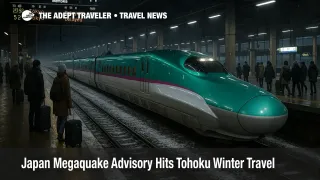
Japan megaquake advisory travel decisions just became more complicated for visitors using Tohoku and Hokkaido rail, after a magnitude 7.5 offshore quake near Aomori on December 8 triggered tsunami warnings, brief airport disruption, and bullet train suspensions. Travelers connecting through northern Honshu or flying into New Chitose Airport (CTS) for ski trips and winter onsens are most exposed, along with anyone stringing together long rail days across Tohoku. The next step is to treat this as a live operational constraint, adding buffer nights, flexible tickets, and concrete earthquake preparedness rather than relying on historical punctuality.
The Japan megaquake advisory for northern Honshu and southern Hokkaido means winter trips that depend on long rail runs and coastal stays now carry a small but elevated seismic risk, and more fragile timetables than usual.
What Happened On December 8
On December 8, 2025, a magnitude 7.5 earthquake struck at 11:15 p.m. local time about 80 kilometres off Aomori Prefecture, registering upper 6 shaking in Hachinohe and prompting tsunami warnings that initially forecast waves of up to 3 metres. Authorities ordered evacuations for roughly 90,000 people in parts of Hokkaido, Aomori, and Iwate, but observed tsunami heights stayed in the 20 to 70 centimetre range, and all warnings were downgraded to advisories then lifted by early December 9.
Damage has been moderate compared with the 2011 disaster, with several dozen mostly minor injuries, some damaged roads and buildings, and scattered power outages, but the quake was strong enough to shut down key pieces of infrastructure. About 200 passengers, most of them domestic travellers and winter holidaymakers, were stranded overnight at New Chitose Airport as airlines halted operations for inspections.
How The Megaquake Advisory Works
The bigger structural change is not the initial damage, but the megaquake advisory that Japan's Meteorological Agency, JMA, issued for the northern Pacific coast after the event. Officials now estimate roughly a one in 100 chance of a magnitude 8 or larger quake along segments of the Japan and Chishima trenches over a one week window, a tenfold increase over the usual probability, and have extended the advisory to 182 municipalities from Hokkaido down to Chiba Prefecture, with current guidance running until around December 16.
This is only the second use of the updated megaquake alert framework since it was introduced in 2022, and authorities have emphasised that it is not a prediction of a specific "big one," but a prompt to revisit evacuation plans, emergency supplies, and public messaging in an area that could face very large tsunamis if a trench segment fails. For travellers, the practical takeaway is that local governments, railways, and airports are likely to err on the side of caution when aftershocks hit, which can mean more frequent stoppages and inspections than usual.
Foreign ministries are adjusting to that message. The United Kingdom's Foreign, Commonwealth and Development Office now notes the quake and warns that, while tsunami advisories have been lifted, JMA expects a possibility of further large scale quakes over the next seven days and urges visitors to follow local instructions. U.S. Embassy Tokyo alerts similarly flag the quake, the initial tsunami warning, and the ongoing advisory, encouraging citizens to avoid affected coasts, monitor local media, and be ready to move to higher ground.
Rail Disruption In Tohoku And Hokkaido
East Japan Railway, JR East, suspended Tohoku Shinkansen services between Morioka and Shin Aomori immediately after the quake while crews inspected track, overhead wire, and viaducts, and some trains made emergency stops. Service has largely resumed, but the section north of Morioka remains the most vulnerable to additional slow orders or short notice suspensions whenever aftershocks are felt or new inspection needs are flagged. Conventional lines in Aomori Prefecture and along parts of the Sanriku coast have also faced partial suspensions or reduced frequencies while damage checks continue.
JR East's own English language train status pages make clear that information is updated frequently but may lag real time conditions, which means a timetable that looks normal the night before can still see disruptions if a morning aftershock triggers another round of checks. For travellers using rail passes or tightly stacked rail days, this increases the risk that a long Tokyo to Hachinohe to Hakodate chain or an ambitious onsen loop through the Tohoku interior will not run exactly as planned.
In Hokkaido, JR Hokkaido has reported short term suspensions and speed restrictions on lines feeding Sapporo and coastal towns after the quake, with priority on safety inspections over punctuality, a pattern that is likely to continue while the megaquake advisory is in effect. Any winter itinerary that assumes back to back regional trains with thin buffers now carries a higher misconnect risk.
If you rely heavily on rail, this is a good moment to cross reference your planned routes with a structural guide such as Adept's own overview of Japan rail disruption and earthquake planning, then adjust day plans so that the most fragile segments have secondary options.
Air Travel Impacts
The quake and subsequent advisory have also rippled through air travel. Aggregate tallies suggest at least 119 flights were cancelled and more than 750 delayed across Japan in the immediate aftermath, with Tokyo Haneda Airport (HND) logging the largest number of delays and cancellations, and New Chitose Airport seeing 42 cancellations and over 200 delays as carriers reset schedules and checked facilities.
For winter travellers, the pattern is clear. Hokkaido flights with tight inbound or outbound connections at Haneda are more likely to unravel than usual, especially on the first few days after major aftershocks. Osaka Itami Airport (ITM) and other domestic hubs have also seen knock on delays, which could affect travellers trying to knit together multi city circuits across Japan.
One practical mitigation is to avoid last departures, especially when you have a nonrefundable hotel night on arrival. Flying from Haneda to New Chitose in the late morning or early afternoon gives more room to absorb a delay or rebooking than a final evening departure that might be cancelled outright. Where possible, build in at least one buffer night in Tokyo or Sapporo between long haul arrivals and onward domestic segments.
Planning Winter Routes And Buffers
Given the megaquake advisory, it makes sense to treat the Tohoku and Hokkaido coasts less as fixed schedule zones and more as corridors where inspections, slow orders, and occasional closures can occur with little notice. Itineraries that once crammed Tokyo to Aomori, an afternoon side trip, and a late connection toward Hokkaido into a single day are now fragile. Stretch those plans across two days, book accommodation near major stations such as Morioka or Shin Aomori, and keep one hotel night cancellable so you can pivot inland if needed.
For long rail chains, use larger hubs as pivots. Tokyo, Sendai, Morioka, and Sapporo offer multiple daily options, alternative routes, and more hotel inventory if a segment fails. Smaller coastal towns, especially those perched on bays or peninsulas, may have only a handful of trains or buses each day, and these are precisely the locations where aftershock related checks or tsunami cautions could cut access most abruptly.
If you are combining flights and trains, plan at least three hours between landing and your first long distance train in this region, and more if you are travelling on separate tickets without protected connections. Consider using smart card balances or flexible regular tickets rather than tightly timed advance discounts for the most quake exposed stretches, even if that means paying a bit more. Adept's previous coverage of Japan's typhoon related rail and flight disruption, such as our Japan typhoon travel disruption 2024 explainer, shows how quickly well planned days can need reshaping when infrastructure is under stress.
Earthquake Preparedness For Visitors
The megaquake advisory also underlines the value of basic earthquake and tsunami literacy for visitors who may be staying in high rise hotels or unfamiliar neighbourhoods. Japan's building codes are among the strictest in the world, and modern properties, especially in major cities, are designed to sway and absorb energy rather than collapse, but your personal actions still matter.
At minimum, learn the drop, cover, and hold routine, check where the nearest interior refuge point is in your hotel or ryokan, and identify a staircase that does not rely on elevators. In coastal areas, make a habit of spotting tsunami evacuation signs and understanding whether "higher ground" means a nearby hill, an inland street grid, or an upper floor of a reinforced building. Keep a small daypack with water, snacks, any essential medicines, a power bank, a paper copy of your passport, and basic cash in case transport or card networks are interrupted for a few hours.
Foreign travellers should also enrol in their home country's alert services where available, such as STEP for U.S. citizens or similar registration tools in Europe and Australia, so that embassy messages reach them promptly if conditions change. Combined with local phone alerts and television crawlers, these channels provide a layered early warning system that can make the difference between an orderly move to higher ground and a rushed last minute evacuation.
Background: Northern Japan's Trench Risk
The reason a single 7.5 quake can trigger such a loud advisory is structural. Northern Honshu and Hokkaido sit beside the Japan Trench and the Chishima Trench, subduction zones where one plate dives under another, storing huge amounts of energy until sections rupture. Government scenario planning suggests that a maximum class quake in this region could generate tsunamis of up to 30 metres and kill up to 199,000 people if poorly handled, which is why authorities prefer to lean into preparedness messaging even when the statistical risk is still around one percent.
For travellers, the key point is not to avoid Japan wholesale, but to treat Tohoku and Hokkaido winter trips the way you might treat Atlantic hurricane season or European river level risk, as a background factor that shapes routing, buffers, and hotel choices. Japan's infrastructure, response systems, and building standards remain robust, but over the coming week in particular, a little extra caution will buy a lot of resilience.
Sources
- Japan lifts tsunami warning after 7.5 magnitude earthquake off Aomori Prefecture
- Why Japan issued an advisory for a possible megaquake in the country's north
- 2025 Sanriku earthquake overview
- Is it safe to travel to Japan despite the megaquake warning
- Japan travel advice, earthquake and tsunami advisories
- Travel advisory for Japan, U.S. Department of State
- Tohoku bullet train services partially suspended after earthquake
- 119 flights cancelled and 755 flights delayed due to Japan earthquake