

South Korea Rail Strike Averted December 11 Trains
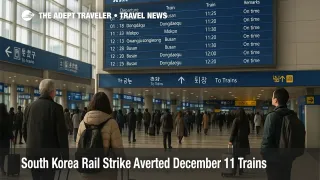
South Korea rail strike plans that would have hit KTX and commuter lines from December 11, 2025 have been suspended after overnight talks kept trains and Seoul Line 9 running on normal timetables. Unionized workers at Korea Railroad Corporation, Korail, and the Korean Railway Workers Union agreed to postpone an indefinite walkout only hours before it was due to start, while the union representing Line 9 staff in Seoul also withdrew its strike call after a separate pre dawn deal. For travelers this means normal rail service into and across Seoul, and routine access to Incheon International Airport (ICN), at least through the current week.
The practical change is that the South Korea rail strike that was expected to disrupt KTX high speed services and airport connections on December 11 has been put on hold, so travelers can treat published rail and Line 9 timetables as reliable again while negotiations continue.
What Changed In The Korail And Line 9 Talks
Korail and the Korean Railway Workers Union had warned of an open ended strike starting at 900 a.m. on December 11 after earlier talks over wages, performance based bonuses, and staffing stalled. According to Korean media, a tentative agreement was reached around 700 a.m. on key issues, including how to normalize performance based bonus payments, which currently sit at about 80 percent of base pay. The union then announced it would suspend the walkout to minimize inconvenience to the public, and Korail confirmed that all KTX, intercity, and commuter trains would operate on their normal timetables.
On Seoul Subway Line 9, the operating division responsible for phases 2 and 3, from Eonju Station to Central Veterans Hospital Station, reached its own provisional wage and staffing agreement with union representatives around 5:00 a.m. on December 11. As part of that deal, unions withdrew a same day strike call and committed to keep trains running while members vote on the agreement. The first phase of Line 9, which is run under a different structure, had already settled, so the full line is operating normally again.
For travelers, this means that KTX links between Seoul and Busan, Gwangju, and Mokpo, as well as popular tourist routes to cities like Gyeongju and Jeonju, are back in the "normal but under negotiation" category rather than the "high disruption" bucket that an open ended strike would have created. Airport rail access, including Korail services that connect through to Incheon and to Gimpo International Airport (GMP), is also stable for now.
Background, How A Korail Strike Would Have Hit Trips
Korail operates the KTX high speed network and most intercity and regional trains outside the Seoul metropolitan subway system. A full rail strike would have sharply reduced frequencies on KTX routes and halted or limited some conventional services, pushing more traffic onto buses and domestic flights, and extending travel times between major cities. Earlier contingency planning by government and local authorities focused on adding highway buses and requesting airlines to secure extra seats on key domestic legs.
In Seoul, Line 9 is one of the heaviest loaded subway corridors, tying together the city's western districts, business centers, and interchange points with other lines. A walkout there would not only have lengthened commutes but also created knock on delays and crowding on parallel routes, which in turn might have stretched connection times for travelers trying to reach long distance buses, intercity trains, or airport rail.
Because Korail and Line 9 sit across both long haul and commuter markets, the original strike threat forced many travelers to consider shifting itineraries away from December 11 and 12, adding large buffers around flights, or preferring domestic flights over KTX on key routes. The suspension of the walkout removes that immediate pressure but does not resolve the underlying dispute.
Ongoing Labor Risk Through Late December
The core issues behind the South Korea rail strike threat are not fully settled. Union statements and coverage in Korean outlets emphasize that performance based bonuses still need to be normalized, that bonus caps remain tied to 80 percent of basic salary, and that staffing and safety concerns are still on the table. The tentative agreement essentially moves the debate into a more structured government channel, in this case the finance ministry committee that oversees public institutions, and creates room for "intensive negotiations" instead of open confrontation.
Separately, there is still a risk that unions at Seoul Transportation Corporation, which operates Lines 1 to 8 of the Seoul subway, could strike from December 12 if last minute wage and staffing talks fail. City officials have said they will try to keep rush hour services at or near normal through emergency staffing and redeployments, but travelers should treat that as a mitigation plan rather than a guarantee.
For visitors relying on rail passes and subway heavy itineraries, this combination of a suspended Korail strike and possible action on other Seoul lines means the country has moved from "imminent nationwide disruption" back to a more familiar "elevated labor risk" environment for the rest of December.
Practical Advice For Travelers In The Next Two Weeks
Travelers already on the ground in South Korea, or arriving in the next few days, can keep their existing KTX and intercity reservations in place. Published timetables for Korail and Seoul Subway Line 9 are expected to operate as normal through at least the current negotiation window, which covers December 11 and 12. That means standard buffers of 60 to 90 minutes between airport arrival and onward train, or between KTX legs, are once again reasonable for most travelers.
However, anyone planning trips for the second half of December should still treat South Korea rail strike risk as a factor in their itinerary. It is sensible to avoid stacking separate tickets tightly on the same day, particularly when connecting between international arrivals at Incheon and long KTX legs to Busan, Gwangju, or the southeast coast. Where possible, consider through tickets that keep your journey under one booking, or choose flexible fares that allow date changes without high penalties.
For backup options, bus networks in South Korea are extensive and can cover most of the same corridors as KTX, albeit with longer journey times. On the busiest routes, domestic flights between Seoul, Busan, Jeju, and other major cities offer an additional safety net, though holiday period load factors can be high. Travelers holding Korail passes should map one or two alternative bus or flight options for each long segment, in case another strike call narrows rail options again.
In Seoul itself, if talks over Lines 1 to 8 take a turn for the worse, travelers can use a mix of Line 9, private rail links, buses, and taxis to bridge gaps. For those with early morning flights from Incheon or Gimpo, reserving an airport bus or airport hotel can shave risk for departure days that coincide with any subway action.
How To Monitor The Situation
For ongoing updates, travelers should monitor official Korail announcements, Seoul Metro and Seoul city government channels, and travel advisories from their home country. Local English language media such as KBS World, the Korea Times, and major Seoul newspapers also provide timely coverage of labor negotiations and strike calls. Many of these outlets will update headlines quickly if a tentative deal collapses or if unions escalate again.
Travelers who rely heavily on rail during a trip should check for any new statements a week before departure, then again 48 hours and 24 hours before key travel days. If a renewed South Korea rail strike is announced during that window, it is likely worth front loading long moves or switching one or two critical legs to bus or air rather than waiting to see how the first strike day plays out.
Sources
- Unionized rail workers shelve plan on strike; train services run on normal timetable
- Rail Strike Averted As Union, KORAIL Reach Tentative Agreement
- Korea Railroad Corp union postpones indefinite strike, ensuring smooth train operations
- Subway Line No. 9, Korail unions call off strike after reaching tentative agreement
- A wage and collective agreement negotiation between labor and management of the Seoul Transportation Corporation was concluded
- Tensions are rising as the labor and management of the Seoul Transportation Corporation entered last minute negotiations