

Baghdad Airport Fog Halt, Flights Resume Dec 11, 2025
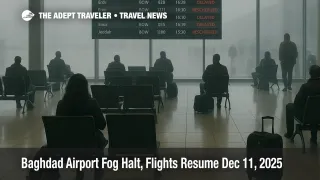
Baghdad airport fog closure on December 11, 2025 temporarily halted flights at Baghdad International Airport (BGW) in Baghdad, Iraq, after dense fog cut visibility and forced authorities to suspend air traffic. Travelers departing Iraq, connecting through Baghdad, or trying to reach religious and regional hubs via Najaf and the Kurdistan Region were the most exposed to misconnects and same day plan failures as schedules stopped, then restarted. Anyone still traveling on the reopen day should assume a rolling backlog, build extra airport transfer time in fog, and make a clear choice between waiting for reaccommodation, rerouting, or shifting travel to a later date.
The Baghdad airport fog closure eased when authorities confirmed operations were resuming later on December 11, 2025, but the restart phase is usually when missed connections, crew constraints, and aircraft positioning problems show up for travelers.
What Happened At Baghdad International Airport
Iraq's Ministry of Transport said Baghdad International Airport was temporarily closed to air traffic early on December 11, 2025 due to poor weather conditions and reduced visibility, with the first closure announcement reported around 12:30 a.m. local time. The same reporting noted that Najaf International Airport (NJF) and Sulaimaniyah International Airport (ISU) were also affected by the low visibility disruption. Later on December 11, the ministry confirmed that airspace had reopened at Baghdad and Najaf, enabling flight movements to resume, while Baghdad's airport also published its own resumption notice.
For travelers, the most important detail is not only that flights resumed, but that the shutdown lasted long enough to break normal aircraft rotations. A pause of roughly half a day is often sufficient to create a queue of delayed departures, crews that time out under duty limits, and inbound aircraft that arrive late enough to miss their next assignment. That combination tends to produce a second wave of disruption even after the weather improves.
How Low Visibility Shuts Down Flights
How It Works: When fog reduces visibility below the safe operating limits for a runway, air traffic control, ATC, and airport operators may slow the arrival rate, suspend certain approach types, or temporarily stop movements altogether. Even if some aircraft and crews are technically available, the system can pause because spacing between aircraft must increase, runway visual references are reduced, and surface movement, taxiing, and parking operations become more complex in low visibility. Once conditions improve, airports do not instantly return to normal, because aircraft and crews are now out of position, and departure slots must be rebuilt in a safe sequence.
This is why a reopen announcement is best treated as the start of a recovery curve, not the end of the event. If you are flying out the same day, you are traveling inside the recovery window.
What The Baghdad Airport Fog Closure Means For Travelers
Travelers should frame the day as a misconnect and rebooking risk event, especially on itineraries that connect through Baghdad onto less frequent regional flights. When a hub restarts after a stop, airlines often prioritize clearing the earliest stranded departures, but that can collide with aircraft arriving late, limited gate availability, and crew duty clocks that were already running before the pause.
The practical result is uneven reliability. Some flights depart close to schedule once the queue starts moving, others take a multi hour delay, and a subset are canceled because the operating aircraft or crew cannot legally complete the rotation. If your trip involves onward hotels, tours, border crossings, or time fixed obligations, it is safer to assume your first plan will change at least once.
A simple decision tree, wait, reroute, or move the trip
If you are already at the airport, the first priority is to find out whether your specific flight has an aircraft and crew assigned, not just whether it is "open." A reopen notice can coexist with significant delays. If your flight is still showing an uncertain departure time and you have a tight onward connection, use the airline app to price or request a protected alternative now, while seats still exist.
If you have not left for the airport yet, the key question is whether you can absorb a several hour delay without breaking the rest of the itinerary. If you cannot, shifting to a later flight bank or moving travel to the next day is often the least painful outcome, even if it feels like "giving up" on same day travel. The goal is to avoid getting stranded mid itinerary with fewer options.
If you are on separate tickets, treat your connection as unprotected, even if the flights are on the same airline brand family. In that case, rerouting to a single ticket itinerary, or moving the second segment, can be cheaper than losing the entire onward leg and buying a last minute replacement.
Ground Transport, Hotels, And Airport Timing In Fog
Fog is not only an aviation problem. Low visibility can slow road transfers into Baghdad, and it can also increase the risk of minor accidents and rolling traffic friction. Travelers with morning departures, even after flights resume, should plan to leave earlier than usual for Baghdad International, and they should keep a backup plan for waiting time inside the terminal.
If a rebooking pushes your departure into the next day, a nearby airport hotel night can be the cleanest way to protect the trip. The best move is to book something cancellable as soon as your flight starts sliding, then cancel it later if the airline recovers faster than expected. This is especially useful for travelers who must catch a long haul departure, or who have onward reservations that would be expensive to lose.
Airport Names And Codes Travelers Will See
Many airline apps and disruption notices will refer to these airports by IATA codes. Baghdad International Airport is BGW, Najaf International Airport is NJF, and Sulaimaniyah International Airport is ISU.
What To Watch Next
Most weather driven disruptions end quietly, but the after effects show up in flight status screens, reaccommodation queues, and baggage delivery timing. Travelers should check whether their airline has issued a travel waiver for Baghdad, Najaf, or Sulaimaniyah, because waivers often open up cheaper self service changes, even when cash refunds are not available.
For travelers planning to connect through Iraq in the next day or two, the best signal of normalization is not a single on time departure, it is several successive banks operating without widespread rolling delays. Until then, assume slower airport processing, less slack in schedules, and a higher chance that the "next best" routing sells out quickly.
Sources
- Flights resume from Baghdad Airport, ALsharqiya
- Baghdad airport reopens after weather disruption, Arab News
- Iraq reopens airspace at Baghdad, Kirkuk and Najaf after fog closure, 964media
- Baghdad International Airport temporarily closed due to severe weather, IraqiNews.com
- Iraqi Airways airport codes listing, Iraqi Airways