

Europe Air Traffic Control Delays Worsen, Add Buffers
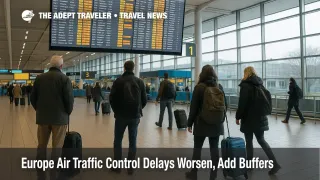
Europe air traffic control delays are rising again as peak season pressures the network, and new IATA reporting says Europe's air traffic flow management delay minutes reached 30.4 million in 2024. Anyone flying to, from, or within Europe, especially travelers connecting through major hubs or building self transfers, should plan for routine knock on delays even on clear weather days. The practical move is to book longer connections, favor earlier departures, and treat tight same day onward plans as optional until you are on the ground.
Europe air traffic control delays are becoming a structural itinerary risk, not just a bad day headline, so the safest booking strategy is to buy time back with buffers.
Europe Air Traffic Control Delays, What The Data Shows
IATA's December 2025 report frames the trend as a decade long capacity problem rather than a one season anomaly. It puts the growth in tactical ATFM delays at 114% from 2015 to 2024, rising from 14.2 million minutes to 30.4 million minutes, even as traffic grew 6.7% in that period. The same report highlights an increasingly sharp summer peak, with 38.3% of 2024 ATFM delays concentrated in July and August, compared with 19.9% of flights in those months.
That seasonality matters to travelers because it breaks the intuitive idea that shoulder season always guarantees smooth operations. Even if you avoid the busiest weeks, ATFM programs can still stack up when staffing, sector capacity, equipment constraints, or airspace complexity reduces throughput. When the network is running close to its limits, small disruptions also become harder to absorb, because there is less slack to recover across later flight banks.
Strikes remain a real accelerant, but they are not the whole story. IATA reports ATC strikes produced 9.8 million minutes of delay from 2015 to October 2025, and those events can drive dramatic reroutes and missed connections across the continent. For recent strike driven context, see Adept Traveler's coverage of the France air traffic control strike cycle and its Europe wide ripple risk: https://adept.travel/news/2025-07-22-france-air-traffic-control-strike-update
How ATFM Slot Programs Turn Into Missed Connections
ATFM delays are not just "late departing aircraft." They are often formal flow restrictions that regulate how many aircraft can enter a sector or arrive at an airport within a time window. When demand exceeds what controllers can safely handle, flights get assigned departure slots, and that delay may show up while you are still at the gate, while taxiing, or as airborne holding and sequencing on arrival.
The traveler facing problem is the domino effect. A regulated departure runs late, the aircraft lands late, the turnaround shrinks, the next sector constrained leg goes out late, and by the time you reach a hub, the inbound delay has eaten the connection time you thought you bought. This is why tight self transfers are fragile in Europe, even on days without storms or headline strikes, because your itinerary has no protection layer. If you miss the connection, the airline operating your second ticket may treat you as a no show.
If you want a concrete illustration of how a single operational constraint can freeze an airport bank and cascade into rebookings, compare this systemic ATC trend with the one off failure mode from Edinburgh Airport (EDI) on December 5, 2025: https://adept.travel/news/2025-12-05-edinburgh-airport-it-failure
A Buffer Framework For Europe Trips
The goal is not to eliminate delay, it is to prevent delay from turning into trip failure. Start by separating three itinerary types.
For point to point intra Europe flights, the main risk is losing half a day at your destination, and then losing your hotel check in window, rental car pickup, or timed entry tickets. Earlier departures reduce this risk because there are fewer upstream legs that can arrive late and steal your margin. If you must fly later, build a soft landing by keeping the first evening flexible, and pushing fixed commitments to the next morning.
For one ticket connections within Europe, you are at least buying misconnect protection, but you are still buying stress if the layover is short. A longer connection also buys resilience against terminal transfers, passport control, and gate changes, which can become slower when disruption pushes more passengers into the same concourses at once.
For self transfers, especially across different airlines or terminals, you should behave as if the published minimum is irrelevant. If you insist on a self transfer to save money, your best protection is time, carry on only baggage where realistic, and a plan for what happens if the first flight lands late. If the second leg is the last flight of the day, assume the overnight is a realistic outcome.
For evergreen tactics that apply regardless of cause, see Adept Traveler's operational playbook here: https://adept.travel/blogs/tips-for-dealing-with-flight-delays-or-cancellations
What To Watch Into 2026
IATA's report points to a concentrated set of air navigation service providers where delay costs and minutes are heavily weighted, suggesting that targeted operational and investment improvements could deliver outsized traveler benefit. At the same time, European institutions continue to pursue Single European Sky reforms aimed at improving performance and coordination, a reminder that the policy side of air traffic management is still in motion. For travelers, the key takeaway is not to bet your trip on reform timelines. Plan as if elevated ATFM delay risk remains part of the baseline, and treat any improvement as upside.