

Madagascar Advisory Level 2, Hotspots Still Flagged
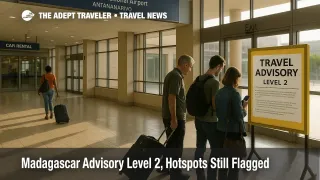
Madagascar travel advisory guidance shifted to Level 2 after a U.S. State Department update on December 4, 2025, but the fine print still matters for 2026 planning. The change affects travelers building overland routes beyond Antananarivo, Madagascar, including anyone relying on long road transfers, remote lodges, or tight domestic flight connections. Trips are still workable, but itineraries should be engineered around daylight movement, vetted transport, and extra recovery time when a plan goes sideways.
The Madagascar travel advisory update lowers the countrywide headline level while keeping several specific corridors and regions under Level 3, which effectively splits trip planning into lower risk urban and resort patterns versus higher risk overland routes.
What Changed In The U.S. Advisory
The State Department's advisory history notes the country rating was decreased from Level 3 to Level 2 on December 4, 2025, and that "health" was added as a risk indicator alongside crime and unrest. In practical travel terms, that means the headline posture is slightly less restrictive than it was earlier in 2025, but travelers still need to plan for crime risk, periodic demonstrations, and limited medical capacity, especially outside major cities.
The advisory is also explicit about when and where risk concentrates. It highlights violent crime risk "particularly after dark," and calls out remote areas and major national roads in the south and western parts of Madagascar as higher exposure zones for banditry and armed incidents. It also flags recurring unrest, including strikes and protest activity tied to political and economic conditions, and urges travelers to avoid demonstrations and crowds.
Level 3 Hotspots Travelers Should Route Around
The most decision useful part for trip design is the list of specific Level 3, Reconsider Travel areas. These are not vague regional warnings, they name places and road segments that commonly sit on classic overland circuits.
The advisory identifies these Level 3 hotspots and corridors: around Tsaratanana in the Betsiboka Region, the road between Tsiroanomandidy and Maintirano, in and around Betroka in the Anosy Region, National Road 34 between Miandrivazo and Malaimbandy, National Road 13 between Ihosy and Betroka, and the Menabe Region south of Morondava. If your 2026 itinerary includes Morondava and inland parks, or you are planning long cross island drives, this list is the routing reality check.
For travelers who booked tours that include those segments, the right move is not to improvise with a rental car and hope for the best. Instead, push your operator to show the exact route, the daytime driving plan, and their mitigation steps, including what they do if a road becomes unusable or insecure on short notice.
Ground Rules For 2026 Itineraries
Start with the transport stack. If you are arriving via Ivato International Airport (TNR) and heading straight out of Antananarivo, Madagascar, treat night driving as a hard no unless you have a trusted, vetted driver and a route your operator is comfortable running in current conditions. The advisory's emphasis on after dark risk is consistent across its crime language and the specific areas it highlights.
Next, build in recovery time for domestic links. Madagascar's domestic network can be the safest way to skip long road legs, but it is also a common point of cascade when schedules shift. If your trip requires a domestic flight, avoid self connecting onto an international departure the same day, especially on separate tickets. An overnight in Antananarivo, Madagascar is the cleanest buffer, and it also keeps you from being forced into a night road transfer if a flight arrives late.
For island and resort patterns, the planning logic is similar. If you are flying to Nosy Be via Fascene Airport (NOS), aim to schedule onward transfers in daylight, and choose accommodation that can arrange a known driver, not a curbside negotiation. That is less about sensational risk, and more about reducing exposure to opportunistic crime and confusion scenarios that spike when travelers are tired, offline, or carrying bags.
Background: How Travel Advisory Levels Work
U.S. travel advisories are a four level system, but the headline level is only the starting point. The "Risks in specific areas" section is where itineraries actually get made or broken, because it may flag particular districts, roads, or regions at a higher level than the countrywide rating. For a quick refresher on how Level 1 through Level 4 categories map to traveler decisions, see Adept Traveler's explainer page on Travel Advisory levels. For context on how this played out earlier in the year, compare this update with Adept Traveler's October 12, 2025 coverage of Madagascar's prior Level 3 posture.
The Health And Medical Constraint Most Travelers Underprice
The advisory's added "health" indicator is not cosmetic. It states that medical infrastructure is very limited in populated areas and extremely limited in rural areas, and that serious emergencies require medical evacuation. That changes the minimum viable insurance and contingency plan for anyone doing remote trekking, wildlife circuits, or long drives.
Before you lock a 2026 trip, confirm three things in writing with your travel insurer or card benefit: medical coverage limits, whether medical evacuation is included, and how evacuation is initiated. If you are traveling with older adults, children, or anyone with chronic conditions, this is not optional planning.
The State Department also highlights entry related health rules, including yellow fever requirements when arriving from countries with yellow fever transmission risk, and it notes rabies is common, with treatment very limited, making pre trip vaccination a consideration for many itineraries involving animals or remote areas. That is worth discussing with a travel clinic well ahead of departure, since vaccine timing can drive your pre trip calendar.
A Practical Decision Framework For Travelers And Advisors
If you are a traveler, the cleanest takeaway is to separate Madagascar into two planning modes. Mode one is city and resort travel with short, daytime transfers, reputable accommodation logistics, and minimal overland exposure. Mode two is expedition style travel where route choice and transport controls determine your risk far more than the country headline level.
If you are a travel advisor or an employer running duty of care, treat the Level 3 hotspot list as your routing filter, and require suppliers to show route maps and daylight movement plans, not just assurances. It is also reasonable to require STEP enrollment for U.S. citizens, and to mandate medical evacuation coverage for any itinerary that leaves major population centers.
For most 2026 trips, the playbook is simple: avoid night roads, do not wing it on long cross country drives, and design the trip so that a single missed domestic flight or delayed ferry does not force an unsafe transfer to "catch up." If your itinerary cannot absorb a disruption without pushing you into night travel, it is not resilient enough yet.
Sources
- Madagascar Travel Advisory, Level 2, Travel.State.gov
- Madagascar Travel Advisory Page, Travel.State.gov
- Madagascar International Travel Information, Travel.State.gov
- U.S. Embassy Madagascar, Travel Advisory, Level 2
- Government Of Canada, Travel Advice And Advisories, Madagascar
- Australia Smartraveller, Madagascar