

Belgium Route Cuts: Ryanair Winter 2026 To 2027
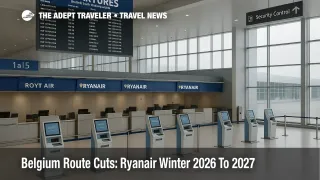
Ryanair Belgium route cuts could thin Brussels winter 2026 to 2027 flights by 1 million seats, changing what shows up when schedules open. Budget travelers, families booking holiday weeks, and anyone relying on cheap nonstop hops to connect onward are the most exposed. Start building a backup plan now by comparing nearby airports, pricing out rail alternatives, and avoiding tight connections that leave no room for last minute schedule reshuffles.
The Ryanair Belgium route cuts story is simple: fewer seats in the market means fewer cheap options, and the remaining seats tend to price higher on peak days.
What Ryanair Announced
Ryanair says it will cut 1 million seats [it frames this as about 22 percent], remove five based aircraft, and drop 20 routes from its Brussels winter 2026 to 2027 schedule. The airline's statement ties the reductions to Belgium's planned increase in its aviation tax to €10 per departing passenger from 2027 and to a proposal for an additional €3 per departing passenger levy linked to Charleroi.
For travelers, the practical detail is where the cuts concentrate. Ryanair says 13 of the canceled routes would be from Brussels South Charleroi Airport (CRL) and seven would be from Brussels Airport (BRU).
Ryanair also warns that if the local Charleroi proposal proceeds, deeper reductions could begin as early as April 2026, which matters because it could affect summer shoulder travel, not just the winter season that is grabbing headlines.
Why Taxes Matter So Much For Low Cost Networks
Low cost airlines run on tight margins, high aircraft utilization, and predictable airport charges. When a government or local authority raises per passenger costs, carriers often respond by moving aircraft to airports and countries where they can sell the same seats with lower fixed costs, especially in winter when demand is softer and networks are more "optional."
Belgium has already adjusted its embarkation [air passenger] tax recently, using a distance split, and industry tax summaries describe a structure of €10 for shorter trips and €5 for longer trips as of late July 2025.
Separately, Belgium's budget framework for 2026 to 2029 includes further planned increases, including raising the long distance rate to €10 from 2027 and additional increases to the short distance rate later in the decade.
Whether the politics resolve or not, travelers should treat the airline's warning as an early signal that capacity in the Brussels area low fare market could be structurally tighter for winter 2026 to 2027 than it has been in recent years.
Timing: What "Winter 2026 To 2027" Really Means For Booking
Airlines and airports plan around IATA scheduling seasons. In the northern hemisphere, the winter scheduling season starts on the last Sunday in October and runs into late March, so "winter 2026 to 2027" generally covers late October 2026 through March 2027.
Most airlines open schedules roughly 11 months ahead, but low cost carriers can release seats in batches, so the exact moment your preferred date appears can vary by route.
That timing creates a traveler trap: if you wait for the perfect fare sale, you may discover that the nonstop you expected simply is not offered anymore. The smarter move is to decide, now, which alternates you can live with, then act quickly once the market reveals what capacity actually exists.
What This Means For Fares And Nonstop Availability
A 1 million seat reduction does not mean every flight becomes expensive, but it does shift the odds. The biggest fare pressure usually shows up on weekends, school holiday weeks, and routes where the low cost carrier was the main source of nonstop competition.
If you are price sensitive, your advantage is flexibility. Flying Tuesday through Thursday, targeting early morning or late evening departures, and being willing to use an alternate airport can preserve the low fare "shape" of a trip even when the headline capacity shrinks.
Also watch for second order effects. When a dominant carrier reduces seats at an airport, the remaining flights can fill faster, and baggage fees, seat fees, and last seat pricing become a bigger share of the total trip cost. That is especially relevant at Brussels South Charleroi, which has built much of its passenger volume on low cost demand.
Brussels Area Alternates To Price Now
For Brussels, Charleroi, Antwerp, and Ghent area travelers, alternates fall into three buckets.
First are nearby airports with large low fare networks, especially Amsterdam Airport Schiphol (AMS) and Eindhoven Airport (EIN), both reachable by rail plus a short transfer. If you are traveling with carry on only, these alternates often keep total trip time competitive once you factor in airport processing.
Second are cross border airports that can work for specific corridors, such as Lille Airport (LIL), Luxembourg Airport (LUX), Cologne Bonn Airport (CGN), and Düsseldorf Airport (DUS). These can be strong for certain leisure markets, but only if the ground transport schedule matches your flight times.
Third is replacing short haul flights with rail for London and Paris. When air capacity tightens, high speed rail can be the most reliable "fixed price" alternative, especially for city center to city center travel where you do not need a car.
If You Already Know Your Dates
If you are planning Christmas, New Year, or school break travel for winter 2026 to 2027, start with three actions.
Lock your must have dates first, and treat "airport choice" as the variable. You can save more by switching departure airport than by gambling on a late fare drop in a tighter market.
Second, avoid tight same day connections, especially any itinerary that assumes a fast transfer between Brussels Airport (BRU) and Brussels South Charleroi (CRL). If schedules change, those transfers become the first weak link.
Third, set alerts, and check inventory patterns, not just price. If you see nonstop options disappearing from the calendar while one stop routings remain, that is a capacity signal, and it is usually a sign to book before the market reprices.
Related Coverage For Brussels Area Planning
This is not the first time Ryanair has threatened, or executed, network reductions tied to costs and policy, including its planned Azores capacity pullback in 2026. Travelers can use that pattern as a reference point for how early the airline communicates and how fast availability can change once routes are finalized. Azores Flight Cuts To Hit Budget Routes In March 2026
If your Brussels trip is also exposed to operational fragility [strikes, ground handling capacity, or transport access], keep Belgium's recent transport strike disruptions in mind when you build buffer time. Belgium National Strike Shuts Airports And Trains
And if you want the broader policy pattern, higher passenger taxes elsewhere in Europe show how quickly airlines shift capacity between nearby markets when costs rise. Netherlands Flight Tax To Rise In 2026, Add Distance Tiers In 2027
Sources
- Ryanair To Cut 1M Passengers At Brussels & Charleroi Due Govt Decision To Double Aviation Tax (Again!)
- Ryanair To Cut Brussels Winter Schedule Over Belgium Ticket Tax Hike (Reuters, December 9, 2025)
- Belgium: Tax Measures In Budget Framework 2026 To 2029 (KPMG, November 25, 2025)
- 'Passenger Will Pay': Airlines Blast Belgium's Extra Flight Taxes (The Brussels Times, November 28, 2025)
- Belgium Embarkation Tax Overview And Rate Structure (FCC Aviation)
- Worldwide Airport Slot Guidelines, Scheduling Season Definition (IATA PDF)
- Ryanair Tips, When It Launches Tickets (MoneySavingExpert)
- Why You Can't Buy A Flight More Than 11 Months In Advance (CheapAir)