

Venezuela Airspace Warning Forces Flight Reroutes
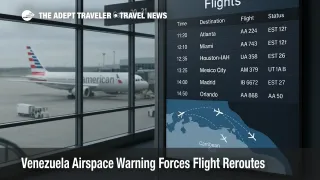
Venezuela airspace warning reroutes are reshaping flight paths near Caracas, Venezuela after the Federal Aviation Administration issued a security advisory NOTAM on November 21, 2025. Travelers are most likely to notice the change on flights that would normally overfly Venezuela, or on itineraries that connect through nearby Caribbean and northern South America routings. Plan for longer routings, occasional schedule padding, and a higher chance that a tight connection turns into a same day rebook.
The Venezuela airspace warning reroutes problem is straightforward, airlines are increasingly choosing to avoid, or minimize time in, the Maiquetia Flight Information Region (SVZM FIR), which can add minutes to hours depending on the city pair and the alternates available.
What The FAA Notice Says, And Why It Matters
The FAA advisory (KICZ A0012/25) tells operators to exercise caution in the Maiquetia Flight Information Region at all altitudes, citing a worsening security situation and heightened military activity in or around Venezuela. The same advisory also asks for at least 72 hours advance notice to the FAA for planned flights into the region, with operator reporting instructions for any safety or security incidents. The current advisory window runs from November 21, 2025, through February 19, 2026, which is long enough that routings and schedules can shift from "temporary workaround" to "new normal" for peak travel weeks.
Separately, FAA background material explains what is driving the concern operationally, it cites an increase in Global Navigation Satellite System (GNSS) interference in the SVZM FIR since September 2025, plus activity tied to increasing Venezuelan military readiness. That background note says some civil aircraft reported interference while transiting the region, and it warns that GNSS jammers and spoofers can affect aircraft far beyond the immediate area and impact critical navigation, surveillance, and safety equipment.
Who Is Affected
This is not only a "Venezuela bound" issue. The biggest traveler impact is for passengers whose flights normally overfly Venezuela as the most efficient line between two points, particularly across the southern Caribbean and northern South America route structure. Even when your origin and destination are outside Venezuela, a detour around the SVZM FIR can change block times, shift connection viability, and occasionally trigger aircraft or crew knock on constraints later in the day.
U.S. operators and U.S. certificated operators are directly in scope for the FAA's advisory and its notice expectations. Non U.S. carriers can still change behavior for practical reasons that travelers feel immediately, including insurer posture, risk management policies, flight planning conservatism, and the desire to keep routings predictable as regional tensions rise.
If you are actually traveling to or from Venezuela, the risk picture has been even more fragile in recent weeks. Reuters reported multiple international airlines had already canceled or suspended Caracas service after the U.S. warning, which can force expensive, multi stop workarounds through third country hubs. For prior context on how service suspensions can compound traveler disruption, see Adept Traveler's earlier coverage of Venezuela flight suspensions after the FAA warning, and the broader U.S., Venezuela, and Colombia travel impacts analysis.
What Reroutes Typically Do To Your Trip
Airlines file flight plans through "flight information regions," or FIRs, which are the air traffic control blocks that manage traffic at cruising altitude and during climbs and descents. When a carrier decides to avoid a specific FIR, dispatchers and flight planning systems usually push routes onto adjacent airways, offshore tracks, or different overwater segments, depending on winds, congestion, alternates, and political constraints. The traveler facing consequence is simple, more miles usually means more time, and more time makes tight connections less reliable.
Reuters reported a sharp reduction in aircraft flying over Venezuelan airspace after the FAA warning, a sign that avoidance is already widespread rather than theoretical. When that happens at scale, "detour corridors" can become busier, which raises the odds of air traffic flow management initiatives, minor altitude restrictions, or speed control that adds more minutes than the detour alone would suggest.
Longer routings also change fuel planning. Most of the time this remains invisible to travelers, but on certain long stage lengths, especially when weather or congestion stacks on top, carriers can protect the operation by carrying extra fuel, tweaking payload assumptions, or adjusting departure times to stay within performance limits. Those operational choices can show up as schedule padding, re timed departures, or last minute equipment swaps, all of which can change your seat assignment or upgrade odds even if your flight still operates.
What Travelers Should Watch For
Start by assuming the "published schedule" is less stable than usual on city pairs that historically used Venezuelan overflight routes. If your itinerary includes a tight connect through a Caribbean or northern South America hub, build a conservative buffer, because a reroute called late in the planning cycle can erase your margin quickly.
The most common failure mode is not a cancellation, it is a late arrival that breaks your onward flight. If you are on one ticket, the airline can usually protect you on the next available routing, but that may be hours later or the next day during peak periods. If you are on separate tickets, you carry the misconnect risk, and the second carrier may treat you as a no show. For trips with hotel check in deadlines, cruise embarkation cutoffs, or onward rail and ferry connections, this is where a "small detour" becomes a real trip cost.
Day of travel, monitor your airline app for route changes, departure time shifts, and "estimated arrival" creep. If your inbound is slipping and your connection is tight, call or message the airline before you land, because rebooking options are often better before the airport queues form and before the next bank fills.
For a structural explainer on why airspace constraints keep creating traveler visible detours worldwide, see Adept Traveler's background piece on conflicts redrawing airspace and forcing costly detours.
What Happens Next
The FAA advisory window currently runs into February 2026, and FAA statements indicate the advisory posture can persist for months and be adjusted as conditions evolve. Reuters has also tied the ongoing routing shift to a broader escalation in U.S., Venezuela tensions, which suggests this is not a one week operational blip that disappears after a single news cycle.
For travelers, the practical approach is to treat certain routings as "detour prone" through the end of the winter schedule, and to buy flexibility where you can, meaning fewer ultra tight connections, fewer last flights of the day, and less reliance on separate tickets. When you cannot avoid a tight connect, pick itineraries with more frequent backup options, and keep your rebooking decisions proactive rather than reactive at the gate.
Sources
- KICZ A0012/25 Advisory NOTAM, Potentially Hazardous Situation In SVZM FIR
- FAA Background Information Regarding U.S. Civil Aviation For The SVZM FIR
- FAA Statement On Venezuela NOTAM
- Flights Avoid Venezuelan Airspace As Tensions Build
- U.S. Warns Airlines Of Potential Hazards When Flying Over Venezuela
- U.S. Issues Security NOTAM For Venezuelan Airspace