

Spirit Airlines Restructuring Labor Deals Ratified
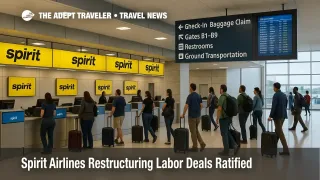
Spirit Airlines restructuring labor deals were ratified in Dania Beach, Florida, on December 12, 2025, marking another step in the carrier's court supervised turnaround. The agreements cover Spirit's pilots and flight attendants, two of the airline's largest work groups. If you are booked on Spirit in the coming months, expect flights to keep operating, but plan for possible schedule adjustments, and build in buffer time on connections while the broader restructuring continues.
The Spirit Airlines restructuring labor deals now move to a new phase, they still require approval from the bankruptcy court before they are fully implemented.
Spirit Aviation Holdings, Inc., Spirit's parent company, said both groups ratified tentative agreements reached in November, and that the deals are subject to court approval. In the same announcement, CEO Dave Davis framed the ratifications as a milestone meant to support Spirit's effort to "better position the airline" during restructuring.
For travelers, this is not a promise that Spirit's route map, flight times, or frequencies will stay fixed. It is better understood as a labor stability checkpoint inside a much larger Chapter 11 process that can still produce aircraft returns, airport exits, and timetable reshuffles.
What The Spirit Airlines Restructuring Labor Deals Cover
The pilot deal is the clearest on public detail because the Air Line Pilots Association, International (ALPA) published ratification results and high level terms. ALPA said Spirit pilots approved modifications to their agreement by an 82% vote, and the modified agreement runs through December 31, 2027, with bargaining set to reopen on January 1, 2028. ALPA also emphasized the bankruptcy context, noting the union's goal of avoiding a court imposed rejection process under Section 1113 of the Bankruptcy Code, and securing protections plus restoration timelines.
Spirit's announcement confirms flight attendants, represented by the Association of Flight Attendants, also ratified a tentative agreement. AFA communications to members earlier in the process described bankruptcy as the driver for management seeking changes under Section 1113, which is the legal mechanism companies can use in Chapter 11 to ask a judge to impose contract changes if negotiations fail.
Background
Chapter 11 is designed to keep a company operating while it restructures debts, leases, and major obligations under court oversight. Airlines often keep flying during Chapter 11, and travelers can usually still use valid tickets, credits, and loyalty points, but the airline may cut flying, return aircraft, and renegotiate contracts to reduce costs. If you want the traveler focused version of how that works, see Adept Traveler's explainer on what an airline bankruptcy can mean for tickets and schedules.
Labor agreements in Chapter 11 sit inside that same court framework. Even after a membership vote, companies commonly seek a judge's approval to formalize the changes, especially when the agreements are part of a restructuring plan and financing conditions.
What This Means If You Are Flying Spirit
The immediate traveler takeaway is narrower than the headlines might suggest. Ratification lowers the odds of sudden labor confrontation in the near term, but it does not lock in your flight time, your aircraft type, or your connection plan. Spirit has been resizing its network and fleet as part of its Chapter 11 case, and court filings and coverage over the past several months show the restructuring has included route and airport pullbacks, as well as lease decisions that can translate into schedule changes.
Practical planning matters more than interpreting this as good news or bad news. For trips where timing matters, favor nonstop flights, avoid tight connections, and consider booking earlier departures that leave more same day rebooking options if a flight is retimed or consolidated. If you are holding separate tickets, assume Spirit will only protect the Spirit segment, and protect yourself with longer buffers.
If you want a quick reference point for what the court has already approved to keep Spirit operating through Chapter 11, Adept Traveler's earlier coverage of the first day motions is the right starting point. The Spirit Airlines restructuring labor deals reduce one category of uncertainty, but they do not remove the operational churn that comes with a shrinking network and fleet.
Sources
- Spirit Airlines Reaches Another Milestone in its Restructuring as Pilots and Flight Attendants Ratify Agreements
- Spirit Airlines Pilots Ratify Restructuring Agreement
- Spirit Bankruptcy Update
- Spirit Aviation Holdings, Inc. Dockets Case: 25-11897
- Spirit Airlines unions agree to pay cuts for flight attendants, pilots