

Argentina Air Traffic Controller Strike, December 2025
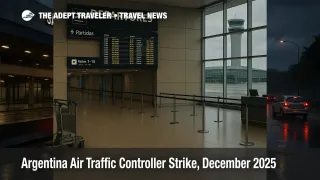
Argentina air traffic controller strike disruption is set to hit Buenos Aires and airports nationwide starting December 17, 2025, after ATEPSA published specific local-time work stoppage windows for peak holiday travel days. Passengers flying within Argentina, or connecting through the Buenos Aires area via Aeroparque Jorge Newbery Airport (AEP) or Ministro Pistarini International Airport (EZE), should plan for short-notice delays, cancellations, and rolling schedule changes. If your flight departs during a listed window, the lowest-risk move is to rebook outside the affected hours, avoid tight same-day connections, and add extra buffer for airport transfers and checked baggage.
The practical change for travelers is that the Argentina air traffic controller strike is not a vague warning, it is a published set of departure-impact windows, which means you can often reduce risk by shifting your takeoff time rather than changing your entire trip.
The Confirmed Strike Windows, And What They Cover
ATEPSA's December schedule shows three domestic-focused windows, one international-focused window, and a nationwide "all aviation" window, all listed in local time. Based on the union's posted calendar, the affected periods are:
On Wednesday, December 17, 2025, "aviation with national destination" is listed from 800 a.m. to 1100 a.m. local time. On Thursday, December 18, 2025, a second domestic window is listed from 400 p.m. to 700 p.m. local time. On Tuesday, December 23, 2025, a third domestic window is listed from 700 p.m. to 1000 p.m. local time.
For international departures, Saturday, December 27, 2025 is listed from 200 p.m. to 500 p.m. local time. The schedule then culminates on Monday, December 29, 2025, when "all aviation" is listed from 800 a.m. to 1100 a.m. local time across the country.
There is also an Aeroparque-specific nuance in ATEPSA's schedule notes: for the domestic-destination windows, Aeroparque is noted as being affected during the first two hours of the stated time band. In plain terms, that suggests the highest-risk slice at Aeroparque may be 800 a.m. to 1000 a.m. on December 17, 400 p.m. to 600 p.m. on December 18, and 700 p.m. to 900 p.m. on December 23, even though knock-on disruption can still continue beyond that.
What "Departure Windows" Usually Mean On The Ground
ATEPSA says the action "only affects takeoffs," and describes restrictions on authorizations for aircraft on the ground, plus a halt in receiving or transmitting flight plans during the measure. The same document notes that flights already in the air are not the target of the measure, and that certain operations are exempted, including emergencies and specific mission categories such as medical, humanitarian, state, and search and rescue.
For travelers, the key consequence is a bottleneck at the exact moment a flight is trying to push back, taxi, and get its takeoff clearance. When departures stack up, airlines often run into gate conflicts (arriving flights have nowhere to park), crew duty-time limits, and aircraft rotation problems that can turn a three-hour window into half-day disruption for specific routes. Even if your flight is not scheduled inside the window, a late inbound aircraft can still pull you into the disruption pattern.
How This Can Hit Buenos Aires Connections
Buenos Aires itineraries are especially sensitive because many domestic trips rely on Aeroparque, while many long-haul and a large share of international flying run through Ezeiza. If you are connecting from a domestic flight into an international departure, or arriving internationally and continuing onward the same day, the strike windows increase the odds that your inbound flight arrives late, your outbound departs late, or your connection becomes misaligned.
On the affected days, treat airport-to-airport transfers as a first-class risk, not an afterthought. Road time between the Aeroparque area and Ezeiza can vary sharply with traffic, and disruption inside the airport can compress check-in and baggage timelines. If your itinerary requires switching airports, aim to build in several hours of buffer beyond what you would consider normal during calm operations.
What Travelers Should Do Now
Start with one simple check: look at the scheduled departure time on your ticket, and compare it to the published local-time windows. If your flight is inside a window, assume you are in the highest-risk group, and act early rather than waiting for day-of cancellations.
If your airline offers a self-serve change tool, use it to move to a departure that is clearly outside the affected hours. "Clearly" matters. Shifting from 930 a.m. to 1115 a.m. on December 17 may still put you inside the post-window recovery queue. A better target is a flight that departs well before the window begins, or several hours after it ends, so the system has time to drain.
If you must travel that day and cannot move flights, lower your exposure by reducing complexity. Favor nonstop itineraries over connections. Avoid booking last-flight-of-the-day returns, because recovery delays are more likely to cascade into cancellations as crews time out. If you are traveling with checked bags, build extra time for irregular baggage acceptance cutoffs and re-accommodation, because late departures can trigger automatic rebooking flows that separate passengers from baggage.
Finally, document everything. Save screenshots of rebooking offers, keep receipts for extra transport and meals, and record the reason codes your airline provides if your flight is canceled or significantly delayed. That paper trail matters later if you need to request reimbursement, insurance coverage, or credit.