

JR East Winter Stop Skips On Senzan And Ou Lines
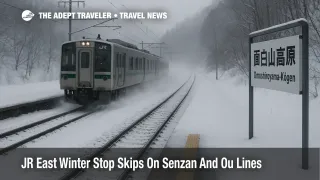
JR East winter stop skips start December 1, 2025, on select lines in northeastern Japan, and they can quietly break plans that depend on tiny mountain stations. Riders on the Senzan Line and the Ōu Main Line, also marketed as the Yamagata Line on this segment, are the most exposed, especially anyone headed for trailheads, ski areas, or rural lodgings. If your trip includes Itaya Station, Oku-Nikkawa Station, or Omoshiroyama-Kogen Station, plan a nearby fallback stop, confirm last mile pickup options, and avoid the specific evening services that JR East says will pass through without stopping this winter.
The JR East winter stop skips mean a published set of trains will run through these stations without boarding or alighting during the stated winter windows, so travelers should reroute via nearby stations and add last mile time.
What JR East Is Changing
On the Ōu Main Line segment that JR East labels the Yamagata Line, JR East says all trains will pass through Itaya Station from December 1, 2025, through March 26, 2026, as a heavy snow measure.
On the Senzan Line, JR East says trains will pass through Oku-Nikkawa Station and Omoshiroyama-Kogen Station from December 1, 2025, through March 13, 2026. The key detail for trip planning is that this is not every train, it is a defined pair of evening local services in each direction, which means many daytime sightseeing itineraries can avoid the issue entirely by shifting departure times.
JR East's posted notice for the Senzan Line names the affected services as an evening Sendai bound and Yamagata bound local train, with the skip applying at Oku-Nikkawa and Omoshiroyama-Kogen. In practice, if your plan has you on the line around the early evening window, you should treat the stopping pattern as a must check item, not an assumption.
Why These Stops Get Skipped In Heavy Snow
In Japan's snow belt regions, winter operations planning is often about keeping trains moving and preventing worse disruptions, not just running on time. JR East's own snow guidance describes how heavy snowfall can affect switches, overhead lines, and trackside conditions, and it notes that rail operators may reduce service or alter operations to limit wider disruption when snow conditions worsen.
For Itaya, JR East's winter notice also points to a very specific traveler risk: passengers can mistakenly try to get off at the station in deep snow conditions. The pass through plan removes that possibility on the affected segment during the stated dates.
Fallback Stations And Last Mile Planning
Itaya Station sits in a mountainous stretch where winter access is inherently fragile, and it is also an unstaffed station. If your lodging, ski plan, or pickup point was built around Itaya, the safest rebuild is to route through a larger station where help, taxis, and alternate onward options are more realistic, then treat the last mile as a separate leg you deliberately solve.
For most travelers, the practical fallback is to use a major node such as Fukushima Station or Yonezawa Station, then arrange a pickup, a taxi, or a hotel transfer based on road conditions that day. The important operational shift is psychological: you are no longer planning a single rail ride to a tiny stop, you are planning rail plus last mile, with a buffer that can absorb snow slowdowns.
Oku-Nikkawa Station is also unstaffed and remote by design, and it is exactly the kind of stop that can become unusable when snow makes platforms, access paths, and nearby roads more unpredictable. If you were using Oku-Nikkawa for a specific outdoor plan, the more reliable fallbacks on the same corridor are typically Sakunami or Yamadera, depending on which side you are approaching from, then a pre arranged ride to your trailhead or lodging.
Omoshiroyama-Kogen Station is closely tied to seasonal outdoor access, including winter skiing, and third party references note that winter road access can be limited even when rail access remains possible. That combination makes the stop pattern issue more than an inconvenience, it can decide whether you arrive at all on a given evening. If your plan depends on arriving late, rebuild it around a train that explicitly stops, or move the overnight to a larger base, then day trip in and out during a wider service window.
Itinerary Examples For Common Tohoku Corridors
Sendai to Yamadera day trip. Many Yamadera itineraries are daytime, so the simplest hedge is to avoid returning in the specific evening window that JR East identifies for pass through operations, and to confirm the stopping pattern before you leave Sendai. If you accidentally end up on a train that skips Omoshiroyama-Kogen, the recovery plan is usually to stay on to a larger stop, then backtrack on a later service that does stop, but that is exactly the kind of time loss that can break dinner reservations or last train connections.
Sendai to Sakunami area lodging. If your hotel or ryokan pickup assumes an Oku-Nikkawa arrival, shift the pickup station to Sakunami and treat Oku-Nikkawa as an optional stop only when you have confirmed that your specific train is scheduled to stop. This is also a case where arriving earlier in the afternoon is materially safer than arriving late, because snow related delays tend to compound into the evening.
Fukushima to Yonezawa, or onward into Yamagata. If you were planning to use Itaya as a quiet entry point into the mountains, rebuild the trip around Yonezawa or Fukushima, then solve the last mile with a pre planned pickup or a flexible arrival time. If you are connecting from Shinkansen services, the extra buffer is not optional, because a missed last mile pickup in a snow belt area can quickly become an unplanned overnight.
What To Check Before You Lock Your Day Plan
First, verify whether your planned departure time lines up with the specific affected Senzan Line services, because most of the line's daily timetable is not impacted by the pass through measure.
Second, screenshot the JR East notice and your alternative route. In rural areas, this is as useful as a paper ticket, especially when mobile signal is inconsistent.
Third, treat the last mile as a booking problem, not a hope. If you cannot confirm a pickup or a safe walkable path from your fallback station, then the right move is to shift the overnight base to a larger town and day trip when conditions are clearer.