

Rain Risk Rises At Manchester Airport December 15, 2025
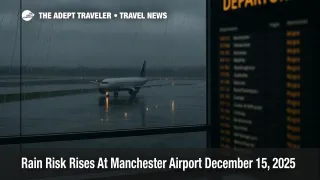
Manchester Airport rain delays are a higher risk in Manchester, England, on December 15, 2025, as heavy rain and reduced visibility collide with airport side constraints. Travelers flying from Manchester Airport (MAN) are the most exposed on short haul schedules that depend on tight aircraft rotations, and anyone with a same day rail or coach connection into the airport. The practical move is simple, check status before you leave, build larger buffers than you would on a normal rainy day, and be ready to rebook earlier than you normally would if your inbound aircraft is drifting late.
This Manchester Airport rain delays situation is not just weather, it is weather plus a constrained operating day, which raises volatility across the schedule and makes recovery harder once delays begin.
The Met Office forecast for Manchester flagged rain through the day and tied it to a yellow warning that notes travel disruption and flooding risk. The airport side problem is more specific, one runway was temporarily closed so engineers could address a surface failure on a taxiway, leaving arrivals and departures to operate on a single runway for a period. That kind of constraint does not only delay one flight, it reduces the airport's ability to absorb late running aircraft, and it concentrates pressure into banks of departures and arrivals rather than smoothing it out across the day.
The Independent reported that poor visibility from rain compounded the runway constraint, and that air traffic controllers capped inbound flights, a classic trigger for a long recovery tail. Even if departures are not formally capped, late arriving aircraft create gaps in the rotation plan, which then cascade into late departures, missed slots, and longer passenger processing queues as flights bunch up.
Operational pinch points for travelers are predictable on days like this. Early morning short haul waves tend to be fragile because many aircraft arrive late the night before, park overnight, then depart in tight sequences. If the operation starts the day behind, every downstream turn has less margin. Late afternoon and evening can look fine on paper, then deteriorate quickly once delayed inbound aircraft, crew duty limits, and de icing style holdovers are replaced by rain driven arrival sequencing and backlog clearance. That is why the day can feel like it improves, then suddenly slides again during the final push.
For travelers deciding whether to go to the airport at all, the most reliable signal is your aircraft, not your planned departure time. If your airline app shows your inbound is significantly late, or your flight is awaiting aircraft, you should assume your departure will move, sometimes multiple times, as the operation tries to rebuild spacing. That is the moment to use self service tools to switch to a later departure, or to a different routing, while seats still exist. By the time a cancellation is posted, the remaining inventory on alternative flights is usually thin, and queues for agent help tend to spike.
If you are checking bags, do not treat airport arrival as optional just because the flight is late. Bag drop cutoffs can still apply, and some airlines hold them even when a departure slips. The Independent reported the airport advised passengers to come as usual, while monitoring airline updates, which is consistent with how airports manage mixed disruption days when individual flights can diverge from the overall trend.
Rebooking strategy should be triaged by what you are trying to protect. If you have a same day international connection on one ticket, prioritize preserving the long haul segment, and accept a longer layover or a different UK or European gateway if your short haul leg becomes unreliable. If you are on separate tickets, treat your itinerary like two unrelated trips, because the second airline is not obligated to protect you if the first one slips. In that case, your best play is often to move the first flight earlier, or move the second flight later, to rebuild slack.
Ground transport adds a second layer of risk. National Rail warned poor weather could affect services and journey times, which matters because the rail leg into the airport is often planned with minimal margin. On days with heavy rain warnings, plan rail to air transfers as if you will lose at least one train path, or face speed restrictions. In practical terms, if you usually buffer 45 minutes from Manchester Piccadilly to terminal arrival, push it toward 90 minutes, and more if you are checking bags. For car travel, add buffer for slower motorway approaches, parking entry, and shuttle or walking time, and avoid timing your arrival to the minute around bag drop or security targets.
Passenger rights are straightforward, but travelers often misread them on weather days. Under UK rules that mirror EU 261, airlines still owe care in many circumstances, such as meals, communications, and hotels when an overnight stay becomes necessary, but cash compensation is generally tied to disruptions within the carrier's control. Weather and airport capacity constraints are commonly treated as extraordinary circumstances, even when the airline still has to reroute you or refund you. Your receipts matter, and documenting what the airline offered, and when, can speed reimbursement claims later.
If you have flexibility and need a Plan B, consider alternate airports in the region only if you can get there reliably, and only if inventory exists. Liverpool John Lennon Airport (LPL), Leeds Bradford Airport (LBA), and Birmingham Airport (BHX) can sometimes provide escape routes, but during widespread rain, surface transport and aircraft positioning issues can affect multiple airports at once. The goal is not simply a different airport, it is a different aircraft rotation and a less constrained path to your destination.
Manchester Airport's disruption profile on December 15, 2025, is a reminder that travelers should plan around the system, not the timetable. When weather reduces visibility and the airport is operating with less runway flexibility, the schedule becomes more fragile, and the safest move is to rebuild slack early, before the operation fully banks delays into the afternoon and evening.
Sources
- Huge delays hit Manchester airport after runway shut
- Manchester airport delays affect thousands of passengers
- Manchester weather forecast
- UK weather warnings
- Incident: Poor Weather, TransPennine Express
- CAA, Delays
- CAA, Cancellations
- Europe Airport Strikes: Compensation and Re-Routing Guide
- Storm Bram slows UK rail and flights, holiday risk
- Storm Claudia hits UK rail, Manchester access risk