

Guatemala Emergency Decree Disrupts Sololá Roads
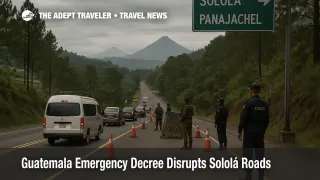
Sololá state of emergency rules are now in force in western Guatemala after armed attacks triggered roadblocks and reports of buses being hijacked in the area. Travelers moving through the highlands, including anyone planning overland transfers toward Lake Atitlán, Guatemala, should expect more checkpoints, sudden road closures, and longer drive times through at least mid to late December. The practical move is to add time buffer, shift tight same day connections, and confirm how your driver, shuttle, or tour operator will handle detours if the main highway corridor tightens.
The Guatemala emergency decree, issued as an Estado de Prevención, applies to the municipalities of Nahualá and Santa Catarina Ixtahuacán in the department of Sololá for a 15 day period starting December 14, 2025.
Background Guatemala's Estado de Prevención is a legal emergency measure that expands the government's ability to restore public order for a limited period. In practice, that can mean tighter controls on public gatherings, more frequent identification checks, and restrictions around carrying weapons or objects authorities consider usable for violence. Some reporting on the legal framework also notes that authorities can move to suspend publications that they say alter public order, depending on how the decree is implemented.
For travelers, the main failure point is not usually a formal curfew posted on a hotel door, it is a transfer that stops moving. The government has described recent incidents in the zone as including blockages on the Inter American Highway (often signed as CA 1) and other actions designed to disrupt free movement. When that happens, private drivers, tourist shuttles, and local buses often funnel into the same limited alternates, which can turn a normal two to four hour highlands drive into an all day transit problem.
What changed this week is the level of official enforcement power now attached to the situation. Under the Estado de Prevención, authorities may limit meetings and public demonstrations, dissolve unauthorized or armed gatherings, restrict the carrying of weapons, and impose controls on the circulation of people and vehicles, including searches and limits by place or time. For a traveler, that translates to more frequent stops, possible reroutes around security activity, and a higher chance that a planned pickup time slips, even if the road eventually reopens.
The decree follows a burst of violence that officials and major news reporting describe as armed attacks on security installations, road blockages, and bus hijackings in the area. The government has framed the violence as driven by organized criminal groups seeking to push security forces out and control territory, while also noting the region's long running local disputes as part of the broader context. Travelers do not need to adjudicate the politics to plan safely, they need to plan for mobility interruptions and fast changing access rules.
For trips built around Lake Atitlán, the risk is concentrated on the overland corridors that connect Guatemala City, Guatemala, to Sololá, and then down toward the lake towns. Many itineraries also pair Atitlán with Antigua Guatemala, Guatemala, Quetzaltenango, Guatemala, or onward border runs, which can force you back onto the same highway spine. If your plan requires passing near Nahualá or Santa Catarina Ixtahuacán, assume you may be redirected, or temporarily held at checkpoints, and do not schedule anything time critical immediately after a drive, including boat departures, paid tours, or fixed time reservations.
Tour pickups are a second common weak spot. If a tour operator normally picks up in one lake town and then transits the highway to collect other passengers, that route may be disrupted without much notice. The lower risk approach during the decree is to choose a single, predictable meeting point, confirm it in writing the night before, and ask directly whether the operator will reroute pickups if CA 1 slows, or if they will cancel and rebook. If you are taking a private driver, have the driver propose two backup routes and a hard cutoff time where you delay departure rather than pushing into a closure window.
Bus travel deserves special attention because the reported tactics in the area included hijacking buses. That does not mean every bus route in Sololá is unsafe, but it is a strong signal to avoid improvising overland bus trips through unfamiliar corridors while the decree is active. Travelers who must use public transport should prioritize daytime legs, keep valuables out of sight, and be ready to exit early if a bus is diverted into a gathering or roadblock. If you are deciding between a local bus and a reputable tourist shuttle, the shuttle is usually the more controlled option in a fast changing security environment, even if it costs more.
Finally, build a document and communications buffer. Carry identification, keep digital copies of your passport and entry stamp accessible offline, and save your lodging and driver contacts in more than one place. If you are flying in and out of La Aurora International Airport (GUA), treat your ground transfer as the variable, not the flight, and leave earlier than you normally would for returns to the airport. If conditions tighten, the smartest play can be to shift an airport day, spend an extra night in Guatemala City, Guatemala, or Antigua, and reattempt the drive when routes are clearer.
Sources
- ¿Qué implica el estado de prevención en Nahualá y Santa Catarina Ixtahuacán durante los próximos 15 días? (Agencia Guatemalteca de Noticias)
- URGENTE: Gobierno declara estado de prevención en Nahualá y Santa Catarina Ixtahuacán (Agencia Guatemalteca de Noticias)
- Guatemala declares state of emergency after armed attacks kill at least 5 (AP News)
- Gobierno declara estado de Prevención en Nahualá y Santa Catarina Ixtahuacán (Prensa Libre)
- Guatemala establece estado de prevención en dos comunidades (SWI swissinfo.ch)