

Asunción Bus Strike Hits Airport Transfers Dec 16 to 17
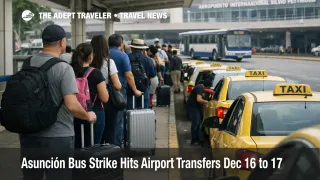
A bus driver strike is disrupting public transport across parts of the Asunción metro area on December 16 and 17, 2025. Service is not uniformly halted because participation is concentrated in a defined set of operators and lines, which means reliability can swing sharply from one corridor to the next. Travelers who were planning to use city buses for hotel checkouts, border bound bus runs, or airport transfers are the most exposed because gaps tend to appear at exactly the moments when a missed departure becomes expensive.
Officials have pointed to a minimum service expectation during the walkout, but on the street the practical outcome is mixed frequency, crowded vehicles where service remains, and longer waits at stops as riders consolidate onto fewer buses. To blunt the worst disruption, the government activated free contingency buses on a handful of trunk routes, a helpful option for some neighborhoods, but not a full substitute for the regular network.
Who Is Affected
Travelers staying in Greater Asunción who rely on specific urban routes are the core group at risk, especially riders on the lines tied to the four companies that reported strike participation. Local reporting identified Automotores Guaraní S.R.L. affecting lines 15-1, 15-2, 15-3, 15-4, and 47, Transporte y Turismo Lambaré S.A. affecting lines 23, 24, and 33, Transporte y Turismo Aldana S.A. affecting lines 10, 21, and 96, and Transporte y Turismo De la Conquista S.A. affecting lines 8 and 31. Even when a traveler is not using those specific lines, the spillover matters because riders displaced from canceled trips tend to pack onto any bus that arrives, slowing boarding and extending dwell times along the route.
Airport runs are the highest stakes use case. Silvio Pettirossi International Airport (ASU) sits outside the city core, and getting there often requires a timed chain, first an urban ride or hotel pickup, then a longer road leg where traffic friction compounds once taxis and rideshares are in heavier use. The strike can also surprise travelers who planned to move at checkout time, because hotels can see a sudden surge in guests requesting taxis at the same hour.
Intercity travel is more nuanced. Paraguay's national transport authority said longer distance passenger services under its jurisdiction were expected to operate normally, so trips between cities may still run as scheduled. The weak link is the first mile, getting from a hotel or neighborhood to the Terminal de Ómnibus de Asunción, or to a pickup point, when urban buses are uneven, and taxis are scarce.
What Travelers Should Do
For same day flights or fixed departure tickets, treat the urban leg as the constraint. Build a larger buffer than usual, and shift the plan from one option to a layered fallback, starting with a confirmed taxi or car service, then rideshare, then contingency buses if the origin and destination corridors match. If a hotel is arranging transport, ask for an exact pickup time and a specific provider, and avoid waiting until checkout to request it, because demand stacks quickly when buses thin out.
When deciding whether to wait for a bus versus switching to a paid ride, use a hard time threshold instead of optimism. If the next bus does not arrive within a short, pre set window, move to the backup immediately, because the next vehicle that does show up may already be full, and the delay can compound with traffic as more travelers make the same switch. For ASU departures, a missed check in window can turn into same day rebooking pressure, so the bias should be toward earlier movement, even if that means paying more for ground transport.
Over the next 24 to 72 hours, monitor operator and government updates for changes in participation, enforcement of minimum service, and any expansion or curtailment of contingency routes. Local reporting has already shown that strike adherence can shift during the day, which is why "partial" can still feel like a full shutdown on a given street. Travelers with multi segment plans should also watch for secondary impacts like delayed city arrivals that force an extra night, or late border or terminal arrivals that break onward reservations, similar to the transfer risks highlighted in Buenos Aires Protest March, Airport Transfers, Dec 18 2025.
Background
Paraguay's urban transport disruption propagates through the travel system because buses are not just a commuting tool, they are the feeder layer for everything else. When a portion of bus supply drops, riders concentrate on remaining vehicles, which slows the network through longer boarding times and stop congestion, and that in turn pushes more people into taxis and rideshares. As paid cars get absorbed by local demand, travelers lose predictability for airport runs and scheduled tours, and hotels see pressure on checkout logistics because guests cannot clear rooms on time without transport. Even intercity services that keep operating can become effectively harder to use if travelers cannot reliably reach the terminal, and missed departures create a chain of knock on effects, including last minute ticket changes, added lodging costs, and disrupted connections on the far end of the trip.
Officials cited a minimum service expectation of 60% during the strike, but the practical meaning for travelers is not that six out of ten buses will appear on their street. It means authorities may expect operators to keep some fraction of service running overall, while real world coverage still varies by company, line, depot availability, driver participation, and enforcement. That variability is why the strike's defining traveler risk is uneven reliability, not a simple citywide shutdown. The government's contingency buses, running on limited corridors during the day, can help travelers whose origin and destination align with those trunk routes, but most itineraries still need a private transfer backup to be resilient.
Sources
- Huelga de choferes: qué colectivos no circularán hoy y mañana
- Opciones de transporte del Gobierno ante huelga de choferes de mañana
- Empresas de Dinatran operarán con normalidad durante la huelga, aclaran
- Tras caldeada tripartita, choferes van a huelga desde hoy y más de 100.000 usuarios se ven afectados
- FETRAM no se suma a la huelga del transporte y garantiza servicio