

Bissau Protests, Strike Call Hit Airport Transfers
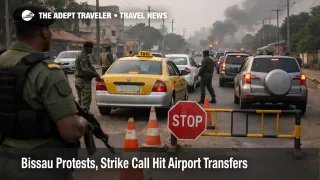
Bissau protests airport transfers are at higher risk in Bissau, Guinea Bissau, after a large march and clashes on December 12, 2025, and an activist call for a general strike plus a week of civil disobedience. Travelers are most exposed on days they must cross the city for Osvaldo Vieira International Airport (OXB) departures, hotel changes, or port side movements, even if flights continue to operate. The practical next step is to build a much larger road buffer than usual, avoid downtown movement if unrest builds, and be willing to shift to a near airport overnight instead of forcing a same day transfer through checkpoints.
The immediate travel relevant change is escalation from a protest event to a broader disruption posture, because strike and civil disobedience calls can affect transport availability, hotel operations, and road access in ways that do not show up in airline schedules.
Reuters reported that protesters burned tires and clashed with security forces during the December 12 march, while civil society figures rejected the transitional authorities and urged wider disruption actions. Separate Reuters reporting earlier in the crisis also described bans on protests and strikes, a combination that can translate into more checkpoints, faster enforcement decisions, and sudden route closures that catch visitors mid transfer.
Who Is Affected
Travelers with fixed departure times are the most exposed, especially anyone departing from Osvaldo Vieira International Airport (OXB) on a ticket that is difficult to change, or anyone on a separate ticket itinerary that relies on a clean, on time road transfer. In Guinea Bissau, a missed departure can be trip ending because rebooking inventory is often thin, and the next workable seat can be a day or more away.
Visitors staying in central Bissau, or moving between hotels, offices, embassies, and waterfront areas, should assume that the same corridor logic applies, the closer you are to government and security sites and dense downtown streets, the faster movement can become constrained when crowd control starts. If you are traveling with a driver, the goal is not to find the shortest route, it is to avoid any area where crowds are forming or security is concentrating.
Travel advisors should treat this as a ground reliability problem first, then an air schedule problem second. Even when airline operations look normal, the failure point is getting to the airport on time, getting through any informal or formal checks, and avoiding situations where a vehicle cannot turn around.
For pattern matching, the operational risk here looks similar to other protest driven transfer stories where the road leg collapses while airports keep processing flights, including Dakar Campus Protests May Snarl Roads Near Key Hubs and Tanzania Unrest Roadblocks Slow Dar Airport Transfers. The place is different, but the traveler decision is the same, build time, keep routing flexible, and do not force a transfer through a developing crowd.
What Travelers Should Do
If you have an upcoming airport day, shift your plan toward predictability. Pre arrange an airport transfer with your hotel or a trusted driver, ask for an earlier pickup than you would normally choose, keep a second route in mind, and carry a printed or offline copy of your booking confirmation plus your passport in case you encounter checks.
Decide in advance what would trigger a rebook versus waiting. If credible strike or civil disobedience activity is underway near your hotel, or if local staff advise that roadblocks are forming, the safer threshold is to delay movement and rebook rather than attempt a last minute dash across town. If your ticket is flexible, moving to an earlier flight window, or shifting travel by a day, is usually cheaper than losing a non refundable itinerary chain.
Over the next 24 to 72 hours, monitor embassy advisories and airline notifications, and use your hotel as an intelligence node. The U.S. State Department warns that demonstrations can occur with little notice and may disrupt transportation and essential services, which is the exact mechanism that breaks airport transfers even when planes are flying. France's travel advisory also recommends avoiding gatherings in central Bissau and checking flight status with your airline.
Background
Guinea Bissau's current disruption risk sits at the intersection of politics and mobility. Reuters reported that the December 12 protests targeted a military coup that it said occurred on November 26, 2025, after elections held on November 23, 2025, and that activists called for broader civil disobedience actions. At the regional level, ECOWAS publicly rejected the military transition plan and warned of targeted sanctions, signaling ongoing pressure and the possibility of additional flashpoints around diplomatic visits, announcements, or detention developments.
For travelers, the way this propagates is straightforward. First order effects are street level, crowds, tire burning, police or military deployments, checkpoints, and sudden roadblocks on main routes. Second order effects hit the travel stack quickly, taxis become scarce or refuse certain areas, hotels operate with reduced staffing or provisioning if workers cannot move normally, and tour operators and drivers may cancel or retime pickups because they cannot guarantee safe passage. Then the aviation layer absorbs the shock, because a single missed flight in a small market can strand travelers overnight, compress rebooking options onto the next limited departure, and create cascading misconnects for onward travel that was built around tight rotations.
The safest mental model is that the airport can be open while the city becomes partially nonfunctional for transfers. That is why official guidance tends to focus on avoiding demonstrations and having an independent plan to leave in an emergency, rather than assuming normal transport will remain available on the day you need it.