

Southern Israel Flash Flood Risk, Desert Roads Close
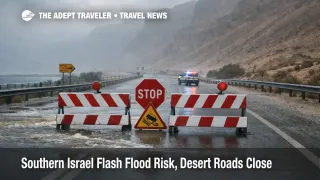
Flash flood risk across southern Israel is triggering proactive desert route closures that can break Dead Sea day trips, Judean Desert drives, and Arava and Negev road itineraries. The key operational change for travelers is that authorities may close highways before water is visible at your location, because runoff can surge down wadis and crossings from rainfall upstream.
Recent road status updates attributed to Netivei Israel have included closures on Road 40 (from Ketura Junction to the entrance of Mitzpe Ramon) and multiple shutdowns on Road 90, including the Dead Sea hotels approach area and Arava segments, alongside additional Negev closures on Roads 222, 227, and 234, with police also reporting a closure on Road 206 near Plants Junction. In separate updates, Netivei Israel also reported reopening specific Highway 90 segments after closures tied to flash flood concerns, which is a reminder that conditions can swing from open to closed and back again within the same travel day.
For travelers trying to reach Eilat, Israel, the disruption can escalate from partial restrictions to broad shutdowns. Ynetnews reported police closures that included Routes 12, 40, and 13 during flooding, followed by expanded closures including Route 90 from Ein Gedi to Eilat and Route 25 from Zefit Junction to Arava Junction, with police also describing limited permitted travel only for specific categories, including passengers heading to Ramon Airport.
Who Is Affected
Travelers are most exposed if their itinerary relies on desert highways to keep a tight schedule, especially Dead Sea resort check ins, Masada sunrise or timed tours, Judean Desert scenic drives, and long distance legs toward the Arava and Eilat. Self drive visitors, tour vans operating fixed departure times, and travelers with separate ticket chains are the highest risk segment because a single closure can force a long delay, a return to origin, or an unplanned overnight.
This also affects travelers who are not "doing the desert," but are using the desert as a transfer corridor. When Road 90 or Road 40 segments close, taxi and private transfer availability can tighten, hotel stays can extend unexpectedly, and day tour inventory can compress into fewer safe windows. Once large numbers of travelers are forced to pause movement, the ripple reaches flight planning because same day airport runs become uncertain, and rebooking lines and standby loads build quickly.
If you are connecting to Ben Gurion International Airport (TLV) by road after a Dead Sea or Negev overnight, or if you are trying to position to Ramon Airport (ETM) for a flight out of the Eilat area, treat the entire ground leg as a variable time operation, not a fixed duration drive.
What Travelers Should Do
First, assume closures can happen early, and plan to move before your day depends on a single desert segment staying open. If a Dead Sea, Judean Desert, Arava, or Negev drive is followed by a same day flight, build enough buffer to absorb a multi hour stop, and be willing to convert the plan into an overnight closer to the airport rather than "chasing" reopening updates mid drive. Nature and Parks Authority guidance reported by Israel Hayom also stresses staying out of stream channels on foot or by vehicle until water levels fully drop, which should be your baseline rule for any wadi adjacent route or hike.
Second, set a simple rebooking threshold before you leave your hotel. If official road updates show your intended corridor is closed, or if warnings explicitly cover the Dead Sea streams, the Judean Desert, or the northern Arava, treat the plan as a no go and switch to an indoor backup day, a nearer site that does not require wadi crossings, or a hotel move that reduces next day risk. If your trip purpose is discretionary, for example a sightseeing loop, waiting for a clearer day is usually the smarter trade than gambling on a reopening that might reverse again.
Third, monitor the next 24 to 72 hours like an operations problem, not a forecast curiosity. Watch for repeated closure and reopening cycles on the same assets, because that pattern tells you drainage is still unstable and that further bursts can shut routes again. For travelers also moving around the region during similar weather setups, the buffer logic is comparable to nearby Gulf disruption playbooks like Oman Heavy Rain Alert, Flash Flood Risk Dec 16 and UAE Rain, Rough Seas Raise Dubai Airport Delay Risk.
How It Works
Flash floods in desert terrain are a routing problem first, and a rainfall problem second. Water concentrates fast in channels, wadis, and low crossings, so a short burst over higher ground can send a surge downstream into a road segment that looks completely fine until it fails. That is why authorities may close highways preemptively, and why "steady rain in town" is not a reliable indicator for whether a desert corridor is safe.
The first order impact is direct, road closures, slower speeds, crash risk, and forced turnarounds on the corridors that connect Dead Sea resort areas, Negev junctions, and the Arava approach to Eilat. The second order ripple spreads into the rest of the travel system: late hotel arrivals push check in operations and housekeeping, canceled tours stack demand into fewer safe slots, and same day airport transfers become unreliable, which can produce missed flights, rebooking surges, and unplanned overnight stays that further tighten local transport capacity.
Sources
- Road closures due to weather conditions
- Segments of Highway 90 reopened to traffic
- Eilat cut off as flooding shuts all access roads to Israel's southern city
- Storm Byron is coming: Severe cold, flooding, power outages
- LIVE UPDATES: Storm Byron Hits Israel: Heavy Rain, Flooding, and Road Closures
- Flood Warnings Issued Across Israel as Storm Byron Unleashes Torrential Downpours