

Southern Thailand Floods Travel Update, Overstay Waiver
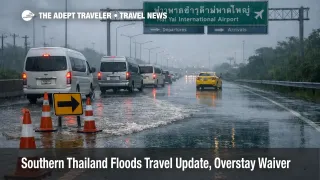
Flood impacts in Southern Thailand, Thailand, have pushed travelers into more flexible, status checked itineraries, even as tourism officials report improving conditions and broad reopening across most provinces. The Tourism Authority of Thailand says mainstream southern destinations are operating normally, with localized adjustments still possible where recovery work continues and where weather can disrupt marine schedules. For foreign visitors caught by flood related transport disruption, Thailand's Immigration Bureau is applying a temporary overstay fine exemption in eight southern provinces for eligible stays expiring from November 20 to December 31, 2025.
For trip planning, the practical shift is that "normal" now depends on where in the region you are moving. Beach hubs and major airports may feel routine, while certain cross province road transfers, rail segments, and last mile links into smaller districts can still be the weak points that break tight same day connections.
Who Is Affected
Travelers already in the deep south provinces of Songkhla, Nakhon Si Thammarat, Phatthalung, Trang, Satun, Pattani, Yala, and Narathiwat are the most exposed to intermittent transport friction, because those provinces are tied directly to the visa flexibility measure and were among the areas impacted by flooding. Visitors transiting through Hat Yai, Thailand, or using the region as an overland corridor to the Malaysian border are also more likely to encounter detours, longer road times, or attraction closures that do not show up in flight schedules.
Travelers headed for island and coastal resort itineraries should still treat ferry days as conditional, not because the region is closed, but because marine operators can adjust for weather and pier operations can shift in response to localized conditions. That matters most for itineraries that chain an early flight, a fixed ferry departure, and a same day hotel check in, where a single road delay can cascade into forfeited bookings or expensive last minute changes.
Anyone whose permitted stay is expiring inside the waiver window, and who has been unable to depart due to flood related disruption, is directly affected by the Immigration Bureau's temporary overstay fine exemption policy.
What Travelers Should Do
Confirm your exact province level situation before you move. Use your airline and airport status tools for flights, but treat road transfers, local buses, and ferry departures as separate systems that can diverge from "airport normal." Reconfirm ferry timing and pier details the day before, and add transfer buffer on travel days that include boats or long road legs.
Use a simple decision threshold for rebooking versus waiting. If your itinerary depends on a single, nonrefundable connection, for example flight to pier to ferry to hotel, and the transfer corridor runs through Songkhla or the southernmost provinces, it is usually better to rebook to a later departure, or add a staging night near the airport or pier, rather than attempting a tight same day chain. If your plans are concentrated in the main resort zones that are reporting normal operations, you can often hold, but only if you have enough slack to absorb a localized road closure or a ferry schedule shift.
If you may benefit from the overstay fine exemption, do not rely on assumptions at the airport counter. Keep your passport and entry stamp details accessible, carry any supporting documentation you have such as airline disruption notices or proof that routes were impassable, and be prepared to explain why you could not depart before your permitted stay ended. Immigration officers at international entry and exit points have been instructed to apply the exemption within the stated rules, so clarity and documentation help reduce delays.
How It Works
Flood disruption propagates through Southern Thailand's travel system in layers. The first order impact is local, water on roads, temporary closures, and slower movement in specific districts, which stretches drive times and makes fixed cutoffs, like ferry departures and check in windows, harder to meet. The second order ripple shows up beyond the flood zone, when vehicles and crews are out of position, when tour operators resequence multi stop trips to avoid closed corridors, and when stranded guests extend stays in unaffected areas, tightening short notice hotel availability and shifting demand for vans, taxis, and boats.
The Immigration Bureau's temporary overstay fine exemption is meant to address a common failure mode in large disruptions, a traveler whose permitted stay expires while transport routes are impassable. The policy described by Thai government channels applies in eight southern provinces, covers permitted stays expiring from November 20 to December 31, 2025, and is framed as relief for travelers unable to depart due to unavoidable flood conditions. Travelers should still expect normal screening and questioning, and should treat the exemption as a narrow operational safeguard, not a general visa extension.
For additional context on how these disruptions have affected rail and corridor travel earlier in the event cycle, see Southern Thailand Floods Strain Rail And Border Travel and Sumatra And Thailand Floods Complicate Travel.
Sources
- Flooding situation in Southern Thailand - Travel conditions update
- Travel conditions across Southern Thailand normalised as TAT advances recovery efforts
- Immigration and Traveler Support Measures Amid Flooding in Southern Thailand
- Death toll from floods in Thailand reaches 145 as receding water reveals widespread damage