

TSA Bid To End US Airport Screener Bargaining Jan 2026
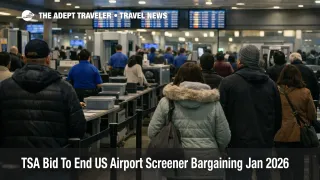
The Transportation Security Administration is renewing a move to end collective bargaining for the Transportation Security Officers who staff U.S. airport security checkpoints. Domestic travelers, especially those with early departures or tight connections at major hubs, could see more variability in lane staffing if workplace rules and retention dynamics shift. With TSA saying it will replace the current seven year agreement with a new labor framework on January 11, 2026, and the union promising a court challenge, travelers should build extra screening buffer and monitor checkpoint conditions right up to departure.
The TSA airport screener bargaining end move matters because a labor rules reset can change how reliably checkpoints absorb peak demand, and that can drive missed flights when lines spike.
TSA's December 12 announcement says the agency will rescind the 2024 collective bargaining agreement and replace it with a "security focused" labor framework beginning January 11, 2026. The agency points to a September 2025 determination by Homeland Security Secretary Kristi Noem that argues TSA screening employees have a primary national security function, and therefore should not engage in collective bargaining or be represented by a union.
This is not the first attempt in 2025. AP reports a federal judge blocked Noem's earlier directive, and the union argues the new effort violates the June preliminary injunction that halted the first attempt to terminate the contract.
Who Is Affected
Any traveler departing from, or connecting through, U.S. airports is in the blast radius because TSA screening is a single point of failure in most itineraries. AFGE describes the affected workforce as 47,000 Transportation Security Officers across more than 400 airports.
The highest practical exposure is at large hubs where passenger volume arrives in waves and checkpoint lane staffing is the main pressure valve, including Hartsfield Jackson Atlanta International Airport (ATL), Chicago O'Hare International Airport (ORD), and Los Angeles International Airport (LAX). Smaller airports can still be fragile because they may have fewer lanes to open when a queue builds, and fewer later flights to save a missed departure.
Travelers most likely to feel the change first are those who routinely cut buffers close, such as weekday business flyers on the first departures, families traveling at holiday peaks, and anyone on a self built connection where a missed first segment voids the rest of the ticket. Anyone relying on same day hotel check ins, cruise embarkations, or prepaid tours also carries higher downstream cost if a security delay turns into a missed flight.
What Travelers Should Do
Add more security buffer than you normally use for your airport and departure time, and treat peak morning banks as the least forgiving. If you have a choice, favor earlier flights with more later backups, and keep baggage plans simple so a long security queue is not compounded by an equally long bag drop line.
Use a decision threshold instead of hope. If conditions on the ground suggest you will reach the gate with less than about 30 minutes before boarding, protect the trip by moving to a later departure or a different routing before seats disappear, especially on routes with limited same day frequency.
Over the next 24 to 72 hours, watch for three signals: court schedule and injunction enforcement updates, TSA implementation guidance about what changes at checkpoints on January 11, 2026, and airport specific wait time patterns that emerge during peaks. If broader disruption is already active, security line risk can stack with delay risk, so cross check system conditions using Flight Delays And Airport Impacts: December 15, 2025.
Background
Collective bargaining at TSA is not just a workplace issue, it is an operations issue because checkpoint throughput depends on staffing, break timing, overtime, and how flexibly supervisors can reassign officers as demand shifts. DHS and TSA argue collective bargaining reduces agility and wastes time, while the union argues the contract improved stability and reduced attrition, which is a direct driver of how many lanes can be staffed on a given day.
The current fight sits on top of a rapid policy back and forth. TSA and AFGE signed a seven year agreement in May 2024 after bargaining authority had been expanded in 2022, according to Federal News Network. Reuters reports that Noem terminated the agreement on December 12 and that DHS says it will stop collecting union dues from officers' paychecks as part of the shift to the new framework on January 11, 2026. AP adds that a federal judge issued a preliminary injunction in June to preserve existing union rights after an earlier 2025 attempt, and that TSA is now trying again using the September determination while the case remains pending.
For travelers, the propagation path is straightforward. First order effects happen at the checkpoint, when lane openings do not match the surge of passengers arriving for a departure bank, which pushes waits from manageable to flight threatening. Second order effects hit the airline system, because missed flights force reaccommodation, consume limited standby and last seat inventory, and increase the odds that a disruption spreads across the day as aircraft depart with more no shows and passengers are rolled to later flights. The third layer is trip spend, as a missed arrival can trigger hotel date changes, car rental repricing, and lost value on timed entry tickets and tours even when the original flight itself operated on time.
Sources
- TSA announces new labor framework on Jan. 11, 2026
- Homeland Security renews push to end TSA collective bargaining agreement
- US invalidates union contract covering 47,000 TSA officers, AFGE vows to challenge
- DHS moves to eliminate TSA collective bargaining agreement, again
- Trump ends collective bargaining at TSA in retaliation against AFGE
- Eliminating collective bargaining at TSA determination (PDF)