

Tunis Rallies, UGTT Strike Call Threatens Airport Transfers
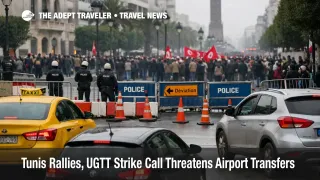
Political tensions spilled onto the streets of Tunis as rival rallies gathered in the capital, increasing the likelihood of road closures, checkpoints, and heavy police presence in central areas. Visitors with fixed schedules, especially airport runs, day tours, and timed tickets, are the most exposed to sudden movement slowdowns. The practical move now is to treat downtown mobility as high variance, shift transfers earlier, and keep plans refundable until the strike picture is clearer.
The Tunisia travel impact is immediate because Tunis rallies UGTT strike airport transfers risk means downtown access can tighten fast, and a confirmed strike date can turn routine logistics into misconnect problems.
Reuters reported that President Kais Saied's supporters rallied in central Tunis on December 17, 2025, as political divisions deepen and protests rise. Separately, Reuters also reported that the UGTT labor union has called a nationwide strike for January 21, 2026, tied to demands around rights and freedoms and wage negotiations, which raises the odds of broad public service disruption next month. Local reporting described gatherings and a planned march centered on Avenue Habib Bourguiba on December 17, 2025, a corridor that is regularly used for major demonstrations and security cordons, making it a predictable pinch point for tourists moving through the city core.
Who Is Affected
Travelers staying in, transiting through, or doing day trips from Tunis are the primary group at risk because downtown street controls are what break schedules first. If you are using taxis, ride hailing, hotel cars, or a private driver, you can still be delayed by perimeter closures and detours even if your driver is experienced, because a blocked junction often forces long loops rather than small course corrections.
Passengers flying via Tunis Carthage International Airport (TUN) are the next group to plan conservatively around, because airport operations can be normal while the road leg fails. This is especially true for early morning departures after a late evening rally, or for travelers trying to thread a same day chain, such as hotel checkout, airport transfer, and an onward connection on separate tickets.
Organized tours, guides, and ground operators are also exposed. When central Tunis becomes difficult to cross, tours compress into fewer stops, timed museum windows can be missed, and operators may shift meeting points to the edges of the cordon, which adds extra walking and extra time that is not always obvious when you book.
What Travelers Should Do
For the next 24 to 72 hours, avoid downtown Tunis during rally windows if you do not have to be there, and build a larger than normal buffer for any airport run, port transfer, or timed tour pickup. If you must move through central areas, have your hotel confirm the best current routing, agree on a hard depart time earlier than you think you need, and keep receipts and screenshots in case you need to claim missed service or travel insurance delays.
If you have a flight, ferry, or paid transfer within 24 hours of the planned January 21, 2026 strike, treat that day as a decision point. If your itinerary depends on one tight ground leg, rebook to an earlier departure or add a hotel night on the airport side of the trip, but if you have schedule slack and refundable bookings, you can often wait for sector scope and minimum service details before paying change fees.
Monitor three things, official travel advice updates, local operator messages from your hotel and tour providers, and credible local reporting about where crowds are gathering, because those indicators move faster than formal transport notices. If you see widening closures around Avenue Habib Bourguiba or a visible rise in checkpoints, assume transfer times will keep degrading, and pivot to staying put until movement stabilizes.
How It Works
Protest and strike disruptions propagate through travel systems in a specific order. First, crowd control measures create localized closures, police lines, and reroutes near demonstration corridors, which slows traffic well beyond the immediate rally footprint because cars funnel into fewer open arterials. Second, those delays cascade into the fixed time parts of an itinerary, airport check in cutoffs, tour meet times, intercity coach departures, and hotel housekeeping cycles, where a one hour delay is not "absorbed" but instead causes missed windows and rebooking.
In Tunis, the city core is the key vulnerability because many tourist activities and many business hotels cluster within or near the areas that can be cordoned quickly. When Avenue Habib Bourguiba is active, travelers can also see knock on impacts such as fewer taxis willing to enter the zone, longer waits for hotel cars, and tour operators shifting staging points, which can strand visitors who assumed door to door pickups would hold.
A strike call adds a second layer of uncertainty because it can affect staffing and service continuity across multiple sectors at once, including transport adjacent services. Travel advisories for Tunisia explicitly warn that demonstrations and strikes can occur, that they are often concentrated in downtown Tunis, and that strikes can affect essential services, including ground and air transport, which is why travelers should plan around the possibility that "normal operations" may not be available on short notice. If you want a general primer on how strike mechanics typically hit transportation systems, including minimum services, rolling cancellations, and recovery lag, see Strikes in Europe.
The most useful planning frame is to treat this as a transfer reliability story, not a politics story. If you have used the same logic in other protest driven disruption cities, such as Dakar Campus Protests May Snarl Roads Near Key Hubs or Jordan Protests Snarl Amman Airport Transfers Thu Fri, the pattern is familiar, avoid the core nodes, leave earlier than normal, and do not let a driver chase shortcuts near crowd control activity.
Sources
- Supporters of Tunisia's Saied rally amid deepening political divisions | Reuters
- Tunisians step up protests against Saied's crackdown on opposition | Reuters
- Tunisian opposition joins forces in protest against President Saied | Reuters
- Tunis: Kaïs Saïed goes to Avenue Habib Bourguiba at dawn - webdo
- Tunis: A popular march to defend national sovereignty - webdo
- Travel advice and advisories for Tunisia | Government of Canada
- Tunisia Travel Advice & Safety | Smartraveller
- Safety and security - Tunisia travel advice | UK FCDO