

Argentina Air Traffic Control Strike, Dec 18 to 29 Windows
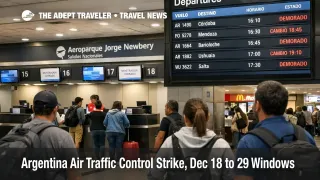
Argentina's air navigation union ATEPSA published a set of December 2025 work action windows that are designed to affect departures, not arrivals, across the country. The next high risk band is Thursday, December 18, 2025, when domestic departures are scheduled to be constrained from 400 p.m. to 700 p.m. Argentina Time (ART). Travelers flying within Argentina, or connecting through Buenos Aires, Argentina, should treat the published windows as a predictable misconnect risk and shift departure times where possible rather than hoping to ride out day of disruption.
The practical change is that the Argentina air traffic control strike is a published timetable of departure constraints through late December, which lets travelers reduce risk by moving flights outside the affected hours, and by adding buffers where same day connections matter.
ATEPSA's published schedule lists domestic departure impacts on Wednesday, December 17, 2025, from 800 a.m. to 1100 a.m., and on Thursday, December 18, 2025, from 400 p.m. to 700 p.m. It then lists another domestic window on Tuesday, December 23, 2025, from 700 p.m. to 1000 p.m. For international departures nationwide, ATEPSA lists Saturday, December 27, 2025, from 200 p.m. to 500 p.m., followed by a nationwide all flights window on Monday, December 29, 2025, from 800 a.m. to 1100 a.m.
ATEPSA says the measures "only affect takeoffs," describing restrictions on authorizations for aircraft on the ground and a halt in receiving or transmitting flight plans during the affected hours. The union also states that emergency operations, plus medical, humanitarian, state, and search and rescue missions, are exempt.
There is an additional nuance for Aeroparque Jorge Newbery Airport (AEP) in Buenos Aires. ATEPSA's published note indicates that, for the domestic only windows, the Aeroparque impact is limited to the first two hours of each band, even though knock on disruption can continue as airlines unwind delayed aircraft rotations and gate conflicts.
Who Is Affected
Travelers most exposed are those departing during the published windows, especially on routes that rely on tight aircraft turnarounds and evening rotations. Buenos Aires itineraries tend to amplify risk because many domestic trips rely on Aeroparque, while many international itineraries rely on Ministro Pistarini International Airport (EZE), and disruption on one side can break same day onward plans on the other side.
This also hits travelers who are not flying during the windows but depend on an inbound aircraft that is. When departures are held, arriving aircraft can end up waiting for gates, crews can run out of legal duty time, and airlines may cancel later segments to reset the network for the next day. That is why a three hour departure constraint can translate into a longer tail of delays, missed connections, and rebooking queues that persist after the clock time ends.
Holiday travel adds a second layer of exposure. Load factors are typically higher, which reduces the availability of same day rebooking seats, and pushes travelers into next day itineraries and last minute hotel nights. That spillover is most visible around airports with large bank structures and around city center hotels in Buenos Aires when late arrivals break check in windows.
Travelers should also account for compound risk on Thursday, December 18, 2025, if they are moving through central Buenos Aires for transfers, since surface disruption can further reduce the margin for airport arrivals during the afternoon and early evening. For the city movement layer, see Buenos Aires Protest March, Airport Transfers, Dec 18 2025.
What Travelers Should Do
If a flight departs inside a listed window, the lowest risk action is to move it. Target a departure that is several hours before the window begins, or several hours after it ends, and avoid shifting to a near edge time that will still be trapped in the recovery queue. If you are flying domestically on December 17 or December 18, check whether your carrier has published limited flexibility, JetSMART, for example, has a no fare difference change option for impacted domestic travel on those two days, with specific blackout dates and a request deadline.
Use a simple decision threshold for whether to rebook or wait. If you have a same day international connection, a cruise embarkation, or any separate ticket plan where one missed segment strands the rest of the itinerary, treat any departure inside the window as a rebook now case. If you are on a single ticket with a long connection buffer and you can tolerate arriving late, waiting for airline reaccommodation may be reasonable, but avoid last flight of the day departures because recovery options collapse when crews time out.
Over the next 24 to 72 hours, monitor three things. First, whether the Ministry of Labor hearing scheduled for Wednesday, December 17, 2025, leads to changes in the plan or a temporary pause. Second, airline travel alerts and waiver language, since carrier flexibility is often narrow by date, route, and ticket issue window. Third, the operational reality at the airport, because even a limited departure constraint can turn into wider cancellations when aircraft rotations and staffing fall out of sync. Keep screenshots of schedule changes, and save receipts for incremental transport and lodging costs in case you need to pursue reimbursement or insurance coverage later.
How It Works
Air traffic control actions that restrict takeoff clearances create a bottleneck at the moment an aircraft tries to push back, taxi, and depart. Even when flights are "only" blocked from leaving, the constraint quickly spreads because gates stay occupied longer, inbound aircraft can have nowhere to park, and airline rotations fall behind schedule. Once a rotation breaks, the delay migrates to the next leg, then to the next city, and, as the day progresses, it often becomes a crew legality problem that forces cancellations rather than continued delay.
This is why Buenos Aires connections are a common failure point. A delayed domestic inbound into Aeroparque can break an onward same day plan, and a delayed departure bank can turn a normal surface transfer between Aeroparque and Ezeiza into a missed check in or baggage cutoff scenario. Outside aviation, the ripple becomes hotel inventory pressure near the airports and downtown, plus mode shift demand onto long distance buses, rental cars, and short haul flights that still have seats.
Because ATEPSA's published plan is windowed, travelers can often reduce exposure without canceling the whole trip. The best risk reduction is schedule shaping, moving your takeoff time away from the constrained band, then widening buffers for airport access, baggage, and same day onward commitments so that a delay does not cascade into a full itinerary failure.
Sources
- MEDIDAS LEGÍTIMAS DE ACCIÓN SINDICAL DICIEMBRE 2025 (Strike Windows PDF)
- Medidas legítimas de acción sindical | A.T.E.P.S.A.
- COMUNICADO MEDIDAS DE DICIEMBRE (ATEPSA PDF)
- Air traffic controllers announce strikes that will affect flights during the Christmas holidays (Buenos Aires Herald)
- Controladores aéreos anuncian medidas que podrían afectar vuelos en las fiestas (Aviacionline)
- JetSMART Argentina, POLÍTICA FLEXIBILIDAD AR (PDF)