

Berlin Hamburg Rail Works Cut Trains, Add 45 Minutes
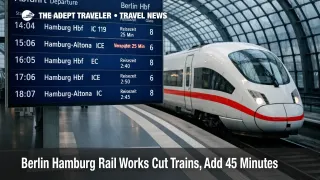
Long distance trains between Berlin and Hamburg are operating on a reduced, diverted pattern because the Hamburg, Berlin high speed corridor is under a full closure refurbishment. For travelers, the practical change is that direct ICE, IC, and EC services are now roughly hourly instead of every 30 minutes, and typical trip times are about 45 minutes longer. If your day includes a flight, a cruise turn, or a hotel check in deadline, you should recheck your itinerary in DB Navigator or bahn.de, reserve seats where possible, and build a bigger buffer than you would on a normal timetable.
The Berlin Hamburg rail works are not a minor timetable tweak, they are a capacity cut that concentrates demand onto fewer trains and shifts some flows onto buses, so the safest plan is to treat this corridor as a connection risk through April 30, 2026.
Deutsche Bahn's disruption notices describe the core constraint plainly: trains are running every hour instead of every half hour, and travel time is extended by around 45 minutes, with long distance routings diverted and select intermediate station patterns changing. Rail Europe's disruption guidance mirrors the same passenger facing outcome and adds that some lines that normally contribute to the corridor pattern are cancelled during the works, which is why trains feel busy even when operations look "stable" on paper.
Who Is Affected
This disruption matters most for anyone riding ICE, IC, or EC trains between Hamburg Hauptbahnhof and Berlin Hauptbahnhof on a same day schedule where being late has a hard consequence, such as a nonrefundable hotel night, a timed event, or a flight connection. It also hits travelers who were relying on the corridor as a reliable spine for a multi city itinerary, for example Hamburg to Berlin to Dresden or Prague, because the first late segment can cascade into a missed onward train and a forced rebooking at a worse fare.
Intermediate stop travelers need extra attention because the closure is not only about longer journeys, it is also about where trains do and do not stop. Deutsche Bahn's long distance disruption card flags Büchen as an omitted long distance stop during the works, and it notes replacement patterns that shift practical access toward other stations. Multiple sources also describe replacement bus use tied to Wittenberge and Ludwigslust during the closure period, which is the kind of detail that can surprise travelers who assume they are staying entirely on rail.
Regional travelers in the wider corridor footprint are also affected because the main line closure removes a set of paths that regional services normally use, and authorities have planned extensive bus substitution to keep local mobility functioning. The VBB notes a full closure from August 2025 through April 2026 and explains that both long distance and regional services are impacted, with regional replacement buses standing in where trains cannot run.
What Travelers Should Do
If you are traveling in the next week, assume you need more buffer than usual. Recheck your exact departure and arrival times on the day of travel, reserve a seat if it is offered on your service, and avoid planning tight same day chains like "train, hotel bag drop, and timed entry" without slack because the corridor is running with fewer trains and longer runtimes.
Use clear decision thresholds instead of hope. If your planned arrival now threatens a flight, a cruise embarkation, or any deadline you cannot miss, move to an earlier departure or an overnight positioning plan, because an hourly timetable gives you fewer recovery options when something slips. If you are on a train bound ticket, remember that Deutsche Bahn says the train binding is lifted when a delay, a cancellation, a missed connection, or an omitted stop is expected, which makes it easier to take the next workable departure.
Over the next 24 to 72 hours, monitor for day specific knock on disruption, not just the baseline works. Watch for platform changes, replacement bus instructions for your intermediate stop, and any "expected delay at destination" notices, then screenshot the details for claims if things go wrong. If you arrive 60 minutes or more late, Deutsche Bahn's published compensation rules explain the standard 25 percent and 50 percent thresholds for many ticket types, which is worth acting on when delays turn expensive.
How It Works
A full closure refurbishment changes rail reliability in two ways that travelers actually feel. First, it removes capacity on the direct high speed path, so long distance trains are rerouted onto alternate lines with different traffic mixes and fewer available paths, which is why the timetable shifts to an hourly pattern and why journey time increases by about 45 minutes. DB Engineering and Consulting describes this as a nine month full closure window and notes that trains are diverted via Uelzen and Stendal, with stops such as Salzwedel and Stendal incorporated into the diverted pattern and alternating calls by hour in Lüneburg or Uelzen.
Second, the closure forces a bus, rail, and road interface for parts of the corridor, which creates new points of failure. When an itinerary includes a replacement bus segment, the risk profile changes because road congestion, loading times, and luggage handling become part of the journey, and a small slip can eat the margin that used to exist in the faster rail timetable. The VBB explains the basic mechanism in plain language, there is no train traffic possible on key stretches during the works, regional service must be replaced by extensive buses, and long distance trains are redirected to keep Hamburg and Berlin connected.
Those first order rail impacts propagate quickly into at least two other travel layers. Connections become less resilient because an hourly corridor offers fewer "next train" recovery options, which pushes some travelers toward last minute flights, rental cars, or unplanned overnight stays when the day no longer pencils out. Hotels, tours, and meetings then see more missed check in windows and reshuffled arrival patterns because the same 45 minute extension that looks manageable in isolation can break a tightly choreographed day, especially in winter when early darkness and weather can further slow transfers.
Sources
- General refurbishment Hamburg ⇄ Berlin: train service halved, journey time extended by around 45 minutes - DB Störungskarte Fernverkehr
- Generalsanierung 2025 Hamburg-Berlin | VBB
- Germany: Delays & disruptions - Rail Europe Help
- General overhaul of the Hamburg - Berlin line - DB Engineering & Consulting
- In welchen Fällen ist die Zugbindung aufgehoben und was bedeutet das?
- Welche Entschädigung erhalte ich, wenn mein Zug verspätet am Zielbahnhof ankommt?