

Brussels Farmers Protest Road Closures Near EU Quarter
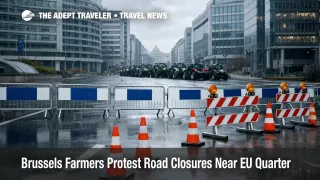
Farmers are bringing tractors and a march through central Brussels on Thursday, December 18, 2025, tightening road access into the European Quarter while an EU summit security perimeter is already restricting movement. Travelers using taxis, rideshares, coaches, and hotel pickups in the city center, especially around Brussels North Station and Place du Luxembourg, are most exposed to delays and missed connections. Move earlier than planned, favor Metro and rail links for key hops, and set a backup pickup point a few blocks outside the closure zone if your ride cannot reach the curb.
Brussels farmers protest road closures, combined with EU summit cordons, make same day transfers across the inner ring and EU quarter unreliable on December 18, 2025.
Regional mobility guidance says gathering begins from 9 a.m. near the junction of Boulevard Roi Albert II and the inner ring road, with the procession moving from 11 a.m. toward Place du Luxembourg via Boulevard du Jardin Botanique, Boulevard Bischoffsheim, Avenue des Arts, Boulevard du Régent, Rue de la Loi, Rue de Trèves, Rue Montoyer, Rue Marie de Bourgogne, and Rue du Luxembourg. Arrival at Place du Luxembourg is projected around 2:30 p.m., with dispersal and the end of the event around 5 p.m.
At the same time, EU summit security measures are active around the Schuman roundabout, with traffic restrictions, access badge checks for pedestrians entering the perimeter, and parking limits on surrounding streets. The Brussels Capital Region notes the Reyers centre tunnel is closed to traffic during the summit period. The Council of the EU's advisory for the European Council meeting confirms the security perimeter around the Council premises is in place from Wednesday, December 17, 2025, at 3:30 p.m., overlapping directly with the protest day.
Who Is Affected
Travelers arriving by train at Brussels North Station and then continuing by car, taxi, or bus toward the city center are in the highest friction corridor because the march starts at the station area and then pushes into the inner ring and European Quarter streets. If you have a meeting, a consular appointment, or a timed entry near Rue de la Loi, Rue de Trèves, or Place du Luxembourg, treat the last mile as the failure point, even if your intercity rail leg looks normal.
Anyone trying to reach Brussels Airport (BRU) from central Brussels should plan for two separate problems, slower road speeds from closures and diversions, and weaker "simple bus" options. STIB MIVB lists its airport linked bus line 12 among the services that can be disrupted by the procession, and it also warns that some lines are being short turned, which can force transfers at stations that are themselves affected by closures.
Public transport users in the EU district should expect station access changes that can turn a short walk into a longer reroute. For the summit window, STIB MIVB says multiple Schuman station accesses close at specified times, and it notes bus diversions around Froissart and local reroutes around key stops. For the farmers demonstration specifically, STIB MIVB also warns that some entrances at Arts Loi and Maelbeek close from late morning onward, depending on the point in the day.
What Travelers Should Do
If you are moving across Brussels on December 18, leave earlier than your normal "city day" instinct suggests, and assume curbside pickup will fail on at least one attempt. Build a buffer that covers both the drive time and the time spent finding a reachable pickup point, and consider walking five to ten minutes away from the march route streets before ordering a car so the driver can actually reach you.
If your schedule includes a flight, a long distance train, or a timed ticket, decide based on how much slack you have once disruptions begin. When your plan depends on arriving within about 90 minutes of a hard cutoff, it is usually better to reroute onto Metro and rail earlier, or to rebook to a later departure, than to gamble on road access into the European Quarter. In practice, that means treating central Brussels road transfers as non guaranteed until the demonstration has clearly dispersed in the late afternoon.
Over the next 24 to 72 hours, monitor three feeds, the Brussels Capital Region mobility updates for summit related restrictions, STIB MIVB's disruption pages for real time line impacts, and your airline or rail operator for knock on schedule changes if crew or vehicles are delayed by city access. If you can, avoid same day chaining of hotel check out, meeting, and airport run on December 18, and instead add an overnight or move the airport transfer earlier to break the dependency.
Background
This disruption is a classic "street network first" event that then propagates upward into the travel system. The first order effect is simple, tractors, cordons, and tunnel closures reduce throughput on the inner ring and the approaches into the European Quarter, which immediately lengthens taxi, rideshare, and coach travel times and makes precise pickup timing unreliable.
The second order effects show up where modes connect. Rail passengers arriving on schedule at Brussels North Station can still miss onward meetings or tours because the last mile fails, and visitors already inside the EU district can find themselves routed around closed station entrances, short turned buses, or stops that no longer serve their direction of travel. That lost reliability then pushes demand into fewer remaining options, which increases crowding, raises taxi prices, and makes hotel check in times harder to hit if the property is within the cordon influenced street grid.
A third layer appears at airports and time critical departures. Brussels Airport (BRU) may operate normally, but the journey to it becomes the weak link, especially if your plan relies on bus lines that are flagged as disruptable or if road congestion shifts unpredictably as the march moves. That is the scenario where travelers end up paying for unplanned hotel nights, losing prepaid entry slots, or rebooking trains and flights at the walk up fare.
For recent, Brussels specific last mile disruption patterns that help set your buffers, see Strike Disrupts Brussels, Wallonia Transport Dec 15, 2025 and Belgium Transport Strikes To Disrupt Travel, Nov 24-26.