

Rail Buses Replace Chester Crewe Trains Dec 16 To 19
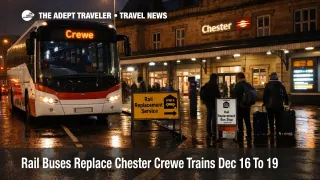
Rail replacement buses are replacing specific late night and early morning trains between Chester, England, and Crewe, England, because overnight engineering work closes all lines on that section. Travelers most exposed are those using Transport for Wales services that normally run through Chester and Crewe on through journeys, including routes linked to Cardiff Central, Birmingham International, Crewe, and Chester. The practical move is to shift onto daytime departures where possible, and if you must travel overnight, plan for longer timings, plus connection buffers at Crewe.
The Chester to Crewe rail buses change how overnight plans work because a rail leg becomes a road leg, and that increases variability right when travelers are most dependent on tight timing for first trains, onward connections, and early airport runs.
On Tuesday to Thursday nights, the 935 p.m. Cardiff Central to Chester terminates at Crewe, and a connecting replacement bus runs to Chester. The 1130 p.m. Crewe to Chester is replaced by a bus for the whole journey on those nights as well. In the early morning pattern, Wednesday to Friday, the 418 a.m. Chester to Birmingham International service starts from Crewe instead, with a connecting replacement bus between Chester and Crewe, and the 448 a.m. Chester to Crewe does not run. A separate bus is scheduled to leave Chester at 420 a.m. and arrive Crewe at 520 a.m. to support long distance connections at Crewe.
Who Is Affected
The highest risk group is anyone traveling late night or pre dawn between Chester and Crewe on Transport for Wales, especially when the rail leg is the first step of a longer itinerary. That includes travelers heading from Wales into northwest England, people repositioning for morning meetings, and anyone catching long distance services from Crewe that run on different operators and platforms. It also includes travelers who built airport transfers around early rail moves, for example reaching Birmingham Airport (BHX) via Birmingham International, or reaching Manchester Airport (MAN) by chaining rail links and interchanges that depend on the first working departures of the morning.
The first order effect is straightforward, buses are slower than trains on average, they have different boarding points, they can be busy, and they are exposed to road conditions. The second order ripple is where plans break. A late bus arrival into Crewe can cause missed long distance trains, and once that connection is missed, options thin quickly in the early morning, which can push travelers into last minute hotels, taxis, or rebooked tickets at higher cost. The ripple can also reach beyond rail, because missed rail connections can become missed airport check in windows, late hotel arrivals, and dropped timed tours when a traveler cannot reliably reach the next city on schedule.
What Travelers Should Do
Start by checking your exact train in a live journey planner for the specific date you are traveling, then plan the bus boarding point at both ends, because rail replacement services can load from station forecourts, nearby bus stops, or signed meeting points rather than a platform. If you must connect at Crewe, treat the replacement bus as a high variance segment, and build a buffer that turns a small delay into an inconvenience rather than a missed long distance departure.
Use a clear threshold for whether to rebook versus ride it out. If your itinerary depends on a single make or break connection, for example the first long distance train of the day from Crewe, or an early flight, the safer call is to rebook onto a daytime rail plan outside the overnight closure, or to add an overnight stop closer to the departure point you cannot miss. If your onward connection is frequent, refundable, or later in the day, then it can be reasonable to keep the overnight plan, but only if you can tolerate road delay and have a backup route in mind.
Over the next 24 to 72 hours, monitor operator updates for any last minute timetable tweaks, plus local road conditions that can slow replacement buses, such as overnight traffic restrictions, weather, or incidents. Recheck again on the day of travel, because engineering windows can trigger knock on changes to platforming and station access, and those details are what tend to create missed connections in real life.
How It Works
Overnight engineering work is scheduled when passenger demand is lower, but when a line is fully closed, trains cannot run through the worksite, which forces operators to either truncate services on each side or replace the closed segment with road transport. In this case, the closure between Crewe and Chester removes a key connecting link for Transport for Wales services that bridge Wales and the English rail network, so planners convert certain late services into rail plus bus, and reshape early departures so that longer distance services can still start from a major junction.
For travelers, the important operational detail is that a replacement bus behaves like a separate mode, not a train with wheels. Boarding locations can differ from station to station, luggage space can be tighter, accessibility arrangements can require advance coordination, and journey times can expand unevenly depending on roads. That is why a timetable that looks only slightly changed on paper can create a much larger risk to a tight interchange at a hub like Crewe, especially when the next step is a long distance train, or an airport transfer where missed timing has expensive consequences.
For broader context on rail disruption patterns and traveler playbooks, see Rail disruptions, plus related UK network items such as UK December CrossCountry Rail Strikes Hit Key Routes and London Liverpool Street Closed Dec 27 To Jan 1.