

DOT AAM Strategy Sets U.S. eVTOL Rollout Path
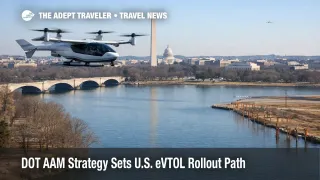
The U.S. Department of Transportation unveiled what it calls the nation's first Advanced Air Mobility National Strategy in Washington, DC, outlining how highly automated aircraft, including electric vertical takeoff and landing designs, could be integrated into U.S. airspace. The move matters most for travelers in metro areas where eVTOL operators want to sell short hops, and for travelers in smaller communities where operators pitch new links to larger hubs. For now, the practical takeaway is to treat this as a planning and regulatory milestone, not an immediate new booking option, and to watch for airport level pilot announcements that could affect local access and curbside patterns.
The DOT AAM national strategy sets out a federal policy vision and an accompanying action plan with 40 recommendations, organized around six pillars, airspace, infrastructure, security, community planning and engagement, workforce, and automation. DOT also published a companion Comprehensive Plan that sequences implementation work across four phases, branded as LIFT, intended to move AAM from early operations to scaled deployment.
Who Is Affected
Most leisure travelers are affected indirectly at first, because the earliest changes are likely to show up as demonstrations, limited pilots, and local planning debates rather than widely available tickets. You are more likely to feel near term effects if you travel frequently through airports that are actively courting new aircraft types, because infrastructure decisions often begin with designated pads, access roads, charging capacity, security procedures, and ground handling rules that can change traffic flow near terminals.
Airports and airport operators are a front line stakeholder because AAM depends on where aircraft can land, park, charge, and be processed safely, and on how those flows coexist with existing airline, charter, and helicopter activity. Airports Council International North America framed the strategy as a trigger to identify infrastructure needs and funding mechanisms, which signals that the next constraints are likely to be concrete capital planning, and approvals, not just aircraft development.
Travel advisors, corporate travel managers, and meeting planners are also in the early impact set because the first scalable use cases tend to be time sensitive trips, airport to downtown transfers, and regional hops that compete with premium ground transport. Even if a traveler never rides an eVTOL, pilot operations can reshape how curbside pickup, premium transfers, and airport landside congestion are managed in a few test markets.
What Travelers Should Do
If you see headlines about "first flights," anchor your expectations to what DOT is actually describing, a phased rollout that starts with demonstrations and initial operations, then expands as policies, infrastructure, and community planning mature. In practical terms, that means you should not rearrange a trip around a speculative eVTOL connection unless it is sold as a protected itinerary with clear rebooking terms, and a realistic ground backup.
When deciding whether to wait for an AAM option versus booking conventional transport, use a simple threshold, if missing the transfer would break a cruise embarkation, an international connection, or a same day event start, do not rely on a pilot service unless it has redundancy, and published disruption handling. If it is a convenience upgrade, such as shaving time off a city transfer, consider it only after you have a standard car, rail, or shuttle plan that still fits your schedule.
Over the next 24 to 72 hours after any local pilot announcement, monitor three things: where the operating footprint is (specific pads and corridors), what hours are permitted, and what the airport says about landside access changes that could affect pickups and drop offs. The strategy itself emphasizes that AAM is more than an aircraft, it depends on workforce, infrastructure, and regulatory frameworks, which is where traveler visible friction, such as access rules, noise limits, and security procedures, tends to surface first.
How It Works
DOT defines Advanced Air Mobility as a rapidly emerging sector focused on integrating highly automated aircraft into U.S. airspace, describing new aircraft types that typically operate below 5,000 feet, plus the support system required to run them safely. In traveler terms, this is a low altitude layer of aviation that has to be slotted into an already crowded ecosystem, helicopters, general aviation, airline arrival and departure flows, drones, and restricted airspace, while still meeting safety, security, and community expectations.
The first order effects start at the source, airspace and airport readiness. If an airport becomes an early AAM node, it may need new arrival and departure procedures, dedicated touchdown areas, passenger processing rules, and charging and maintenance capacity. Those changes can ripple into second order effects across at least two other layers of the travel system. One ripple is connections and crew flow, because even small procedural changes near terminals can reshape curbside congestion, premium transfer timing, and the reliability of short connection windows. Another ripple is local lodging and ground transport, because pilot operations often cluster around downtown cores and convention districts where hotels, rideshare supply, and event schedules already create peak period choke points.
The National Strategy also sketches a timeline for maturity, calling for demonstrations and initial operations by 2027, broader operations in urban and rural areas by 2030, and more advanced operations later in the next decade. The companion Comprehensive Plan explains that its LIFT phases are meant to cascade from leveraging existing programs for near term operations, into engagement and research, then new policy models, and finally ecosystem transformation. For travelers, that sequencing is the clue for what will change first, local pilots, planning, and infrastructure, then standardized rules that could eventually make schedules predictable enough to sell at scale.
Sources
- Trump's Transportation Secretary Sean P. Duffy Launches First-Ever National Advanced Air Mobility Strategy to Unlock the Future of Flight
- The Advanced Air Mobility National Strategy 2025 (PDF)
- The Advanced Air Mobility Comprehensive Plan 2025 (PDF)
- NBAA Welcomes DOT's Introduction of Advanced Air Mobility National Strategy