

Eurostar Cancellations London Paris Trains Dec 18
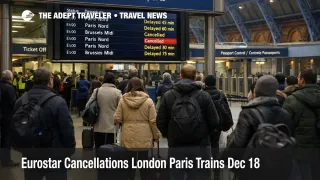
Eurostar has posted a higher disruption risk for cross Channel travelers between London, United Kingdom, and Paris, France, on Thursday, December 18, 2025, including cancellations and a multi station delay pattern. Travelers booked on the cancelled services, including trains 9013 and 9044, plus anyone relying on tight same day connections through London, Paris, Brussels, and Lille, is most exposed. The practical move is to verify your train number now, then either exchange into a later departure or lock in a backup plan, such as an overnight buffer or a flight, before station queues and sell outs build.
The Eurostar cancellations London Paris pattern matters today because Eurostar is also flagging delays tied to late running inbound trains at London St Pancras International, Paris Gare du Nord, and Brussels Midi, plus delay drivers on the French and Belgian networks and on the wider Eurostar network itself. When those nodes wobble at once, a single late arrival can consume platform time, border processing capacity, and crew and set availability, which then pushes the next departure late even if your own train is not the original problem.
For context, this is a broader disruption picture than the earlier Amsterdam and Rotterdam stop cancellations on a single Netherlands service, and it also lands inside the wider mid December to early January tightening that has already reduced schedule slack on key Channel routes. Travelers who have been treating Eurostar as a stable backbone for Christmas week itineraries should assume less resilience today, especially at the Lille Europe interchange where flows from multiple corridors converge.
Who Is Affected
Passengers booked on Eurostar trains 9013 and 9044 on December 18, 2025, should expect to rebook, because Eurostar lists those specific trains as cancelled due to operational restrictions. Travelers whose itineraries include London St Pancras International, Paris Gare du Nord, Brussels Midi, or a connection via Lille Europe should also assume a higher probability of missed onward services, because Eurostar is simultaneously flagging delays at those terminals and on the connecting national networks that feed them.
The highest misconnect risk hits travelers on separate tickets, meaning a Eurostar booking plus a separate onward rail, flight, hotel, or tour reservation that will not automatically protect you if the first leg slips. The second tier is travelers with airport plans on the same day, because short haul seats can price up fast when rail goes unstable, particularly on London to Paris and London to Brussels air corridors. If you are considering flights as a fallback, plan around London Heathrow Airport (LHR) and London Gatwick Airport (LGW) on the UK side, and Paris Charles de Gaulle Airport (CDG), Paris Orly Airport (ORY), and Brussels Airport (BRU) on the continent, and expect longer same day rebooking lines and fewer seats later in the day.
What Travelers Should Do
Start with immediate actions and buffers. Check your exact train number in Eurostar's live updates before you leave for the station, then move quickly if you see a cancellation or a growing delay. If you are keeping the trip today, protect yourself by shifting to a later departure, widening your station arrival buffer, and treating any onward plan in London, Paris, Brussels, or Lille as provisional until you are through the terminal and boarded.
Use clear decision thresholds for rebooking versus waiting. If your arrival time slipping would cause you to miss a last train onward, a hotel check in cutoff, or a flight on a separate ticket, rebook proactively rather than hoping the timetable recovers. If you can tolerate arriving late but still on the same day, it can be rational to hold your current booking, but only if you have a realistic backup hotel night and you are not depending on a second tight connection through Lille Europe or a cross city transfer that collapses when you miss the planned slot.
Monitor the right signals over the next 24 to 72 hours. Today's pattern is driven by late inbound trains and multi network constraints, so you should keep checking Eurostar's live updates for station specific delay causes, and for whether operational restrictions persist into the next departure banks. If you must travel again within the next few days, assume that knock on effects, such as rolling crew and set displacement, can linger even after the original technical or operational issue clears, and book with more margin than you would on a normal day.
Background
Eurostar is a tightly scheduled, high throughput system where small disturbances can amplify quickly because the cross Channel core has limited paths, fixed terminal processes, and constrained platform availability at the busiest stations. On a normal day, a late inbound train might be absorbed by a bit of timetable slack, but on December 18, Eurostar is simultaneously listing late arrival driven delays at London St Pancras International, Paris Gare du Nord, and Brussels Midi, alongside delays on the Belgian and French networks and on the Eurostar network. That combination increases the odds that your departure is waiting for a platform, a trainset, or a crew that is still arriving from the previous run.
The first order effect is straightforward, cancellations force rebooking, and delays break timed connections. The second order ripple is where travelers get surprised, because once you miss your intended slot, you hit border and security reprocessing, fewer remaining seats on later trains, and a chain reaction across hotels near the stations as displaced passengers need unplanned overnights. If you end up stuck in London, a practical fallback is to shift plans locally and preserve tomorrow's mobility, and travelers who suddenly need an extra day can use London Travel Guide: The Ultimate 7-10 Day Itinerary for First-Time Visitors to quickly pick neighborhoods and transport options that reduce friction while the rail network stabilizes.
On the rebooking mechanics, Eurostar directs passengers on cancelled trains toward exchanging to another train or requesting a refund through its disruption and manage booking tools, and it also publishes how compensation is handled when delays or cancellations occur, including the important limitation that compensation for a disrupted connection is paid only on the Eurostar leg.