

Spirit Frontier Merger Talks Could Change 2026 Fares
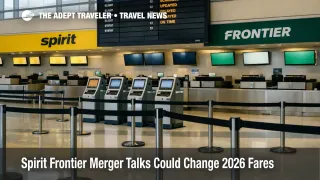
Spirit Aviation Holdings and Frontier Group are again discussing a merger, according to a Bloomberg report summarized by Reuters. The talks matter most for U.S. travelers who rely on ultra low fares on leisure heavy routes, especially for early 2026 travel, because either carrier can adjust schedules quickly while trying to stabilize finances. For now, travelers should treat this as a developing situation, keep itineraries flexible where possible, and watch for schedule change emails and waiver announcements before locking in nonrefundable trip pieces.
The Spirit Frontier merger talks are important because Spirit is operating under Chapter 11 protection again, and any strategic transaction would likely reshape where, and how often, the airline flies in 2026.
Spirit has told investors and customers that flights and ticket sales continue as usual during its restructuring, while it negotiates both a potential strategic transaction and a standalone plan of reorganization. That dual track is a signal that nothing is settled yet, even if a headline agreement emerges. Frontier, meanwhile, is changing leadership and experimenting with higher yielding products as it looks for a post pandemic formula that works in a market where larger airlines can compete aggressively with basic economy seats.
Who Is Affected
Travelers already holding Spirit or Frontier tickets for the next several months are the most exposed to near term volatility, not because a merger would instantly rewrite reservations, but because financially stressed airlines often keep trimming flying to preserve cash and improve performance. When frequencies are reduced, a single cancellation can have fewer same day alternatives, and that is what turns a manageable disruption into an overnight problem.
Travelers who depend on these carriers for price competition at key bases and focus cities should also pay attention. Spirit has historically been a major presence at Fort Lauderdale-Hollywood International Airport (FLL) and Orlando International Airport (MCO), while Frontier has anchored growth around Denver International Airport (DEN) and Las Vegas Harry Reid International Airport (LAS). If the companies combine, overlapping routes may be consolidated, and some smaller city pairs that only work at ultra low fares could lose frequency first.
Anyone building complex trips around tight same day connections, cruise embarkations, theme park packages, weddings, or prepaid tours should treat the current moment as a risk management exercise. The biggest second order effect is not a single flight cancelation, it is the knock on cost when a retimed arrival breaks a hotel check in window, a rental car pickup, or a ship boarding cutoff, and the only replacements are expensive last minute options.
What Travelers Should Do
If you already have tickets, confirm that your reservation contact details are current, and turn on airline notifications so schedule changes do not sit unread. Pair flights with flexible hotels when possible, and keep screenshots of the original itinerary, fare rules, and any schedule change notices in case you need to argue for a refund instead of a credit.
If you are deciding whether to book now or wait, use a clear threshold. If the trip is time critical, and the Spirit or Frontier flight is the last departure of the day, consider rebooking to an earlier departure or a carrier with more daily frequencies, even at a higher fare, because fewer frequencies reduce recovery options when plans change. If the trip is discretionary, and you can tolerate a time shift of several hours, waiting can be rational, but avoid stacking nonrefundable pieces until the schedule stabilizes.
Over the next 24 to 72 hours, monitor three things: whether either airline publishes waiver language, whether your flight times move in the booking record, and whether Spirit's court filings or investor updates signal a shift toward a sale process versus a standalone exit. If a transaction is announced, expect weeks to months of regulatory and court process before any network integration, and expect the earliest traveler visible changes to be incremental schedule edits rather than an overnight brand overhaul.
Background
A merger between Spirit and Frontier would sit at the intersection of bankruptcy law and merger review. Spirit's Chapter 11 process is designed to keep planes flying while the company renegotiates debt and contracts, including aircraft leases, under court supervision. A strategic transaction, if pursued, typically requires negotiations with creditors and approval steps inside the bankruptcy court process, alongside the standard corporate and financing work.
Separately, any airline combination that meaningfully changes competition can face antitrust scrutiny, and the industry has fresh memory of how that can play out. A federal judge blocked JetBlue's planned acquisition of Spirit in January 2024, and the Department of Justice framed the decision around protecting competition and low fare options. That history matters because it shapes how regulators, and competitors, may respond to another consolidation attempt involving a carrier that has been a major fare disrupter.
The practical travel system ripple works like this. First, Spirit's restructuring pressures the schedule through fleet and lease decisions, which reduces frequency in some markets and concentrates flying in stronger stations. Second, Frontier's profitability push, including its move toward more premium seating options, signals a strategy that depends on higher yields, which can reduce the willingness to keep marginal routes alive at rock bottom fares. Third, larger network carriers can selectively add basic economy inventory on overlapping routes, which can temporarily blunt fare spikes while also making the competitive environment harsher for a smaller combined carrier.
For travelers, the near term is mostly about schedule reliability and trip design. The medium term, if the Spirit Frontier merger talks become a signed agreement, is about route maps, frequency, baggage and seat fee structures, loyalty program changes, and whether ultra low fare availability tightens in markets where the two currently compete head to head.
Sources
- Spirit and Frontier Airlines eye merger, Bloomberg News reports
- Spirit Airlines Announces Amendment to DIP Credit Agreement to Support Restructuring Progress
- Form 8-K, Spirit Aviation Holdings, Inc., filed December 16, 2025
- Frontier Airlines Names James Dempsey President and CEO
- Frontier Airlines Reports Third Quarter 2025 Financial Results
- US judge blocks JetBlue from acquiring Spirit Airlines
- Justice Department Statements on District Court Decision to Block JetBlue's Acquisition of Spirit
- Spirit Airlines to cut fleet by almost 100 planes amid bankruptcy restructuring