

United App Virtual Gate Shows Live Boarding Progress
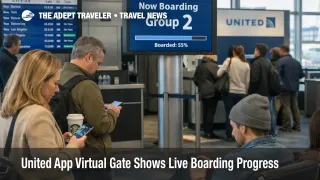
United Airlines has rolled out new mobile app features designed to make day of travel decisions more predictable, especially during busy periods when gates and lounges are crowded. The update centers on Virtual Gate, which shows which boarding groups are currently being called and adds a boarding progress bar so customers can see how far along boarding is without standing in the gate area. Travelers using the United app should treat this as a timing tool, check it before approaching the lane, and pair it with tighter buffers when they have a short connection or a checked bag to reclaim.
The change is that United app Virtual Gate now gives live boarding status in the app, alongside new lounge recommendations, upgraded bag tracking, and trip specific prompts, so travelers can time gate arrival, lounge use, and baggage decisions with fewer surprises.
Virtual Gate is the most visible traveler facing addition, but it sits inside a broader set of features that aim to reduce friction at three common pinch points, gate crowding, lounge hunting, and baggage uncertainty. United also says the features are rolling out ahead of the winter holiday travel window, and it frames the work as part of a push toward more personalized, real time guidance inside the app.
Who Is Affected
Any United traveler who uses the mobile app on travel day will see the biggest benefit, particularly those who board in later groups, travel with family gear, or need extra assistance, because they are more likely to wait near the gate, juggle timing, or require extra prompts. United's announcement also points out that a large majority of its customers use the app the day they fly, which matters because these features only help if travelers actually open the app while moving through the airport.
United Club members and premium cabin travelers are directly affected by the new United Club closest and best tool. At launch, the app can recommend which lounge to use based on proximity to a traveler's gate and on capacity, with capacity insights initially available at Chicago O'Hare International Airport (ORD), and an expansion to additional airports planned in 2026. In practical terms, this is most useful in large terminals where the wrong lounge choice can cost time and still end in a wait or a full sign at the door.
Checked bag travelers are also affected because the upgraded bag tracking aims to show real time locations across the bag's journey in a package delivery style view. That is most valuable on itineraries with a connection, tight onward ground transport, or a late arrival when carousel timing determines whether you make the last train, the last shuttle, or a hotel check in window.
Finally, travelers who often get surprised by process requirements, such as traveling with a stroller, requesting wheelchair service, or needing specific documents, are affected by the app's personalized prompts and reminders. United's release also notes biometric boarding options where available, plus added arrival information such as local weather and rideshare instructions, which can help travelers plan the last mile from the airport.
What Travelers Should Do
Open the United app earlier than you normally would, ideally when you arrive at the airport and again when you are 20 to 30 minutes from boarding. Use Virtual Gate to time when you physically approach the boarding lane, and treat the progress bar as a crowd avoidance tool rather than a reason to cut it close, because last minute gate changes, pre boarding needs, and overhead bin space can still punish late arrivals.
If you are deciding whether to wait, rebook, or reroute, use the new signals as thresholds. If Virtual Gate shows boarding is well underway and you are still far from the gate, stop trying to shop for food or squeeze in a lounge visit, and move. If you have a tight connection and arrival tools show an unworkable path to your next leg, prioritize rebooking inside the app early instead of joining airport lines, because options typically shrink as more disrupted travelers compete for the same limited seats.
Over the next 24 to 72 hours, monitor three things as you learn the new workflow. First, watch whether Virtual Gate updates quickly enough at your departure airport to be trustworthy, especially during irregular operations. Second, if you are a lounge user, compare closest and best recommendations against real world queues and, if you are traveling through Chicago O'Hare, treat the capacity insight as directional rather than perfect. Third, if you check a bag, screenshot the bag tracking milestones when something looks off, because a time stamped record can help you communicate clearly if you end up needing baggage support.
Background
Airport friction often comes from information gaps that force travelers to guess. At the gate, people crowd forward because they cannot reliably tell when their group will be called or how far boarding has progressed, and that congestion can slow scanning, create aisle blockages, and make announcements harder to hear. Virtual Gate is meant to shrink that uncertainty by moving boarding status into a personal screen, which can reduce gate area clustering and improve flow for travelers who need to time pre boarding or family boarding more carefully.
Lounges have a similar information problem. In large hubs, a lounge that is geographically close may be effectively unavailable if it is at capacity, and a lounge that has space may be a long walk that breaks your boarding timing. By combining proximity to a traveler's gate with available capacity, United's lounge recommendation tool is attempting to prevent wasted walks and failed attempts, which also reduces secondary congestion in concourses as travelers bounce between locations. The rollout detail, capacity insights starting at Chicago O'Hare and expanding in 2026, matters because it suggests United is layering operational telemetry into customer decision making, airport by airport.
Baggage tracking is the third layer where better visibility can reduce system strain. When travelers cannot tell whether a bag is still in the sort area, already loaded, misrouted, or on the carousel, they often default to waiting at the belt or lining up at the baggage office, which increases crowding and can slow problem resolution. A more granular, real time tracker can shift behavior earlier, for example deciding whether to wait at the carousel, head to a connection, or initiate help through official channels, and those choices ripple into fewer missed onward transfers, fewer hotel night surprises, and less pressure on airport staff during peak periods.