

VIA Rail Ontario Corridor Failure Delays Toronto Trains
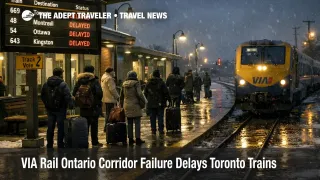
VIA Rail Ontario Corridor Failure conditions flared after a mechanical failure near Brockville, Ontario, Canada, left passengers stranded overnight and rippled across multiple Corridor trains. Travelers on the Quebec City, Quebec, Canada, to Montréal, Quebec, Canada, to Ottawa, Ontario, Canada, to Toronto, Ontario, Canada, spine were most exposed, especially anyone relying on same day arrivals for onward connections. The practical move now is to widen buffers, avoid tight airport handoffs, and be ready to switch modes if delays begin stacking early in the trip.
The incident was reported as impacting trains 669, 48, and 54, with repair attempts unsuccessful and a passenger transfer used to get people moving again. Coverage of the response described passengers from train 669 being shifted onto another working set, with additional reassignments that turned a localized failure into a corridor wide delay day.
Who Is Affected
The highest risk group is anyone booked on VIA Rail Corridor service through eastern Ontario in the Toronto to Ottawa to Montréal lanes, where an immobilized train can trap following movements and force dispatchers into stop and hold patterns until equipment and crews can be repositioned. When that happens, the initial delay is not just the time to fix the train, it is also the time to rebuild the operating plan once trains are out of sequence.
Travelers with same day flight plans are also exposed because rail arrival uncertainty turns into missed check in windows and misconnected itineraries. The first mention airports to watch in this corridor handoff pattern are Toronto Pearson International Airport (YYZ), Montréal-Pierre Elliott Trudeau International Airport (YUL), and Ottawa Macdonald-Cartier International Airport (YOW), because many itineraries use Corridor trains as the feeder leg that protects a longer trip. When the rail leg slips by several hours, the failure mode becomes expensive, last minute air rebooking, hotel nights, and ground transport scramble.
A third group is travelers on separate tickets, mixed modes, or timed events, including cruise embarkations out of Toronto area ports, tours with fixed start times, and meetings that cannot slide. Long delays also create second order pressure on one way rental cars and short haul flights out of Toronto and Montréal, which can tighten inventory quickly when a large passenger cohort abandons rail at once.
What Travelers Should Do
If you are traveling in the next few days and your plan depends on arriving within a narrow window, treat the train as the variable and build a buffer night or an earlier departure into the schedule. The moment a corridor train shows a multi hour slip, assume follow on trains can inherit it, and start pricing alternates before availability disappears, including a one way car rental from an intermediate city or a short hop flight if the fare is reasonable.
For an abandon versus wait threshold, the cleanest rule is to protect the highest stakes connection first. If you must reach Toronto Pearson, Montréal-Trudeau, or Ottawa Macdonald-Cartier for a flight, it is usually smarter to rebook once the delay forecast threatens your minimum airport arrival time, rather than gambling on an on the ground recovery that can reset again with crew and equipment constraints. If you are not connecting onward and you have flexibility, waiting can be rational, but only after you confirm you have power, heat, food, and a clear estimate that is being updated regularly.
Over the next 24 to 72 hours, monitor VIA Rail service alerts and independent reporting for signs that the corridor has returned to normal patterns, not just that your individual train is moving. In practice, you are watching for knock on indicators such as recurring late turns, swapped trainsets, or trains being annulled or consolidated, because those are signals the system is still absorbing the disruption. Keep screenshots of updates, note timestamps, and save receipts for meals, taxis, lodging, and rebooked transport because documentation is what turns an unpleasant day into a recoverable claim.
How It Works
A corridor breakdown becomes a system problem because passenger rail is scheduled as a tightly timed chain. When one train fails near a constrained segment, following trains may be held behind it, crews may run out of legal duty time, and equipment that was supposed to turn and operate the next departure is now in the wrong place at the wrong time. Even after passengers are transferred, the operator still has to recover the disabled equipment, reposition locomotives and crews, and rebuild the lineup of departures, which is why a single incident can spill into multiple train numbers and destinations.
In this case, reporting described a cascading sequence across trains 669, 48, and 54, with a multi step transfer operation used to keep passengers moving once repair attempts failed. The recovery itself then created new constraints, because one train was effectively repurposed while another was held back to secure the disabled set, which shifts delay onto passengers who were not on the original failed train.
Compensation can also shape traveler behavior and downstream impacts. VIA Rail said affected customers would receive both a full refund and a 100 percent travel credit, which helps travelers financially but can also increase near term demand for rebooked trips when people try again on new dates. That rebound demand matters most around weekends and holiday peaks, when seats sell out faster and alternate modes, especially short haul flights, become more expensive.