

Emirates Dubai Weather Disruption Hits Connections
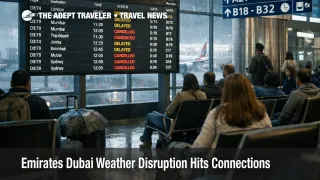
Emirates is warning of irregular operations tied to severe weather around Dubai, United Arab Emirates, with some flights cancelled, delayed, or retimed across December 18 and December 19, 2025. For travelers, the practical change is that the Dubai hub can lose its normal connection reliability when departure banks slip, aircraft rotations arrive late, and reprotected itineraries stack up behind limited open seats. Emirates has posted a rolling travel update that includes a list of cancellations for December 19, 2025, and notes that weather in the UAE and the surrounding region is impacting operations.
Dubai Airports has also issued a travel advisory for Dubai International Airport (DXB), warning that adverse weather conditions may cause flight disruptions, and that water accumulation on some roads can affect access to the airport. The airport advises travelers to allow additional travel time or to use the Dubai Metro, and to confirm flight status with their airline before heading to the terminal.
Who Is Affected
The highest risk group is passengers transiting Dubai on tight connections, especially those moving from a short haul arrival into a long haul departure where the next available seat may be a day later, not a few hours later. The same applies in reverse for travelers arriving on long haul flights and trying to connect onward into the Gulf region, the Indian subcontinent, East Africa, or Europe, where late inbound arrivals can compress the connection window and force last minute gate changes.
Travelers originating in Dubai are also affected because airport access can become the limiting factor even when the flight is technically still operating, particularly if road conditions slow ground transport into DXB. Anyone traveling with checked baggage should plan for longer delivery timelines if they misconnect and are reprotected onto later departures, because bags may not follow immediately when the hub is in recovery mode.
A third exposure category is passengers holding separate tickets, for example a low cost carrier ticket into Dubai paired with an onward Emirates booking, or an Emirates arrival paired with a separately booked onward flight, cruise, or tour. When disruptions hit, separate ticket itineraries often become self managed problems, because the second booking may not be automatically protected if the first flight arrives late or cancels.
For prior Gulf region connection reliability context during weather related disruptions, see Fog Disruptions In Dubai And Sharjah Hit Connections and Gulf Airport Delays Hit Dubai, Jeddah, Bahrain Flights.
What Travelers Should Do
Start with immediate actions and buffers. Check your Emirates booking using your PNR in the Emirates app or website, and take screenshots of your current itinerary, seat assignments, and any rebooking offers before you make changes. If you still need to travel, build extra time to reach Dubai International, and strongly consider public transport if road conditions are degraded, because the airport has explicitly warned that water accumulation on some roads can slow access.
Use clear decision thresholds for rebooking versus waiting. If your Dubai connection is under 2 hours, or if a single missed segment would strand you overnight, proactive rebooking is usually the better move once you see your first leg trending late, even if it has not cancelled yet. If you see a cancellation posted for your flight date, shift into recovery mode immediately, and take the first workable protected routing that preserves your core trip purpose, then optimize later, because hub recovery inventory can vanish quickly when multiple flights retime at once. Emirates is publishing a live disruption update that includes cancellations for December 19, 2025, which should be treated as a hard signal to re plan rather than to wait at the gate.
Over the next 24 to 72 hours, monitor three things, the DXB flight status trend for your departure bank, Emirates rebooking messages tied to your booking, and road access conditions into the terminals. If you are on separate tickets, protect the second booking early by changing it to a later departure, or by adding an overnight buffer in Dubai, because neither airline is obligated to treat two separate reservations as one journey. If your onward segment is essential, treat any meaningful delay or a retime that cuts your layover below your personal minimum as the trigger to move the second ticket, not as a reason to hope the hub catches up.
How It Works
Weather disruptions at a mega hub like Dubai propagate in layers. First, heavy rain, wind, and low visibility can reduce runway acceptance rates, and increase spacing between arrivals and departures, which creates airborne holding, late gate arrivals, and slower turn times on the ground. Second, once inbound flights arrive late, the aircraft and crew that were supposed to operate the next outbound sectors may no longer be in position, or may run into duty time limits, forcing retimes, aircraft swaps, or cancellations as dispatch tries to rebuild a legal schedule.
Dubai's network structure then amplifies the problem because many passengers are moving through banked connection waves. When one bank slips, the misconnect count rises sharply, rebooking lines lengthen, and gate areas crowd as passengers wait for new boarding times. That passenger backlog turns into operational friction, baggage offloads increase, and mishandled bag risk rises because the system is moving bags for travelers who are no longer on their originally planned flights. The second order ripple shows up outside Dubai as well, because late departures from DXB arrive late into Europe, Asia, and Africa, which then impacts onward connections, aircraft rotations, and crew positioning at those downstream stations, sometimes degrading reliability into the following day.