

Schengen EES Border Delays At Airports Into 2026
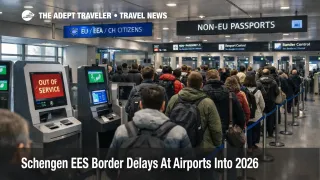
Schengen EES airport delays are building at passport control in some European airports as the new Schengen Entry Exit System rolls out in live operations. Non-EU travelers entering the Schengen Area, including U.S., UK, and many other passport holders, are most exposed because first-time enrollment requires biometric capture in addition to the usual document check. The practical move is to add arrival buffer time, plan longer connections when you must connect after immigration, and avoid separate-ticket itineraries that depend on a tight arrival-to-departure handoff.
The Schengen EES airport delays issue is that border checks are taking materially longer in practice, and the planned ramp-up in how many travelers must be enrolled could push peak queues from inconvenient to trip-breaking during winter travel.
ACI EUROPE says the progressive scale-up that began October 12, 2025 has increased airport border processing times by as much as 70%, with peak waits up to three hours. ACI ties the slowdown to recurring system outages, incomplete or unavailable self-service kiosks for registration, limited availability of automated border control gates for EES processing, the lack of an effective pre-registration app, and staffing shortages among border authorities. The immediate risk is not only long lines, it is unpredictability, because outages and configuration issues can swing a queue from manageable to gridlocked within a single arrival wave.
The calendar risk is the scheduled increase in the registration threshold. ACI says airports are already seeing passenger experience and operational impacts with a 10% registration threshold, and it warns that raising the threshold to 35% on January 9, 2026, as required by the implementation calendar, could create more severe congestion and systemic disruption for airports and airlines, and potentially safety hazards if crowding becomes extreme.
Who Is Affected
The EES process applies to travelers who are not citizens of an EU country, or of Iceland, Liechtenstein, Norway, or Switzerland, when they enter the Schengen Area for short stays. For airport travelers, the pain concentrates in two groups. First are travelers entering Schengen at a major international arrival hub, especially on the first trip after EES enrollment begins at that airport, because biometric capture adds time per person and can involve kiosk steps, guidance from staff, and retries if systems are unstable. Second are travelers connecting onward within Schengen after clearing immigration, because the delay hits on the back end of the inbound flight and can erase the planned connection window even when the flight lands on time.
ACI EUROPE says airports in France, Germany, Greece, Iceland, Italy, Portugal, and Spain are especially impacted right now. For travelers, that means the highest exposure is at airports that combine heavy non-EU arrivals with banked schedules, where many widebody and long-haul flights arrive in a short window. When one arrival bank meets slower processing, lines can spill into circulation areas, and border agencies may shift staff to manage safety, which can further reduce throughput at other lanes.
The second order ripples show up beyond the passport desks. Missed onward flights create a reaccommodation pulse for airlines and alliance partners, adding call center load and shrinking same-day reroute options. Baggage delivery can become more chaotic for misconnected passengers when people reach reclaim later in larger waves, and ground transportation demand can bunch when an arrivals hall clears in bursts instead of continuously. When misconnects require overnights, airport area hotels can tighten quickly, and late-night transfer capacity, including taxis, rail links, and prebooked shuttles, can become the next pinch point.
What Travelers Should Do
Add buffer where it actually protects you, which is after landing. For point-to-point arrivals, plan for longer time from touchdown to curb, and avoid scheduling fixed-time commitments too soon after arrival. For connections, favor itineraries with generous post-immigration connection time, and treat separate tickets as high risk unless you can absorb a missed flight without cascading costs.
Use a clear rebooking threshold instead of waiting in uncertainty. If your itinerary requires clearing immigration and making a short onward connection, moving to a longer connection, or a later departure the same day, is often safer than hoping the queue is light. If you are traveling during a holiday peak or into one of the countries ACI says is especially impacted, consider shifting the arrival to a different time of day, or rerouting to an itinerary that minimizes tight Schengen-entry connections.
Over the next 24 to 72 hours, monitor three signals that predict whether your day will deteriorate. Watch for airport operator advisories about border hall congestion, airline messages that hint at proactive rebooking or misconnect support, and reports of EES outages or degraded kiosk availability. If you see repeated system interruptions at your arrival airport, assume variability, and increase your buffer further, because the worst outcomes come from unpredictability, not from a steady but slow line.
How It Works
The Entry Exit System is the EU's digital replacement for manual passport stamping for short-stay trips, recording entries and exits and storing certain traveler data. In airport settings, the operational challenge is that the first interaction for many travelers is longer than a traditional document check because it can include fingerprints and facial image capture, and in many airports it relies on a chain of tools, kiosks, gates, network connectivity, and staffing, all of which must work together to keep throughput stable.
EES is being phased in, rather than switching every traveler at once. Official EU messaging around launch described a gradual rollout that becomes fully operational in April 2026, which is meant to give border authorities time to stabilize processes. ACI EUROPE's warning is that the current operational instability, combined with the scheduled ramp in the share of travelers who must be registered, can produce nonlinear effects during peaks, where a small per-passenger time increase becomes a very large queue, and then becomes secondary disruption through missed connections, reaccommodation, transfers, and hotel overnights.
Sources
- Review of Schengen Entry-Exit System urgently needed to avoid systemic disruptions impacting passengers
- EU begins gradual rollout of digital border system
- With start of operation of new EES border control system the EU will strengthen border security and increase efficiency for travellers
- The Entry/Exit System Successfully Connected Across Europe
- Warning as EU entry-exit system causing three-hour waits at airports