

Carnival Firenze IT Outage Delays Long Beach Sailings
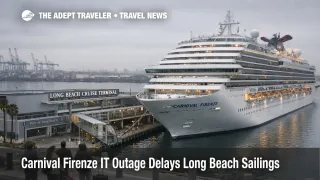
Carnival Firenze's December 15, 2025 sailing from the Port of Long Beach, California, left about 21 hours late after a shipwide IT outage disrupted connectivity and key guest systems. Holiday cruisers on the six night Mexican Riviera itinerary, and anyone with tight flights or hotel bookings built around the original schedule, were most exposed to the disruption and the revised port plan. Guests should confirm their updated itinerary in official channels, check what refunds apply, and add buffer time to flights and hotels at both ends of the trip.
The Carnival Firenze IT outage kept the ship in Long Beach overnight, canceled a scheduled call in Ensenada, Mexico, and triggered $100.00 (USD) in onboard credit per stateroom as compensation.
Passenger reports during embarkation described a loss of internet connectivity and knock on outages across services that depend on the ship's network, including WiFi access and parts of onboard app functionality. Carnival confirmed that Firenze experienced an IT issue that delayed departure, and onboard announcements later indicated that connectivity had been restored and the ship was cleared to sail.
Because the ship missed its planned Monday afternoon sail away, the itinerary was rewritten to protect usable destination time later in the week. Guests were advised the Ensenada call would be missed, and the ship would instead proceed directly to Cabo San Lucas, Mexico. Once cleared for departure at about 1:00 p.m. on December 16, 2025, the updated plan shifted to a double call in Cabo on December 18 and December 19, 2025, replacing the lost Ensenada day.
Carnival's compensation was framed around the missed port rather than the hours alongside. The line said it would provide $100.00 (USD) in onboard credit per stateroom, which can offset onboard purchases once systems stabilize, but it does not automatically reimburse third party excursions or prepaid plans in Ensenada. Travelers who booked independently should assume they will need documentation and a clear timeline to pursue refunds or insurance benefits.
Who Is Affected
The direct impact is for guests on the affected sailing, but the exposure varies by how tightly the cruise is chained to other reservations. Travelers who live within driving distance and built in flexibility mostly lost time and a port day. Passengers who flew in, paid for pre cruise hotels, or planned a same day flight home after disembarkation carry the higher risk, because uncertainty is what forces expensive last minute changes.
Air travel is where the second order ripple shows up fastest. A near day long delay at the pier increases the chance that guests rebook flights, add hotel nights, or split their party to get home, especially during holiday demand when seats are limited. If you are connecting through Los Angeles International Airport (LAX) or Long Beach Airport (LGB), even small timing changes on return morning can turn a comfortable transfer into a missed flight when airline reaccommodation options are thin.
The reshuffled port mix also changes excursion math. Ensenada is a short call where many guests book tastings, coastal drives, and Valle de Guadalupe wine tours with independent operators, and those vendors do not automatically know the ship is skipping port. Cabo is a higher demand excursion market, and adding a second day can help travelers recover value, but it can also concentrate demand into the same headline products, which may shift departure times, sell out, or become more crowded.
The outage is also a reminder that cruise vacations now rely on digital plumbing. When onboard IT and connectivity are unstable, basic assumptions can break, including being able to message your party, manage reservations, see folios, and reliably charge purchases to an onboard account. That tends to amplify stress, because it reduces visibility and control at the exact moment the schedule is changing.
What Travelers Should Do
If you are onboard during a systems disruption, prioritize documentation and flexibility over perfect plans. Save screenshots of your booking and any shore excursion confirmations, check your onboard account once systems are back, and ask guest services for a short written note that confirms the skipped port and the revised schedule if you need it for third party refunds.
If your trip is chained to flights or hotels, use a hard decision threshold based on what you cannot miss. When a same day flight home is essential, move it later in the day or add a buffer night, because waiting for final timing until the morning of arrival is usually when options disappear and prices jump.
Over the next 24 to 72 hours, monitor official ship communications for any further timing shifts, plus tender, tour, or pier timing in Cabo. Independent tour operators should be contacted immediately with the revised dates to request a rebook or a refund, and travelers should keep confirmations and receipts together in case a claim needs a clean timeline.
How It Works
A modern cruise ship's guest experience rides on a network that links satellite internet, onboard WiFi, point of sale terminals, cabin services, and the ship's internal apps. When a core connectivity or IT service fails, it can cascade into lost guest WiFi, impaired commerce systems, and slower distribution of schedule updates to thousands of guests at once. Holding a ship in port until those systems are stable is increasingly rational, even when the ship is otherwise seaworthy, because it reduces the chance of compounding problems after departure when port side technical support is no longer available.
Once a departure slips far enough, cruise lines usually recover the week by changing ports rather than trying to sprint through the original plan. Dropping a short call like Ensenada can prevent a late arrival that leaves guests with an unusable half day ashore. Extending Cabo to two days preserves meaningful destination time, but it also shifts onboard crowding onto the replaced day, and it can create friction for travelers who prepaid independent plans in the skipped port.
For a deeper explainer on how onboard credit works, and how to judge whether it is real value or a distraction, see Wave Season - Travel News and Guides from The Adept Traveler. For a documentation and claims workflow that translates well to most cruise disruptions, see MSC World Europa delay, claims and next steps. Travelers planning future West Coast calls can also use Ensenada Cruise Port Village Plans Announced December 2025 to understand how the port experience is expected to change over the next few years.