

London Airport Strikes Disrupt Christmas Flights
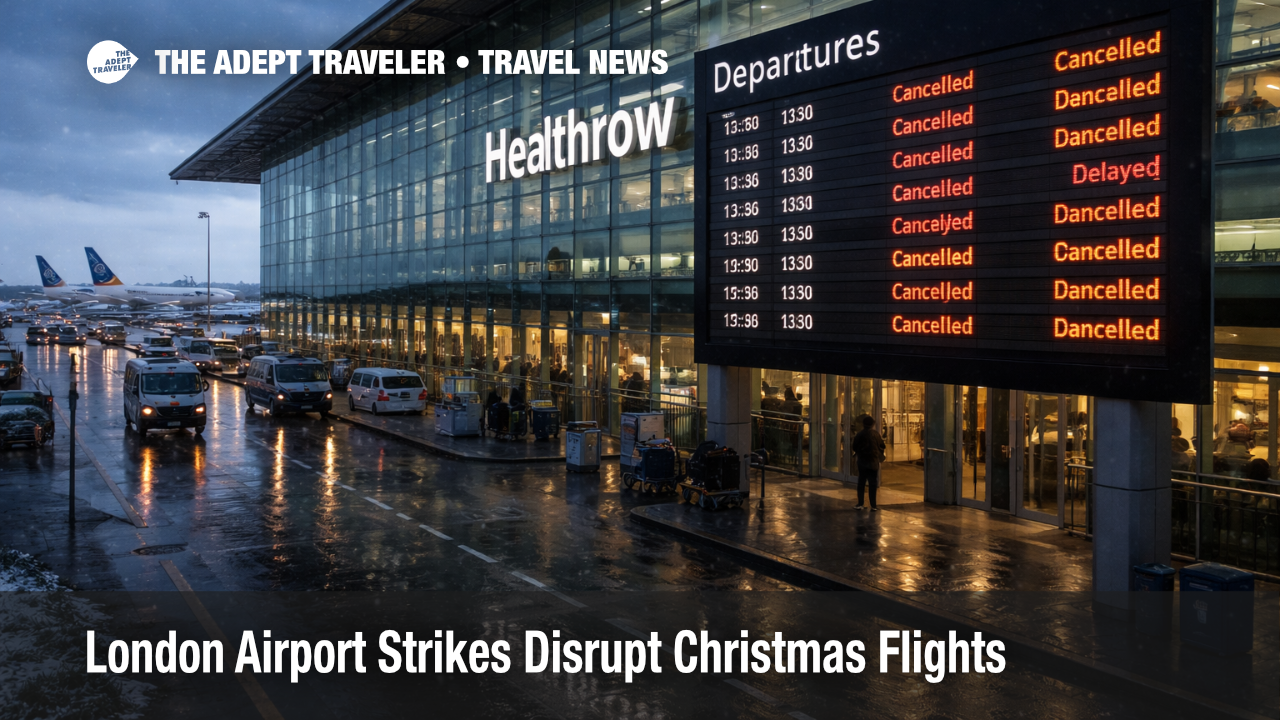
Strike action is set to disrupt Christmas week travel through London Luton Airport (LTN) and London Heathrow Airport (LHR), with the highest risk around check in, baggage handling, and short notice flight cancellations. easyJet passengers using Luton, plus SAS travelers flying between Heathrow and Scandinavia, are the groups most likely to feel the impact through missed cutoffs, late bags, and reduced reaccommodation options. If your itinerary touches either airport during the strike dates, the practical move is to reduce reliance on checked baggage, avoid tight connections, and decide in advance when you will rebook instead of waiting.
The London airport strikes Christmas disruption is not one single stoppage, it is two separate labor actions that hit two different choke points in the system, ground handling at Luton, and cabin crew availability for SAS at Heathrow. Unite says DHL workers supporting easyJet at Luton are striking from 300 a.m. local time on Friday, December 19, 2025, to 300 a.m. on Monday, December 22, 2025, then again from 300 a.m. on Friday, December 26, 2025, to 300 a.m. on Monday, December 29, 2025. Unite also says Heathrow based Scandinavian Airlines Services cabin crew plan to walk out on Monday, December 22, Tuesday, December 23, Wednesday, December 24, and Friday, December 26, 2025.
These dates matter because they sit on top of peak holiday load factors, which reduces the system's ability to absorb disruption. A minor queue becomes a missed bag drop cutoff, a delayed turnaround becomes a late arriving aircraft, and a cancellation becomes a long rebooking queue because the next available seat might be days away on popular city pairs.
For travelers who want more London specific context on the two separate disputes, see Heathrow SAS Cabin Crew Strike, What to Do Dec 22 to 26 and Luton Airport Ground Handling Strike Dates and Bag Delays.
Who Is Affected
At Luton, disruption risk clusters around passengers who need staffed processing, meaning travelers checking bags, needing passport or document checks at desks, traveling with bulky items, or relying on tight curb to gate timing. Even when flights operate, a ground handling slowdown can show up twice, first as longer lines before security, then again as late baggage delivery on arrival, which can break onward rail, coach, and rental car pickup plans.
At Heathrow, the strike action is tied to cabin crew for SAS services. The most exposed itineraries are direct flights between Heathrow and Scandinavian gateways like Copenhagen Airport (CPH), Stockholm Arlanda Airport (ARN), and Oslo Airport (OSL), plus onward connectors that depend on those hubs. If you are traveling on separate tickets, the risk is not just a single cancelled flight, it is a misconnection that you must fix yourself, at holiday pricing, while nearby hotels fill.
Travelers can also be affected indirectly even if they are not flying SAS or easyJet. When a London departure bank degrades, it puts extra pressure on shared infrastructure, curbside access, security screening waves, gate crowding, and taxiway sequencing. That congestion can slow other operators, and it can amplify missed connection risk for passengers trying to reposition to other London airports at the last minute.
What Travelers Should Do
Start with immediate actions that remove you from the fragile parts of the system. If you can travel carry on only, do it, because it reduces exposure to both Luton ground handling constraints and downstream baggage delays. If you must check a bag, arrive earlier than normal, and treat the airline's published bag drop cutoff as non negotiable, not as a suggestion, because lines can jump quickly once the first wave of travelers realizes staffing is thin.
Use decision thresholds that force a choice before you are stuck. If your flight departs inside the Luton strike blocks, and you have an onward plan that fails if you arrive more than about 60 to 90 minutes late, proactively move to an earlier departure, a different day, or a different airport before the day of travel. If you are booked on SAS out of Heathrow on December 22, 23, 24, or 26, 2025, treat any cancellation notice as a reason to reroute immediately, especially if you are connecting onward within 6 to 10 hours at a Scandinavian hub, because holiday rebooking inventory can collapse fast once the first cancellations hit.
Over the next 24 to 72 hours, monitor the things that actually predict whether your day will break. Watch for schedule changes in your booking, waiver or fee free change options, and airport passenger updates, then decide whether you are willing to accept a same day delay, or whether you will rebook if the flight moves by more than a set amount, for example two hours. If your trip involves separate tickets, build a buffer night before a critical departure, or change to a protected single ticket itinerary, because consumer protections and reaccommodation are much stronger when the same carrier is responsible end to end.
How It Works
Ground handling and cabin crew disruptions propagate differently, but they both hit the same traveler outcome, unreliable departure timing, and scarce recovery options. At Luton, Unite's notice frames the dispute around DHL workers supporting easyJet's operation. When check in and baggage processes slow, you can get a queue that spills into common terminal space, which then changes the rhythm of security arrivals. Once passengers reach gates in a late surge, boarding can slow, pushback slips, and the day's aircraft rotations start to drift, exporting delay to later flights that reuse the same aircraft.
At Heathrow, a cabin crew walkout can force outright cancellations rather than just slower processing. Even if only a subset of SAS rotations is cancelled, the second order effect is often bigger than the first, because passengers must be reaccommodated onto already full flights. That can ripple into hotel demand around Heathrow, plus crowding at help desks, and longer waits for call centers and chat support, precisely when travelers have the least flexibility.
Zooming out, London's holiday disruption picture sits inside a wider European system that is already under strain from operational change. Airports Council International (ACI) Europe has warned that the phased rollout of the Schengen Entry Exit System has increased processing times at some airports and produced peak waits that can reach hours, which raises the stakes for anyone trying to recover from a missed flight by taking a later departure the same day. Spain is also seeing continuing ground handling labor action tied to Ryanair's contractor Azul Handling, scheduled across recurring days and time windows through the end of December, which can tighten alternative routings if you are trying to detour via major Spanish hubs such as Adolfo Suárez Madrid Barajas Airport (MAD) or Josep Tarradellas Barcelona El Prat Airport (BCN). The net result is that contingency plans that look fine on paper can fail in practice if they rely on tight airport processes, late evening recovery flights, or a last minute hop through a busy hub.
If your flight is cancelled, airlines still owe you core remedies such as a refund or rerouting, plus care while you wait, depending on the circumstances. Compensation eligibility can depend on the reason for the disruption, but the safest traveler posture is to document everything, keep receipts for necessary expenses, and push for rerouting options that preserve your trip's anchor events, like a cruise departure, a wedding, or a non refundable tour.
Sources
- Festive Luton Airport travel turmoil as DHL workers will strike
- Scandinavian Airlines workers at Heathrow in Christmas strikes
- Cancellations, UK Civil Aviation Authority
- Air passenger rights, Your Europe, European Union
- UGT convoca huelga en el handling de Ryanair a partir del 15 de agosto
- Resolución de servicios mínimos, huelga Azul Handling
- Review of Schengen Entry Exit System urgently needed to avoid systemic disruptions impacting passengers
- Entry Exit System, European Union