

Schengen EES Airport Delays Worsen With Jan 9 Ramp
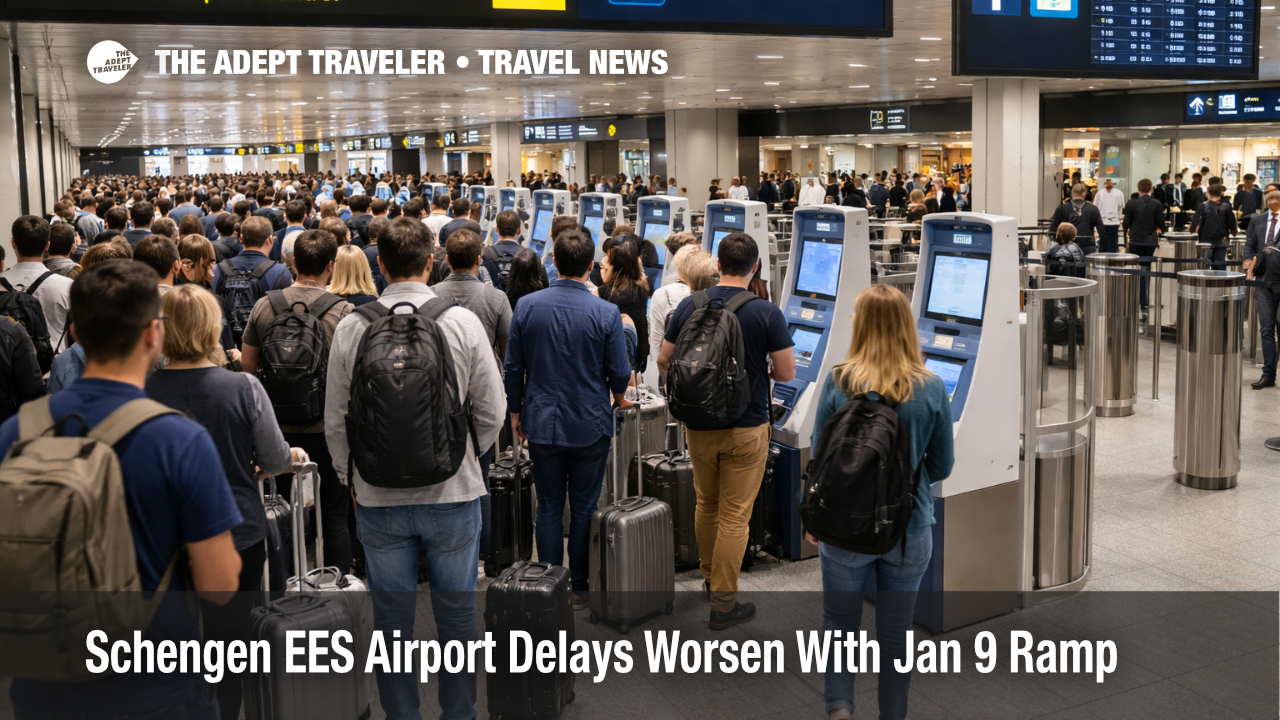
Europe's airport trade group is warning that the Schengen Area's new Entry Exit System is already stretching border processing at some airports, even though only a limited share of eligible travelers are currently being enrolled. Airports Council International Europe, ACI EUROPE, says border control processing times at airports have increased by up to 70 percent, with waiting times up to three hours during peak periods, and it is calling for an urgent review before the next planned ramp up.
Non EU travelers arriving by air, including many U.S. and UK passport holders, are most exposed on their first entry where biometric enrollment is required. The near term calendar risk is January 9, 2026, when ACI says the required enrollment threshold is scheduled to rise from 10 percent to 35 percent, a change it argues could turn today's long lines into broader operational disruption at airports and for airlines.
The counterpoint is that the European Commission disputes the scale and causation of the current airport impacts. In comments reported by The Independent, a Commission spokesperson said member states have exceeded early thresholds, and that concerns about the 35 percent step have been disproven, while also saying no member state has confirmed ACI's cited 70 percent increase and three hour peak waits due to EES.
Who Is Affected
The Entry Exit System, EES, applies to non EU nationals traveling for a short stay and is being introduced gradually at external Schengen borders. For airport travelers, that means the highest exposure concentrates in arrivals immigration halls, where first time enrollment adds steps, and where throughput is limited by how fast border officers, kiosks, and supporting systems can process each person.
If you connect onward after clearing immigration, the risk is amplified because the delay happens after your inbound flight lands. A flight can arrive on time, and still leave you with too little time to reach the next gate, especially in tightly banked schedules where several widebody arrivals feed the same immigration hall in a short window. When that happens, airlines see a burst of misconnects, rebookings, and baggage tracing, and the disruption can propagate into later departures through seat availability, aircraft rotations, and crew duty time constraints.
ACI did not name specific airports in its statement, but it did say airports in France, Germany, Greece, Iceland, Italy, Portugal, and Spain are seeing the worst impacts so far. For traveler planning, treat major international arrival hubs in those countries, for example Frankfurt Airport (FRA) in Germany, as higher risk during peak arrival banks until the EES process stabilizes and staffing catches up.
What Travelers Should Do
Start by protecting the part of your trip that EES can disrupt most, the time from touchdown to exiting the arrivals hall. If you have a tour pickup, a rail departure, or a timed appointment, move it later or build a larger cushion, because the variability from outages and kiosk availability can swing a normal line into a long wait quickly.
Use a decision threshold for rebooking versus waiting, especially for onward flights after immigration. If your itinerary relies on a tight connection after clearing passport control, shifting to a later departure, or choosing a longer connection, is often safer than gambling on a light queue, particularly around holiday peaks and on arrival waves that concentrate many long haul flights. Avoid separate tickets that require you to clear immigration and recheck baggage quickly, unless you can afford the full cost of a missed onward flight.
Over the next 24 to 72 hours, monitor three practical signals. Check your arrival airport's operations updates for border hall congestion, watch for airline notices that hint at proactive reaccommodation or same day flexibility, and pay attention to reports of EES outages or kiosk downtime at your arrival point, since ACI specifically cites outages and configuration issues as drivers of unpredictability. If conditions look unstable and you are traveling close to January 9, 2026, consider rerouting to an itinerary with a longer buffer, because that is when the required enrollment share is scheduled to increase.
How It Works
EES is the European Union's digital system for recording entries and exits for short stay visitors, replacing manual passport stamping once fully implemented. The European Commission says EES has been introduced progressively from October 12, 2025, with full replacement of manual stamping planned for April 10, 2026.
At airports, the operational challenge is that biometric capture and system checks add time per person, and those seconds compound into long queues during peaks. When kiosks are unavailable, when automated gates cannot be used for EES processing, or when border guard staffing is insufficient, throughput drops, lines extend into circulation areas, and airports may have to shift resources for crowd management, which can reduce capacity elsewhere. Those first order border delays then ripple outward into missed connections, reaccommodation demand, baggage claim bunching, ground transfer surges, and tighter same day hotel inventory near major hubs.
Sources
- Review of Schengen Entry-Exit System urgently needed to avoid systemic disruptions impacting passengers
- Review of Schengen Entry-Exit System urgently needed to avoid systemic disruptions impacting passengers (PDF)
- Entry-Exit System (EES), Migration and Home Affairs, European Commission
- Entry/Exit System (EES), Travel to Europe, European Union
- EU Entry/Exit System: First phase of rollout leaves passengers waiting up to 3 hours at airports
- Warning as EU entry-exit system causing 'three-hour waits' at airports