

French Riviera Cruise Caps Limit Nice, Cannes Tender Calls
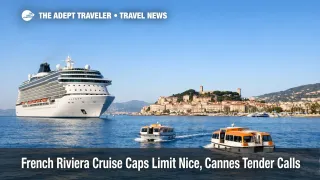
French authorities have put a single, departmentwide set of cruise limits into force along the Alpes Maritimes coastline, covering high demand Riviera stops such as Nice, Cannes, Villefranche sur Mer, and Menton. The new framework is built around managing how many passengers can disembark on any given day, especially at tender heavy anchorages that concentrate visitors into short shore windows. For travelers, the practical result is simple: some calls will be resized, rescheduled, or swapped, and shore time may be engineered to avoid peak crowding rather than maximizing headcount.
The decree caps passenger disembarkation to an annual average of 2,000 passengers per port call day in each port, with an exceptional allowance to reach 3,000 disembarking simultaneously on a given day so long as the annual average remains within the 2,000 threshold. Separately, it targets large tender calls by limiting ships carrying more than 1,300 passengers to one ship per day per anchorage or stopover area, and during the peak window from July 1 through August 31, those large ship tender calls are capped at 15 per month per area. The large ship tender limits do not apply to ships that are berthed at a quay.
Cruise lines that adhere to the Sustainable Mediterranean Cruise Charter are positioned to receive priority for scheduling and authorizations, which effectively turns the charter into an access lever, not just a sustainability pledge. Regulators and industry both framed the new rules as a negotiated compromise, but CLIA has also stressed that cruise itineraries are built years ahead, and that any new restrictions need review against downstream economic effects and operational feasibility.
To understand why this matters, it helps to compare it with earlier, city level moves that were narrower, and easier for lines to work around, including Cannes Cruise Ship Ban: Riviera Icon Limits Mega-Vessels to Curb Overtourism and Nice Cruise Ship Restrictions Spark Showdown at Sea. The Alpes Maritimes approach aims to prevent "port shopping" within the same coastline by applying a coordinated rulebook across multiple nearby stops.
Who Is Affected
Travelers on mainstream, high capacity ships are the most exposed, particularly on itineraries that rely on tendering in Cannes Bay or off Villefranche sur Mer, because the new limits explicitly constrain large ship tender frequency and the daily disembarkation flow. Guests on smaller ships and luxury yachts will often see fewer operational changes, and in some cases, may benefit from more predictable authorizations as capacity is reallocated away from peak crowding.
Independent shore plans are more fragile than cruise line excursions under this kind of cap, because the operational response usually involves tighter time slot control, earlier last tender times, and more managed group movement to stay within the day's passenger accounting. If a port call is converted into a shorter tender window, self planned trips to Monaco, Èze, or inland Provence can become risky if they require long return buffers or multi leg transport.
The second order effects extend beyond the pier. When a Riviera call is dropped or shifted, the shock travels into the cruise system via revised port rotations, excursion inventory reshuffles, and crew scheduling that is tied to port arrival times. It then ripples into the local tourism stack, with pressure moving to nearby substitute ports, higher demand for motorcoaches and licensed guides on the remaining calls, and potential spillover into hotel nights for travelers who decide to add pre or post cruise stays on land to "replace" a lost port experience.
What Travelers Should Do
If you are sailing in 2026, treat Riviera tender calls as conditional until you are inside final documents. Confirm whether your ship is scheduled to berth or tender, then build a same day buffer that assumes earlier last tender and heavier traffic around the port zone, especially in July and August when large ship tender frequency is explicitly capped.
Use a simple decision threshold for rebooking versus waiting. If Cannes, Nice, or Villefranche sur Mer is the primary reason you chose the sailing, and your ship carries well above 1,300 passengers, you should be mentally prepared for a substitution, a shortened call, or a re timed arrival, and consider itineraries that berth in larger ports nearby to reduce tender dependence. If the Riviera stop is a nice to have, waiting is reasonable, but lock in refundable shore plans and avoid stacking non refundable timed tickets without a generous return margin.
Over the next 24 to 72 hours after any itinerary update, monitor three things: whether the line has reclassified the call as berth versus tender, whether shore excursions have been re issued with new meeting times or group sizes, and whether the port day has moved in the sequence in a way that affects sea day pacing and onboard reservations. The decree is already being applied to new stopover requests, so late operational refinements, including how passenger counting is implemented, can still change what you see in practice.
Background
The French Riviera problem is not "cruise ships exist," it is the surge pattern created when multiple ships tender thousands of people into dense, high profile waterfront districts at the same time. Passenger caps and large ship tender frequency limits are designed to flatten the peak, and to shift cruise traffic toward fewer, more controlled disembarkation windows, or toward ports and berths that can handle higher throughput without swamping city centers.
The Sustainable Mediterranean Cruise Charter matters here because it adds a behavioral incentive on top of a capacity limit. In June 2025, Monaco and France highlighted a reinforced 2025 charter with expanded commitments that include biodiversity and cetacean protection, limits on discharges and waste, and reductions in noise, light pollution, and emissions, plus encouragement for low emission transport on excursions and crowd management at popular sites. If charter adherence becomes a consistent tie breaker in access decisions, it can influence which ships, and which operators, get the most desirable Riviera slots over time.
From an industry planning perspective, this is also a calendar mismatch story. Cruise lines sell itineraries far in advance, ports contract services, and shore operators staff up based on schedules that are often locked a year or more ahead. When regulators impose new caps that apply immediately to new requests, the near term impact tends to show up as "next season reshuffling," with ship redeployments to alternative ports, revised excursion offerings, and a gradual rebalancing of the Riviera toward smaller ships, berth calls where available, and fewer simultaneous mass disembarkations.
Sources
- French authorities issue new cruise regulations for Alpes-Maritimes coast
- Alpes-Maritimes : l'arrêté "anti-croisière" est signé !
- Cruise Ship Limits Become Effective on the French Riviera
- Monaco signs up to tougher cruise sustainability charter for the Mediterranean
- Sustainable Cruise Charter in the Mediterranean: Celebrating First anniversary