

Japan Nozomi Shinkansen Reserved Only Through Jan 4
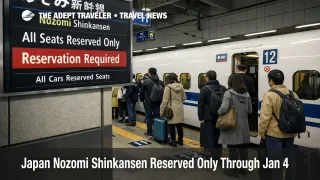
Nozomi bullet trains on the Tokaido and Sanyo Shinkansen are operating as reserved seat only services during Japan's year end and New Year travel rush, removing the usual option to line up for a non reserved car and board spontaneously. The change matters most for visitors and groups moving between Tokyo, Japan, and Kyoto, Japan, and Osaka, Japan, where Nozomi is a common default for fast city hops. Travelers should treat Nozomi like an airline seat assignment for this window, reserve before arriving at the platform, and add extra time if a Shinkansen ride connects to an airport departure or a fixed check in deadline.
The Japan Nozomi reserved seats policy applies from December 26, 2025, through January 4, 2026, and covers Nozomi services on the Tokaido and Sanyo Shinkansen corridor between Tokyo and Hakata.
Who Is Affected
Travelers who usually rely on unreserved seating are the most exposed, including visitors who land late, clear baggage slowly, and then try to make a same day Shinkansen connection without pre planning. The risk is not only having to stand, it is also missing a preferred departure, splitting a group across multiple trains, or losing the time cushion that protects hotel check in, dinner reservations, tours, or theme park entry windows.
Passengers holding tickets that only permit non reserved seating should also take this seriously. JR Central's published guidance for the peak period notes that riders with non reserved seat limited express tickets, including certain commuter products, cannot be seated on Nozomi during the reserved only window, and that boarding may mean standing in the deck area unless the passenger pays the designated reserved seat limited express fare if they sit.
Japan Rail Pass holders are a special case because Nozomi is not a simple "walk through the gate and sit anywhere" option. JR Central's guidance for the peak period says that if a Japan Rail Pass holder wants to ride Nozomi from December 26, 2025, to January 4, 2026, they should purchase the required ONLY WITH JAPAN RAIL PASS NOZOMI MIZUHO Ticket for a reserved seat, and that this ticket cannot be reserved online before arriving in Japan and must be purchased at ticket machines or station counters.
What Travelers Should Do
Lock in seat reservations as soon as the schedule is stable, especially for travel days that feed a flight or a cruise embarkation. The official online services linked to the Tokaido and Sanyo Shinkansen, including Smart EX, are the cleanest way to avoid platform surprises because they let travelers see seat availability in real time and complete the reservation before arriving at the station.
Use simple decision thresholds for whether to wait or reroute if you arrive without a reservation. If the next available Nozomi seats push your arrival beyond a hard commitment, for example a same day flight from Tokyo Haneda International Airport (HND), Narita International Airport (NRT), or Kansai International Airport (KIX), treat that as a reroute trigger and look at non Nozomi options with reserved seating, or shift the flight earlier if the airline will allow it. If your plans are flexible, waiting for the next reserved seat opening can be reasonable, but assume holiday loads will compress choices and keep groups from traveling together.
Over the next 24 to 72 hours, monitor two things, seat inventory on your exact departure and real time disruption notices that could tighten connections. Smart EX has published the reserved only rule for the December 26, 2025, to January 4, 2026 window, and it is also where many travelers will see service notices if delays or suspensions start to ripple across the corridor.
Background
Nozomi is the high frequency fastest pattern on the Tokaido and Sanyo Shinkansen spine, which means it acts like a conveyor belt for Japan's biggest city pair travel, and it also quietly supports airport bound flows by keeping schedules predictable. During the year end peak, JR Central and its partners shift Nozomi to all reserved seating, removing non reserved cars as a way to manage crowding and reduce onboard conflicts, and Smart EX frames it as a standing policy across the three major peak periods, Golden Week, Obon, and year end and New Year.
That change propagates through the travel system in predictable ways. First order effects appear at the station, where more travelers need ticket office help, vending machine time, or app troubleshooting, which increases concourse congestion and makes late arrivals more costly. Second order effects show up in connections, where a single missed train can cascade into missed domestic flights, missed last mile transfers, or a forced hotel night if the next workable routing lands too late for onward transport. A third layer is group dynamics and luggage handling, because splitting across multiple departures raises the odds that bags, families, or tour members arrive at different times, which can turn a simple city hop into a multi hour coordination problem.
There are still operational fallbacks, but they are not free. JR Central notes that non reserved seating remains available on non Nozomi services such as Hikari and Kodama, and the broader corridor also has other train patterns, but those seats can become crowded during peak travel, and switching often adds time or reduces frequency. For travelers trying to protect a tight schedule, the practical takeaway is that this is a reservation first period, not a "show up and see what happens" period, even if trains are running normally.
Sources
- Periods during which Nozomi Trains Will Operate with All Reserved Seats on the Tokaido and Sanyo Shinkansen in FY2025 (PDF)
- <All Seats of "Nozomi" Trains Are Reserved Seats> during the year-end and New Year holidays. | Topics | Tokaido Sanyo Kyushu Shinkansen Internet Reservation Service
- All seats on Nozomi trains on the Tokaido and Sanyo Shinkansen are reserved seats during the major peak periods.
- Special ticket for NOZOMI with JAPAN RAIL PASS
- Shinkansen Update: Nozomi Trains to Operate on a Reservation-Only Basis
- Use of NOZOMI/MIZUHO trains