

Telluride Ski Patrol Strike Closes Resort Indefinitely
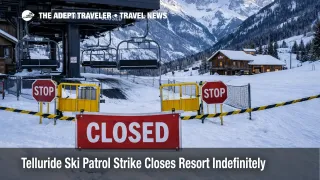
Telluride Ski Resort in Colorado says it will shut down operations starting December 27, 2025, after its unionized ski patrollers voted to strike. The closure affects guests with lift tickets, lessons, and lodging plans tied to Telluride and Mountain Village during one of the busiest travel weeks of the season. Travelers should assume skiing and on mountain services will be unavailable, move immediately to protect refundable bookings, and set a clear deadline for rerouting to another resort if the shutdown extends beyond the first day.
The Telluride ski patrol strike is a high impact disruption because the resort is treating patrol coverage as a safety gate for operating lifts and terrain. In reporting around the dispute, the union has said it is pushing for wages closer to peer resorts in the region, including raising starting pay from $21 to $28 per hour, and increasing pay for the most experienced patrollers into a higher band.
Who Is Affected
Guests arriving for December 27, 2025, and the following days are the most exposed, especially travelers holding nonrefundable lodging, prepaid lift products, and fixed travel dates around holiday schedules. Families and groups are also more likely to take a larger hit because they tend to prebuy lessons, rentals, and multi day lift tickets, and because coordinating a same week pivot to another mountain can be difficult.
Travelers using regional gateways such as Montrose Regional Airport (MTJ) and Durango La Plata County Airport (DRO) can see second order effects even if their flights operate normally. When a destination resort closes with little lead time, the system shock shifts into airlines, car rentals, and shuttle providers, as passengers try to change arrival days, switch to alternate resorts, or abandon the trip entirely. That rebooking churn can tighten remaining seat inventory, raise last minute fares, and create mismatches where a traveler can change flights but cannot rebook comparable ground transport on the new schedule.
Local businesses in Telluride and Mountain Village, including restaurants, bars, retailers, and guides, can see abrupt drops in visitor volume during a period when staffing and inventory are normally built around peak skier demand. At the same time, nearby ski towns can see a sudden spike in demand from displaced travelers, which compresses lodging and increases day of lift ticket competition at alternates.
What Travelers Should Do
Start by freezing the parts of your itinerary that are still protected. If you have prepaid lift tickets, passes, or ski school products, contact the resort using the published channels for refund guidance, and keep screenshots of receipts, confirmation emails, and card charges. If you booked lodging, check the cancellation deadline now, then call before you click cancel, since some properties will offer date shifts or partial credits that are not visible online. If you have a package, contact the package seller first so you do not accidentally void a bundled refund.
Set a decision threshold for whether you are waiting or rerouting. If your trip is primarily ski days and you cannot easily substitute another mountain within the same drive shed, treat December 27, 2025, as the pivot point and plan for an alternate by the end of that day. If your lodging is refundable through a later deadline, you can wait longer, but only if you have a viable backup resort and transportation plan that you can book quickly without penalty. If you are already en route, price the cost of staying for non ski activities against the cost of moving, since holiday week availability can make a pivot more expensive than postponing the trip.
Over the next 24 to 72 hours, monitor three things, the resort's reopening plan and operating status, the union and company bargaining updates, and the refund processing guidance for each product type. Also watch your airline's change fee and fare difference rules, since fare jumps can accelerate once other travelers begin rebooking. If you carry trip protection, review the terms in your policy now, and use a single reference page like Travel Insurance to confirm what documentation, timelines, and triggers your insurer expects before you change anything.
How It Works
Ski patrol is not just medical response, it is also the safety backbone for opening terrain, managing avalanche mitigation, and responding to incidents across a large mountain footprint. When patrol staffing becomes uncertain, operators face a hard choice, either keep terrain closed, reduce lift operations to a minimal footprint, or shut down entirely. In Telluride's case, reporting indicates the owner is opting for a closure starting December 27, 2025, while the parties remain in dispute, with the duration not clearly defined.
This kind of closure propagates quickly through the travel system because it collapses demand that is normally time anchored to weekend arrivals and holiday week schedules. First order effects hit the resort product stack, lift access, lessons, rentals, dining, and on mountain services, which then triggers second order ripples into lodging occupancy, airport arrivals, and ground transport capacity. A third ripple follows as displaced travelers pile into alternate resorts, tightening lodging and transport in nearby markets, and raising the odds of misaligned check in, check out, and flight times. The outcome is that a localized labor event can become a regional availability and pricing event within a day.
For a practical strike playbook that focuses on traveler decision thresholds and refund timing, the dynamics are similar to other service interruptions, even outside ski towns. A recent example is MSP Airport Food Strike Threatens Thanksgiving Week, where the key traveler lever was acting early on refundable components, and avoiding last minute bottlenecks.
Sources
- Telluride Ski Resort in Colorado to close Saturday due to labor dispute | AP News
- Telluride ski patrollers vote to go on strike starting Saturday | The Colorado Sun
- Telluride Ski Resort Announces Closure - KGNU Community Radio
- Telluride Ski Patrol Strike | Visit Telluride
- Newscast 12-26-25 | KOTO FM
- Striking ski patrollers at the biggest US resort return to work claiming victory | AP News
- About MTJ | Montrose Regional Airport
- Fly Durango | Durango La Plata County Airport