

Channel Tunnel Power Failure Halts Eurostar December 30, 2025
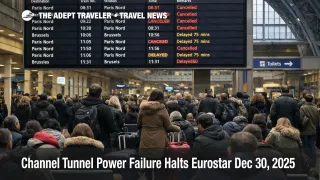
A power supply failure in the Channel Tunnel halted cross Channel rail traffic on Tuesday, December 30, 2025, forcing Eurostar to cancel many departures between London and continental Europe. Rail passengers and drivers using the LeShuttle vehicle train were affected, with long queues reported at the Folkestone and Calais terminals and major disruption at London St Pancras and Paris Gare du Nord. If you are traveling today, the practical next step is to treat same day crossings as high risk, confirm your specific departure status before leaving for the station or terminal, and be ready to reroute or overnight.
Channel Tunnel power failure Eurostar disruption matters because the tunnel is a single critical link that concentrates holiday demand, so cancellations and late running quickly cascade into the next day's schedule and into onward trips across Europe.
Who Is Affected
Eurostar passengers ticketed for Tuesday, December 30, 2025, including London St Pancras to Paris Gare du Nord and other Eurostar routes that rely on the tunnel, are the primary group, especially anyone chaining rail into a same day flight, cruise embarkation, or a fixed time event. Eurostar's own disruption notices warned that even trains shown as running could still face severe delays and last minute cancellations, and it advised passengers to postpone travel where possible.
Drivers and passengers booked on the Eurotunnel LeShuttle are also directly affected, because tunnel rail traffic constraints reduce loading rates and extend terminal dwell times. Getlink, which operates the tunnel infrastructure and LeShuttle, described a very gradual resumption on one track with alternating directions and significant delays, which is the kind of operating mode that creates uneven waves of movement and long, hard to predict waits.
Travelers not using the tunnel can still get pulled into the disruption. As stranded passengers shift to ferries and short haul flights, remaining seats can disappear quickly, prices can jump, and hotels near major terminals can fill, particularly around central London and northern Paris where many travelers end up needing an unplanned night. The ripple is strongest through connections, for example UK domestic rail to London, then Eurostar, then onward trains in France and Belgium, because a break at the tunnel severs the entire chain.
What Travelers Should Do
If you are booked today, start with status confirmation, not assumptions. Check Eurostar's travel updates and train status for your exact train, and follow the instruction not to go to the station if your train shows as cancelled, because station crowding can spike while staff capacity remains fixed. If you already repositioned into London, National Rail disruption guidance indicates some UK operators may allow affected passengers to return home on the strength of their existing tickets, which can be the least bad option when same day cross Channel inventory is gone.
Decide whether to rebook or wait based on how time sensitive your onward commitments are. If you have a cruise sailing, a flight on a separate ticket, or prepaid time locked lodging, waiting for a same day tunnel slot is usually a losing bet once the system has entered alternating, constrained operations. In that case, price out a ferry reroute, a flight reroute, or an overnight near your departure side, and compare the all in cost against the value of keeping the rest of your trip intact, because the hidden cost is often a missed onward connection rather than the tunnel ticket itself.
Over the next 24 to 72 hours, watch for two things that signal whether the network is stabilizing. First, whether Eurostar continues to warn of severe delays and last minute cancellations for trains that are technically running, which is a sign that the operating plan is still fragile. Second, whether LeShuttle terminal flow and published journey information normalizes, because lingering vehicle backlogs can keep pressure on tunnel operations and border processing even after repairs progress. Keep buffers wider than usual for December 31, 2025 and January 1, 2026 crossings, and avoid tight same day connections on separate tickets until you see consistent, on time running.
How It Works
The Channel Tunnel is a high throughput, tightly scheduled system where passenger trains, vehicle shuttles, and freight share constrained infrastructure, so an electrical supply fault can stop traffic quickly and leave limited room to recover. When overhead power is compromised, operators may have to suspend movements entirely, then restart on partial capacity, for example using a single track with alternating directions, which reduces throughput and creates queues that grow faster than they can be cleared.
Once trains are held or turned back, the knock on effects spread beyond the tunnel. Rolling stock and crews end up on the wrong side of the Channel for the next set of departures, station security and border processing windows get overwhelmed in short bursts, and rebooking concentrates demand onto fewer remaining departures. That pushes travelers into ferries, flights, and overnight stays, and it can also disrupt inbound positioning for the following day's schedule, which is why recovery day performance can be uneven even after a partial reopening.
For additional context on already tight holiday rail capacity, see Eurostar Winter Cancellations Hit Channel Routes and Eurostar Holiday Cancellations Cut Rail Capacity. If you end up needing an unplanned overnight in London, London Travel Guide: The Ultimate 7-10 Day Itinerary for First-Time Visitors has practical neighborhood and transit guidance.
Sources
- Disruptions, Travel News, Eurostar
- Live Departures and Journey Information, Eurotunnel LeShuttle
- Major disruption to Eurostar services between London St Pancras International and Paris Nord, National Rail
- Power failure halts Channel Tunnel rail traffic, causing travel mayhem, Reuters
- Eurostar cancelled and delays at Folkestone after power failure sparks Channel Tunnel chaos, ITV News
- Channel tunnel train services suspended after power outage, The Guardian
- Channel Tunnel disruption affects Eurostar and vehicle shuttle services between France and England, AP