

Mount Etna Ash Catania Airport Disruption Risk
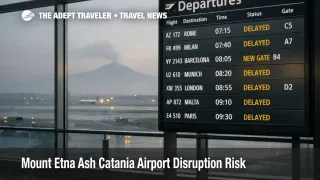
Mount Etna's recent eruptive pulses have triggered volcanic ash advisories that can tighten aviation restrictions over eastern Sicily, raising the disruption risk for flights using Catania Fontanarossa Airport (CTA). Holiday week travelers arriving, departing, or connecting through Catania, and anyone chaining flights into ferries, cruises, or fixed time plans, are most exposed when ash or visibility shifts. If you are traveling in the next few days, build more buffer into every leg, and track official ash bulletins and airline notices before committing to onward plans.
The Mount Etna ash Catania airport risk rose because aviation warning products moved quickly through higher concern levels, meaning operational limits can change within hours and cascade into missed connections and unplanned overnights.
Italy's Civil Protection Department moved Etna from green to yellow alert on December 27, 2025, citing intense and continuing strombolian activity and the potential for rapid evolution. In parallel, the Toulouse Volcanic Ash Advisory Center (VAAC) issued a run of Etna advisories, including a bulletin on December 28, 2025 that carried an aviation color code of red and described a weak ash eruption. By the December 29, 2025 advisory cycle, the VAAC aviation color code was orange, and the VAAC forecast stated no ash was expected, with no further advisories planned unless conditions changed.
For travelers, that sequence is the key signal. Even when an airport remains operational, ash advisories can force air traffic constraints, widen spacing on approaches, or require tactical changes that show up as rolling delays, diversions, and late notice cancellations when aircraft rotations break.
Who Is Affected
Travelers flying into or out of Catania are most directly exposed, especially those scheduled on late afternoon and evening arrivals where there is less recovery room if arrival rates are reduced. The highest personal risk sits with tight connections through mainland hubs, separate ticket itineraries, and anyone who must reach a same day cruise embarkation, a ferry sailing, or a prepaid tour check in.
Secondary exposure spreads across Sicily because disruption rarely stays pinned to one airport. When arrivals to Catania are metered, airlines may choose alternates that keep aircraft and crews legal and positionable, commonly including Palermo Falcone Borsellino Airport (PMO) and Comiso Airport (CIY), depending on weather, gate availability, and airline handling contracts. That shift can strand travelers far from their intended arrival point, and it can also compress hotel inventory and ground transport supply in whichever city becomes the diversion catch basin.
The ripples extend beyond aviation. When a wave of passengers land late or land elsewhere, airport rental car desks run out of the vehicle classes people actually booked, private transfers miss their pickup windows, and intercity rail and coach demand spikes as travelers self rescue across the island. If you are chaining modes, the stress point is not the initial delay, it is the last connection of the day, whether that is a ferry departure, a cruise boarding cutoff, or the final practical train or bus to your destination.
What Travelers Should Do
Start by protecting the next 12 hours of your itinerary, not just the flight. Check your airline app for aircraft tail changes, review the airport's flight status before you leave for the terminal, and shift to carry on only if you can, because diversions and baggage misroutes are much harder to fix when you land at an alternate airport. If you have a transfer, message the provider now with a contingency plan that covers a late arrival and a diversion to Palermo or Comiso.
Use a decision threshold instead of waiting for the day of travel to collapse. If you are holding a same day cruise embarkation, a paid event, or a once daily onward connection, treat any material delay risk as a reason to rebook earlier, or to add a buffer night near Catania or your embarkation port. If your trip is flexible, waiting can be rational, but only if you have slack, and only if you are on a single ticket that keeps reaccommodation obligations clear.
Over the next 24 to 72 hours, monitor three inputs that actually move outcomes, the VAAC advisories, the INGV VONA notices, and your airline's operational messaging. When advisories stop and then restart, that is often a sign of pulsing activity rather than a clean end, and it is when travelers get caught by surprise. If the situation tightens again, expect the first visible symptoms to be longer taxi times, wider arrival spacing, and diversions that push the whole day's schedule later.
How It Works
Volcanic ash is treated as an aviation hazard because fine particles can damage engines, pit windscreens, and contaminate sensors, so airlines and air navigation services tend to avoid any forecast ash polygon rather than gamble on threading through thin layers. Two public products matter most for travelers following Etna, the INGV Osservatorio Etneo VONA notices, and the Toulouse VAAC advisories that translate observations and modeling into flight level guidance.
The VONA is a volcano observatory notice for aviation that summarizes activity and includes a color code. For example, INGV issued an orange coded VONA on December 26, 2025 and reported strombolian activity with light ash fallout reported from Linguaglossa and Taormina. The VAAC advisories then incorporate VONA inputs, satellite imagery, and webcams, and they publish time boxed guidance about observed and forecast ash, including aviation color code and expected flight levels, which is why those bulletins can swing rapidly as winds shift and ash production rises or falls.
At the airport level, the practical effect is rarely a single dramatic shutdown. More often, ash and visibility concerns reduce the number of arrivals per hour, trigger temporary constraints in specific approach corridors, or force runway cleaning and inspections that quietly eat capacity. That first order effect then propagates through the system. Aircraft arrive late and miss their next rotation, crews time out and require replacement, and the irregular operations day bleeds into the next morning's schedule, which is when "it cleared" still feels like chaos to travelers.
These dynamics mirror other ash events where advisories, not local weather, are the binding constraint on safe routings, including Ethiopia Volcano Ash Cancels Gulf Flights, Hubs Risk and the contrasting case where a low ash eruption kept airports running in Iceland Eruption Travel: Flights and Roads Still Running. Sicily sits closer to the source, so even low altitude ash near the volcano can matter for approaches, and travelers should assume that risk is episodic, not linear, until official bulletins stabilize for multiple cycles.
Sources
- Civil Protection Department: Allerta Gialla Per Il Vulcano Etna (Press Release, December 27, 2025)
- INGV Osservatorio Etneo VONA Etna Issued 20251226/0956Z (Notice 2025/0116/12N02)
- VAAC Toulouse Advisory ETNA.87 (DTG 20251228/0758Z, Aviation Colour Code RED)
- VAAC Toulouse Advisory ETNA.98 (DTG 20251229/2010Z, Aviation Colour Code ORANGE)
- ANSA: Etna Activity Update, Airport Operational (Published December 28, 2025)