

Thailand Cambodia Border Conflict Travel Zones
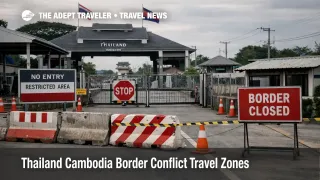
Official travel guidance tightened again for the Thailand Cambodia border region as governments keep, or expand, no travel buffers near the frontier and warn that the security situation can change quickly even when ceasefire announcements are in place. The travelers most affected are anyone planning to cross by land, anyone booking border corridor road transfers, and anyone taking tours to temple areas near disputed zones. The practical next step is to keep itineraries away from the border belt, treat land crossings as unavailable, and plan alternate gateways and buffer nights so a single closure does not collapse the rest of the trip.
The Thailand Cambodia border conflict travel update matters because the buffer distances are large enough to catch popular overland loops and some rural excursion routes, not just the border line itself. Multiple governments now advise against travel within 50 kilometers of the border, and some add wider "essential only" buffers in specific Cambodian provinces, which can change where tour operators will run and what travel insurance will treat as a covered cancellation versus a voluntary change.
Who Is Affected
Travelers attempting classic overland routings between eastern Thailand and northwestern Cambodia are the most exposed, because official sources continue to say land border crossings remain closed. That includes bus and minivan bookings, self drive plans, and rail linked itineraries that depend on crossing in a specific time window.
Travelers going to Siem Reap, Cambodia, for Angkor focused trips can still have workable plans, but the routing matters. Advisories that apply to parts of Siem Reap province, Cambodia, are framed around distance from the border, so the risk is concentrated in frontier corridors and remote side trips, not necessarily the city stay itself. Canada's guidance also highlights Cambodia's long running landmine risk in rural areas, while noting that Siem Reap town and the Angkor temples are considered clear by Cambodia's government. That split is exactly why travelers should avoid improvising rural drives or last minute "back way" transfers when border tensions rise.
Travelers staying on Thailand's main tourist circuits, such as Bangkok, Thailand, and the major southern resort areas, are generally outside the immediate border belt, but travelers heading to eastern provinces near Cambodia, or planning island trips that rely on mainland transfers through those provinces, should read the fine print. The UK, for example, applies a 50 km no travel band along the whole border while carving out different thresholds for specific islands, which can still affect operator decisions and insurance eligibility.
What Travelers Should Do
Lock in a border free routing now rather than hoping crossings reopen on your travel day. If any segment of your plan depends on crossing Thailand to Cambodia, or on road transfers that approach the frontier, treat that as an immediate rebook trigger and switch to flights, or separate the trip into two country visits with a buffer night in Bangkok, Thailand, Phnom Penh, Cambodia, or Siem Reap, Cambodia.
Use decision thresholds that are based on what you can control. If your hotel, tour, or transfer provider will not confirm that your route stays outside advisory zones, or if you are on separate tickets where a missed connection would be self pay, it is usually smarter to move the trip earlier inland, or to rebook to air, rather than wait for day of clarity. If you are already in country, avoid night road moves near the eastern Thai provinces or northwestern Cambodian corridors, and follow local authority instructions if controls tighten.
Over the next 24 to 72 hours, monitor three things and act quickly when they move. Watch for advisory updates that change the distance buffers, watch for any announcement about reopening, or extending, border crossing closures, and watch for flight schedule changes and seat availability into Siem Reap Angkor International Airport (SAI) and Phnom Penh International Airport (PNH), which are the most practical alternatives when overland routes are disrupted. If demand spikes, rebooking options can narrow fast, especially around holiday periods and weekend peaks.
Background
Border conflict guidance propagates through travel logistics in predictable ways. First, authorities restrict access in frontier districts, which closes crossings and makes road corridors unreliable. Second, travelers and tour operators shift demand away from land routes toward air gateways and inland highways, which tightens flight inventory and pushes more travelers into a smaller set of hotel markets for buffer nights. Third, cancellations and reroutes cascade into tours and transport, especially when excursions are built around border adjacent landmarks, or when providers cannot operate within a government advisory zone without voiding duty of care or insurance.
Ceasefire announcements can reduce immediate risk, but they do not automatically reopen crossings, de mine routes, or restore normal tour operations. Reuters reported that clashes continued even as officials discussed resuming, or reinforcing, ceasefire terms, and the Guardian reported a new "immediate" ceasefire agreement taking effect December 27, 2025, while also noting reports of strikes around the same period. In practical travel terms, the planning posture remains the same until multiple governments relax the buffer zones and official border status changes from closed to open with consistent operations.
For additional context from earlier phases of this disruption, see Thailand Cambodia Border Clashes Disrupt Travel Plans and Thailand Cambodia Border Clashes: 50 km Avoid Zone.
Sources
- Cambodia Travel Advice & Safety, Smartraveller
- Thailand Travel Advice & Safety, Smartraveller
- Cambodia Travel Advice, GOV.UK
- Thailand Travel Advice, GOV.UK
- Thailand International Travel Information, U.S. Department of State
- Travel Advice and Advisories for Cambodia, Government of Canada
- Thai and Cambodia Militaries Hold Talks on Resuming Ceasefire, Reuters
- Thailand and Cambodia Agree 'Immediate' Ceasefire After Weeks of Deadly Border Clashes, The Guardian