

Cyclone Hayley, Queensland Floods Disrupt Australia Travel
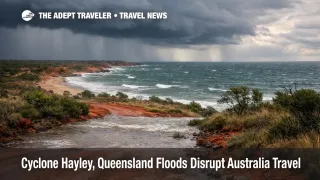
Tropical weather is disrupting travel across two far apart parts of Australia, with Ex Tropical Cyclone Hayley weakening inland over Western Australia's Kimberley while a persistent rain and flood setup keeps parts of Queensland on alert. Travelers are most exposed on regional routes and remote self drive corridors where a single closure or missed flight can remove the only same day backup. The practical move now is to treat airport transfers and long road legs as unreliable, lock in flexible lodging, and track official warnings and road status feeds before you commit to departures.
Cyclone Hayley Australia travel disruption is less about one headline landfall moment, and more about the slow recovery window where heavy rain, debris, and marine conditions keep transport brittle across low frequency networks.
In Western Australia, the Bureau of Meteorology warned Hayley would bring destructive winds and heavy rainfall to the north west Kimberley, including gale force winds from north of Broome to Cockatoo Island and peak gust risk around the northern Dampier Peninsula. The cyclone then weakened into a tropical low as it moved inland, but heavy rain and flash flooding risk remained part of the hazard set as it tracked through the Kimberley. Coastal waters forecasts for the West Kimberley also flagged that Ex Tropical Cyclone Hayley was continuing to weaken while a trough over the Kimberley would persist into Friday, January 2, 2026, a signal that showers, squalls, and rougher local marine conditions can linger even after the cyclone rating drops.
In Queensland, the Bureau of Meteorology said ongoing rain over already saturated areas would continue through December 31, 2025, and into the first couple of days of January, with warnings spanning parts of the Central West and North West, plus a separate warning zone from just south of Cairns down to around Townsville. The Bureau also described major flood warning conditions on the Flinders River, surrounded by moderate flood warnings on other rivers including the Norman, Cloncurry, Georgina, and Western rivers, with minor flood warnings along the tropical coast. The same update emphasized that the broader low and trough pattern was not expected to move far before the weekend, which is why road cutoffs, isolation risk, and schedule volatility can persist even if hourly rainfall rates ease.
Who Is Affected
Travelers in the Kimberley who are flying through Broome International Airport (BME) or relying on long overland transfers should plan for uneven recovery, including debris related hazards, temporary road restrictions, and weather driven schedule changes that are hard to predict more than a day ahead. A clear example is the Broome Cape Leveque Road, which authorities reported closed during the cyclone impacts, the kind of single corridor failure that can strand resort stays and touring routes on the Dampier Peninsula.
In Queensland, the most acute itinerary risk is in the Central West and North West where road closures are widespread and long lived, and where the alternate route is often hundreds of miles away, if it exists at all. Queensland's Transport and Main Roads district status reports listed multiple closures on major corridors, including segments of the Flinders Highway between Richmond and Julia Creek, the Gulf Developmental Road between Normanton and Croydon, and sections of the Landsborough Highway, among many others. If your plan depends on driving between towns like Winton, Boulia, Cloncurry, Julia Creek, Normanton, Croydon, or Karumba, assume that route plans can fail at short notice and that detours may not be possible the same day.
Coastal north Queensland travelers, including those connecting via Cairns International Airport (CNS) or Townsville Airport (TSV), face a different failure mode, short intense rain bursts that close local roads, suspend some water based activities, and push flight and tour operators into conservative cancellations. Inland flyers using Mount Isa Airport (ISA) can also be affected when access roads flood, when crews and aircraft rotate irregularly, or when diversions cascade across the network.
What Travelers Should Do
Start by widening every buffer that touches a deadline. For flights, aim to arrive in gateway towns earlier than planned, and consider booking an extra refundable night if you have a hard must travel date. For drives, treat any long leg in the Kimberley or Queensland outback as conditional on same day road status, and do not commit to non refundable lodging on the far side of a flood prone crossing unless there is a credible alternate route that remains open.
Your decision threshold should be simple. If your itinerary relies on a single road corridor that is already listed as closed, or on a low frequency regional flight where missing one service effectively means losing a day, rebook proactively. If you are inside the warning area but still have multiple transport options, for example, you can shift to a different airport, shorten the drive, or swap a remote lodge night for a larger center, it can be reasonable to wait, but only if your booking terms stay flexible and you have cash or points headroom for an unplanned overnight.
Over the next 24 to 72 hours, monitor three indicators instead of general headlines. First, Bureau of Meteorology warning area updates, because boundary changes often predict which airports and highways get hit next. Second, Queensland Transport and Main Roads district closure lists, because reopening is usually staged and can reverse after new rain. Third, coastal waters forecasts and port status notes in the Kimberley, because small craft limitations can disrupt cruise tenders, fishing charters, island transfers, and any itinerary that assumes a calm sea day.
Background
Australia's remote travel network is fragile by design. Many outback roads have no parallel route, and when water crosses a highway or a developmental road is closed, it is not just a detour problem, it is a supply chain and staffing problem that can shut down fuel access, food deliveries, and accommodation turnover. That first order disruption then ripples into air travel because regional airports depend on predictable road access for passengers, baggage, catering, and staff, and because aircraft and crews rotate through multiple stations each day, so one missed turn can break the schedule for the rest of the network.
Cyclone impacts add another layer. Even after a cyclone is downgraded, cleanup, fallen trees, power interruptions, and residual squalls keep driving conditions hazardous, and marine forecasts can remain unsettled when troughs linger over coastal waters. Ports may reopen in stages as vessels return and inspections clear navigation risks, which matters for expedition style cruising and for local marine tours that need safe launch conditions.
Queensland flooding adds a parallel second order squeeze on lodging and rentals. When roads close, travelers consolidate into the nearest town with open access, pushing up last minute room prices and tightening rental car availability, especially when one way returns fail and fleets become stranded on the wrong side of closures. Those effects can persist after rain weakens, because reopening timelines depend on floodwater drainage and road surface repairs, not just the next forecast.
Sources
- Severe weather update: Severe TC Hayley to impact the Kimberley coast | The Bureau of Meteorology
- West Kimberley Coastal Waters Forecast: Kuri Bay to Wallal
- Tropical Cyclone Hayley downgraded to tropical low after thrashing remote Kimberley coast - ABC News
- Ex-Tropical Cyclone Hayley downgraded to tropical low - ABC News
- Severe weather update: Further heavy rain for central, northern Qld | The Bureau of Meteorology
- data.qldtraffic.qld.gov.au
- data.qldtraffic.qld.gov.au
- Flooding claims a life as deluge cuts north-west Queensland roads, isolates towns - ABC News
- Kimberley ports prepare to re-open after cyclone
- Road and traffic information (Department of Transport and Main Roads)