

Aden Airport Closure Disrupts Yemen Flights
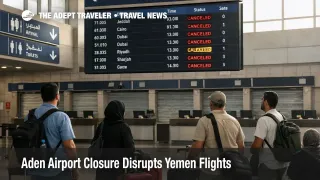
Aden International Airport (ADE) halted air traffic on Thursday, January 1, 2026, as a dispute over new Saudi backed flight restrictions widened a political fracture inside Yemen and triggered immediate operational fallout for airlines. Yemen bound travelers, plus anyone transiting regional gateways, should expect cancellations, missed connections, and uneven rebooking as carriers protect their wider networks first and push lower frequency routes to the back of the recovery queue. The practical next step is to treat every Aden segment as tentative until your airline shows an operating flight number and a confirmed reroute, then rebuild the rest of the trip around that new arrival time.
The Aden airport closure flights disruption is being driven by control over permits and screening rules, not weather. Reuters reported that Yemen's transport minister, aligned with the Southern Transitional Council, ordered a full halt to air traffic rather than implement restrictions the Saudi backed government wanted to impose on flights to and from the United Arab Emirates.
Who Is Affected
Travelers booked into or out of Aden are the direct victims because an airport shutdown usually becomes a hard break in the journey, not a manageable delay. Even when a reservation still shows confirmed, airlines can stop check in at origin when they cannot secure landing permissions, handling support, or a compliant inspection path for the final leg into Aden, Yemen. That can show up as denied boarding, last minute reroutes, or refunds that take time to process, depending on fare rules and local consumer protections.
Transit travelers can also get caught because Aden services tend to sit at the edge of airline networks, and there are fewer daily alternatives when a single flight drops. When a final leg cancels, upstream sectors into Dubai International Airport (DXB) or Zayed International Airport (AUH) can inherit disruption through offloaded bags, misconnected passengers, and rebooking queues that consume the next available seats across multiple destinations. This is the same hub cascade risk described in Saudi UAE Rift Risks Gulf Flight Connections, and an airport shutdown turns that abstract connection risk into a concrete itinerary failure.
Anyone whose itinerary touches the UAE is particularly exposed to stop start rules. Xinhua reported that Saudi Arabia required international flights departing and entering Yemen to undergo security screening at King Abdulaziz International Airport (JED) before continuing, and that while some restrictions were later eased, tighter rules remained for flights traveling to and from the UAE.
What Travelers Should Do
In the next 12 to 24 hours, confirm whether your trip is on one protected ticket or split across separate bookings, and do not begin ground travel toward the airport until your operating flight number shows as running in your airline app. If you are already mid trip, ask the airline to move you to the earliest stable reroute that avoids fragile same day overland timing inside Yemen, and keep lodging cancellable where possible because arrival times can slip by a full day when the first available seats are not on the same carrier.
For decision thresholds, treat any itinerary with a hard same day commitment in Aden as a rebook case rather than a wait and see case. If you must arrive by a fixed time, shift to an earlier departure window, or add an overnight buffer in your last stable hub city, because reopening can be uneven, and the first reopened flights often go out full while systems clear backlogs and revalidate permits.
Over the next 24 to 72 hours, monitor whether the permit and inspection regime is clarified in a way airlines can operationalize, and whether carriers publish travel waivers that make voluntary changes cheaper and faster. Also keep an eye on government travel advisory posture, because high risk advisories can affect insurance coverage interpretations, assistance availability, and what airlines will require for rerouting, refunds, or duty of care processes when security conditions deteriorate.
Background
Aden's airport sits inside a travel system where politics and security protocols can change the operating conditions faster than schedules can be rebuilt. When authorities impose new inspections, permit requirements, or routing constraints, airlines cannot simply fly as planned, they must secure the paperwork and operational clearance that lets them enter airspace, land, and depart on time. If those clearances are withheld, disputed, or changed with little notice, cancellations follow quickly, and passengers are forced into rebooking paths that often route through a limited number of regional gateways with finite seat inventory.
The second order ripples are usually felt outside Yemen because aircraft and crews do not remain neatly parked at the disruption point. When an airport shuts, inbound aircraft may divert or hold at alternates, crews can time out, and the next day's departures in the wider network can degrade as airlines reposition equipment to protect higher demand routes first. That pushes more travelers into the same hubs at the same time, which raises hotel demand in transit cities, increases missed last mile connections, and increases the odds that baggage and passengers will travel on different itineraries.
This is also a high stakes planning environment for traveler support. The U.S. Department of State lists Yemen as Level 4, Do Not Travel, and the UK Foreign, Commonwealth and Development Office advises against all travel, a posture that can shape what travelers can reasonably expect from consular assistance, and what insurers and assistance companies will cover or exclude. When the underlying dispute involves inspections and movement restrictions, reopening can depend as much on political de escalation as on the physical condition of the runway and terminal.
Sources
- Yemen's Aden airport shuts as Saudi-UAE rift deepens, Reuters
- Aden's pro-separatist officials reject Saudi flight restrictions, partially halt airport operations, Xinhua
- UAE vows to pull remaining forces from Yemen in crisis with Saudi Arabia, Reuters
- Yemen Travel Advisory, U.S. Department of State
- Yemen travel advice, UK Foreign, Commonwealth and Development Office
- Saudi-led coalition in Yemen warns UAE-backed separatists of immediate action, AP News