

Netherlands Hotel VAT 21% Raises 2026 Stay Costs
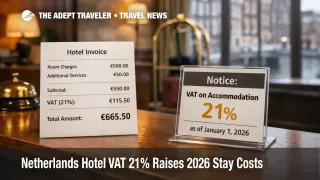
The Netherlands increased VAT on short stay accommodation to 21% starting January 1, 2026, raising the tax portion of hotel bills in Amsterdam, Netherlands, and across the country. The change affects leisure and business travelers with stays in 2026, including guests who booked in 2025 but arrive in 2026, because the higher rate can still apply to the stay period and to advance payments tied to that stay. Travelers should recheck final totals before arrival, watch for updated invoices or itemized tax lines, and set a budget threshold for changing properties or trip length if the new total no longer works.
The Netherlands hotel VAT 21% change raises the lodging tax rate for short stay stays in 2026, and it can change what you owe at check in even when your reservation was created before the rate took effect.
From the tax authority's guidance, the 21% rate applies to short stay lodging supplied by hotels, pensions, and vacation accommodation businesses, and it also applies to common lodging related provisions such as utilities and parking when those are part of the lodging supply. The same guidance flags a key traveler trap, advance payments made in 2025 for lodging that occurs in 2026 or later can still fall under the 21% VAT rate, including certain single purpose vouchers intended for 2026 stays.
Who Is Affected
Travelers with 2026 stays in the Netherlands are the most exposed, especially when a booking confirmation shows a tax line separately, or when the reservation terms allow the property to adjust taxes at the time of stay. This is most likely to show up with prepaid rates that still require a property issued invoice, corporate rates billed on departure, group blocks, long lead conference bookings, and reservations where a deposit was collected in 2025 with the balance due in 2026.
The coverage is broad across the short stay market. Government guidance describes short stay lodging as making a furnished accommodation available for a short period, including hotels, guesthouses, holiday cottages, cabins, and other furnished units, including accommodation rented through platforms. Short stay is framed around the guest not being responsible for maintaining the inventory, and separate guidance defines short period stays as those where guests in practice stay up to six months and do not shift the center of their social life to that address.
Budget travelers and families who are already price sensitive will feel the change more because tax now takes a larger share of the nightly rate. Camping is a meaningful exception in the official guidance, the VAT rate for camping remains 9%, which can widen the gap between campsites and hotels, and increase competition for peak summer and event week inventory.
Travelers who booked an "all in" stay should also expect more invoice complexity. The tax authority notes that when lodging is sold together with separate facilities, such as breakfast or access to amenities, those separate facilities can still be taxed at 9%. That does not mean the total will be lower, but it can produce revised line items that confuse guests comparing an old confirmation to a new invoice.
What Travelers Should Do
Before you travel, pull up your booking confirmation and look for three things, whether taxes are included in the displayed total, whether the property reserves the right to adjust taxes, and whether your deposit is described as fixed or as a percentage of a future total. If anything is unclear, ask the property or your booking channel for a refreshed invoice that shows the final total for your exact stay dates, and keep that confirmation saved offline for check in.
If the updated total is meaningfully higher than expected, make a simple decision rule. If you can cancel or rebook with minimal penalty, compare nearby properties of the same category, and also compare alternative lodging types that may price differently under the new VAT structure, including camping where it fits your trip. If your reservation is nonrefundable or has steep penalties, focus instead on reducing exposure, shorten the stay, switch room types, or move one or more nights to lower demand dates rather than trying to fight the tax change at the front desk.
Over the next 24 to 72 hours, monitor for reissued invoices, updated payment links, or messaging from the property or the platform about tax handling for 2026 stays. If you are traveling as part of a package, confirm whether the tour operator is absorbing the difference or passing it through, and confirm what happens if the hotel component changes after final payment. For trips routing through airport hotels, especially around Amsterdam Airport Schiphol (AMS), assume demand can tighten during peak arrival banks if travelers add buffer nights to protect connections.
How It Works
VAT, value added tax, is applied to goods and services in the Netherlands, and accommodation is treated as a taxable supply. Starting January 1, 2026, the tax authority's published rate for short stay lodging moves to the general 21% level for the lodging component. For travelers, that usually shows up as a higher "tax included" total, or as a larger VAT line on an invoice, depending on how the property and the booking channel present pricing.
The tricky part is timing. The official guidance is explicit that advance payments made in 2025 for lodging that takes place in 2026 or later are still subject to the 21% VAT rate, which is why some guests will see a mismatch between an older confirmation and a refreshed invoice. In practice, properties and platforms handle this differently, some will reissue invoices automatically, some will adjust the balance at arrival, and some will show a tax recalculation when you view the reservation in the app. Travelers should treat the final invoice total tied to the stay dates as the source of truth, not an earlier screenshot.
Bundled pricing adds a second layer. When lodging is sold together with separate facilities like breakfast, the tax authority notes that the lodging portion is taxed at 21% while certain separate facilities can be taxed at 9%, and providers may need to split an "all in" price across those components. That split is mostly a back office issue, but it can change the line items travelers see, and it increases the odds of revised invoices.
This VAT step up also interacts with other Netherlands travel cost pressures, particularly in Amsterdam where local policy debates have already centered on overnight stays, supply limits, and lodging taxes. For travelers, stacked costs can push substitution behavior, shorter stays, more day trips, and more nights in secondary areas, which can in turn raise peak train crowding, and shift demand toward airport adjacent inventory. Related coverage, Amsterdam overtourism lawsuit challenges tourist cap, is a reminder that lodging pricing in the Netherlands can reflect multiple policy levers at once. With the Netherlands hotel VAT 21% rate now live, the practical traveler move is to validate totals early, and to build small buffers into arrival day plans so a billing hiccup does not cascade into missed trains, tours, or onward flights.