

Belgium Rail Strike Disrupts Trains Jan 26 to 30
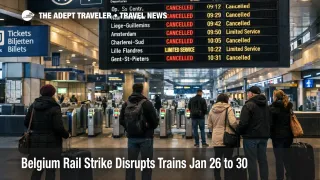
Belgium rail strike plans could materially cut passenger train service across Belgium from Monday, January 26, 2026, through Friday, January 30, 2026, after rail unions signaled a coordinated walkout tied to proposed reforms and funding changes. Travelers who rely on SNCB trains for city hops, station connections, and airport positioning, including visitors moving between Brussels, Belgium, Bruges, Belgium, Ghent, Belgium, and Antwerp, Belgium, are the most exposed. The practical move is to assume the timetable will be thinner and less predictable than usual, then choose between shifting travel days, booking a road backup, or adding an overnight where a missed connection would break the trip.
Unions have framed the action as a week long strike window, with reporting indicating the official strike notice is expected to be filed in the week of January 5, 2026, which is when travelers should start seeing clearer operational guidance from operators. SNCB has indicated that minimum service would apply during strike action, with the actual list of running trains published close to the event rather than far in advance.
Who Is Affected
The first group is travelers who use Belgian trains as the primary way to move between Brussels, Belgium, Bruges, Belgium, Ghent, Belgium, Antwerp, Belgium, and day trip cities, because a reduced timetable turns easy same day flexibility into a sequence that can break after one missed departure. Even when trains run, fewer options can create platform crowding at peak times, longer waits, and late arrivals that cascade into hotel check in windows, timed tours, and dinner reservations.
The second group is flyers who plan to reach Brussels Airport (BRU) by train. The airport's rail station sits directly under the terminal, and the normal plan depends on frequent service and fast access from Brussels stations. During a minimum service strike day, that frequency assumption is the fragile link, and the failure mode is ugly, a traveler can be on time for the city leg, but still miss a flight because the final positioning train never appears.
The third group is cross border travelers whose itineraries depend on Belgian domestic trains to feed an international departure. That includes passengers connecting into Brussels Midi for Eurostar, or using Antwerp as a transfer point for Netherlands bound rail, plus anyone chaining a Belgian train into a same day flight elsewhere in Europe. If your itinerary is on separate tickets, the risk jumps because a missed domestic leg can turn into a full fare re purchase on the international segment. This is also the scenario where prior disruption on the London, United Kingdom, corridor matters, because system stress can stack, and fewer fallback departures can amplify the cost of a single missed connection, especially on Eurostar routes that are already sensitive to rolling schedule changes. Channel Tunnel Disruption Hits Eurostar, LeShuttle Dec 31
What Travelers Should Do
Start with the decision that saves the most money, and stress, if you can move the trip. If your Belgium plans are flexible, shifting long distance travel away from Monday, January 26, 2026, through Friday, January 30, 2026 is the cleanest fix, because it avoids paying peak walk up taxi rates and avoids getting trapped by a minimum service timetable that is only confirmed close to departure. If you cannot move dates, tighten the chain by removing same day dependencies, which usually means adding an overnight in Brussels the night before a critical departure, or switching to a direct flight rather than a rail connection you cannot replace.
If you must travel during the strike window, build buffers that reflect how the system fails. For Brussels Airport (BRU), treat train to airport as optional rather than primary, and pre price a taxi or pre booked car so you have a known fallback if trains are sparse. The airport notes that trains normally run frequently from Brussels stations and that the station is directly under the terminal, which is great when service is normal, but it also means strike day demand will concentrate fast at the same access points. If your flight is long haul, or nonrefundable, an airport hotel night can be cheaper than a last minute road scramble.
Use clear thresholds for rebooking versus waiting on the day. If the published minimum service plan does not show a workable train within your buffer, or if you cannot absorb a two hour slip and still make check in, switch to the road backup immediately rather than hoping a later train appears. For cross border trips, avoid itineraries that require a tight domestic connection into Brussels Midi, and if you must connect, choose an earlier domestic arrival that still works if one train is canceled. Over the next 24 to 72 hours before each travel day in the strike window, monitor the SNCB strike page, the journey planner, and international operator travel update pages, because that is where the real running plan and late changes surface.
How It Works
Belgium's rail strike operations are not a complete black box, but they are also not a normal published timetable problem. SNCB's minimum service approach is built as an alternative transport plan based on how many essential staff declare they will work, and the relevant continuity rules require essential staff to declare their intention at least 72 hours before the strike begins. The practical consequence is that travelers often do not get a reliable, train by train view until close to the day, because the operator cannot finalize the plan until staffing declarations are in.
That uncertainty then propagates through the travel system in layers. The first order impact is fewer trains, longer waits, and less recovery slack inside Belgium, which makes routine station transfers and city hops less reliable. The second order ripple hits other layers, road modes and hotels. When rail capacity collapses, demand shifts into taxis, buses, car rentals, and rideshares, which can tighten road corridors around Brussels and Antwerp and raise transfer prices quickly, and it also pushes stranded travelers into short notice hotel stays near major stations and near Brussels Airport (BRU). The third order ripple is cross border misconnect risk, because international rail pages can show a train as running while the Belgian feeder leg that gets you there is the segment that fails, leaving you to rebook at the worst possible moment.
Sources
- Belgian rail unions announce week-long strike over reforms and funding cuts
- Railway union announces week-long strike in January
- Strikes and union actions | SNCB-NMBS
- Train to and from Brussels Airport | Fast & direct
- By train to Brussels Airport - Zaventem | NMBS
- Traffic disruptions and works | SNCB International
- Service information | Travel information | Eurostar