

DXB Passenger Surge Crowds Dubai Airport January 3 and 4
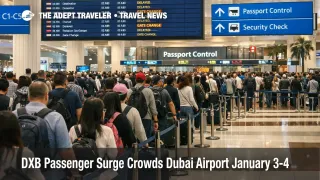
Dubai International Airport (DXB) logged its busiest days on record, with Dubai Airports reporting more than 324,000 guests passing through in a 24 hour period on January 3, 2026. The volume stayed near that ceiling on January 4, 2026, at more than 322,000, turning the first week of January into a practical stress test for arrivals, departures, and connections. If you are flying through Dubai this week, plan for longer queues and slower terminal movement, and build buffer into curbside timing, security, immigration, and onward connections.
DXB Record Passenger Crowds matter because this peak is not a one off spike, Dubai Airports said it expects about 3.4 million guests between January 1 and January 11, 2026, with daily volumes consistently above 300,000.
Who Is Affected
Travelers most exposed are connecting passengers using DXB as a hub, especially those with short protected connections that depend on fast terminal transfers, re screening, and punctual gate boarding. When a hub runs this full, small frictions add up, late arriving widebodies flood transfer corridors, security queues lengthen, boarding lines back into concourses, and the airport's ability to absorb irregular operations shrinks.
Origin and destination passengers are also at risk, particularly for early morning and late evening departures when curbside traffic, bag drop lines, and outbound immigration can become the real constraint. Gulf News reported that Emirates flagged high outbound volumes in the same January 1 to 11 period and advised passengers to arrive at least four hours before departure, and to use remote check in options where available to avoid queues.
Airlines and travel sellers should expect knock on effects beyond the terminal. Heavy banks increase the chance that delayed baggage delivery, crowded rideshare pickup areas, and slower ground transport availability push travelers into missed hotel check in windows, paid transfer no shows, and rebooked excursions, even if flights themselves operate normally.
What Travelers Should Do
Take immediate actions that buy time where the system fails first. If you are departing DXB, treat curbside and bag drop as the highest variance steps, arrive earlier than your normal routine, complete online check in when eligible, and minimize checked bags if you have a tight onward plan. If you are connecting, choose the more conservative connection path, and assume that transfer security and gate walks can be materially slower at peak density.
Use clear decision thresholds for rebooking versus waiting. If your connection drops under 60 minutes after delays post, or you are on the last realistic flight bank to your destination, rebook early while inventory still exists, even if it means a longer layover. Waiting is rational only when you have multiple later protected options on the same ticket and you can absorb a same day slip without buying a new hotel night or losing a time sensitive booking.
Monitor the right signals over the next 24 to 72 hours. Watch your airline's app for gate changes and minimum connection time warnings, monitor airport travel alerts for sustained daily volume above 300,000, and keep an eye on local road congestion patterns if you have a fixed pickup or drop off time. This week's peak is forecast to persist through January 11, 2026, so plan as if tomorrow is also a high volume day, not a recovery day.
How It Works
Hub airports like DXB run on timed arrival and departure banks. When a bank hits, thousands of passengers move through the same pinch points at once, including arrival immigration for origin passengers, transfer security for connecting passengers, outbound passport control for departures, and the gate areas that must board multiple widebody flights in parallel. In a record crowding scenario, the system does not need a major disruption to feel disrupted, minor delays, extra screening, gate changes, and late inbound aircraft are enough to create visible congestion.
Disruption then propagates through the travel system in layers. First order effects are inside the airport, queues grow, walking speeds fall, gate areas saturate, and missed boarding increases for the tightest itineraries. Second order ripples hit airline networks, when even small delays in a hub bank push crews and aircraft out of sequence, tightening later banks and reducing reaccommodation options. A third layer lands off airport, where ground transport and nearby hotels absorb overflow demand from misconnects and schedule slips, raising prices and shrinking availability.
DXB's record days also sit inside a longer capacity story. Reuters reported DXB handled a record 92 million passengers in 2024, and Dubai is expanding Al Maktoum International Airport (DWC) with plans to shift operations there in the future as demand grows. That macro capacity pressure is why traveler friendly planning, larger buffers, and earlier rebooking decisions are becoming normal at global hubs, not exceptional. For a practical planning mindset on how fast inventory can collapse when networks get tight, see FAA Delays on Boeing 737 MAX 10 Hit Airline Capacity and Flight Delays and Airport Impacts: January 2, 2026.