

Greece Air Traffic Radio Failure Delays Flights Nationwide
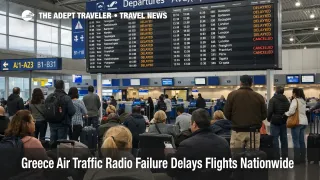
A failure affecting air traffic radio frequencies in Greek airspace disrupted flight operations nationwide on Sunday, January 4, 2026, including impacts tied to Athens Approach serving Athens International Airport Eleftherios Venizelos (ATH). Travelers flying to, from, or over Greece, plus anyone connecting onward to island flights, faced grounded departures, uneven arrival flows, and difficult reaccommodation as capacity was sharply restricted for hours. If you are traveling today, treat every connection as fragile, check your airline's day of travel messages, and be ready to shift to a later departure bank or reroute via a nearby gateway if your schedule cannot absorb a long hold.
The Greece Air Traffic Radio Failure reduced how many flights could be safely managed per hour, which is why the recovery is expected to be incremental rather than instant, even after limited service resumes.
Who Is Affected
Passengers with same day connections through Athens are the most exposed, because a disruption that limits airspace communications can break the tightly timed arrival and departure banks that feed domestic and regional flights. That matters most for travelers continuing to Greek islands on separate tickets, and for anyone scheduled on one of the last flights of the day to a smaller destination where there may be no later option.
Travelers booked on Greece's main domestic carriers should anticipate schedule changes, not just delays, because airlines indicated reduced capacity was driving both delays and cancellations to and from Greek airports. If you are flying Aegean Airlines or Sky Express, rely on the contact details in your booking and app notifications, because those channels are where carrier specific rebooking paths and protected connections typically appear first.
Island travelers are also indirectly affected even when their inbound flight is not canceled, because late arrivals can cascade into missed ferries, shortened hotel nights, and lost tour start times. This is most acute in winter schedules, when there are fewer daily frequencies and fewer spare seats to absorb a backlog.
What Travelers Should Do
Start by securing information, not standing in line. Confirm your flight status in your airline app, turn on notifications, and screenshot any cancellation or delay notices for insurance or employer documentation. If you are still at your origin airport, consider delaying your arrival to the terminal if your flight is not yet assigned a realistic departure time, because a capacity constrained recovery often produces long gate holds.
Use a simple threshold for rebooking versus waiting. If you have an international to domestic connection in Greece under about three hours, or you are on separate tickets into an island flight, a same day misconnect is plausible, and rerouting via a later nonstop, or via another nearby hub with a longer buffer, is usually safer than hoping the connection holds. If your trip hinges on a fixed start time, for example a ferry sailing, a tour departure, or a ship boarding window, treat any multi hour delay as a trigger to move the whole itinerary forward with an extra hotel night or to shift to the next day.
Over the next 24 to 72 hours, watch three signals: the effective hourly throughput being handled, the pattern of cancellations versus pure delays, and whether airlines publish flexible rebooking options. Capacity limits that remain stuck at reduced rates tend to prolong the backlog into the next operating day, because aircraft and crew rotations cannot simply snap back to plan.
How It Works
Air traffic control, ATC, depends on reliable communications between controllers and pilots, plus supporting systems that coordinate the flow of aircraft through a Flight Information Region, FIR. When radio frequencies serving key control centers are disrupted, controllers may pause departures, restrict arrivals, and reduce the number of aircraft handled per hour to protect separation standards. In this event, reporting citing the Hellenic Civil Aviation Authority described widespread interference affecting Athens FIR frequencies and a reduction in traffic flow, with later updates indicating limited hourly throughput as the system moved into a managed recovery.
The travel system ripple is what makes these outages linger. First order effects are grounded departures, arrival holding, diversions, and missed slots at the source airports. Second order effects show up quickly across Europe as aircraft and crews end up out of position, which can cancel later flights that were not originally near Greece at all, especially when airlines have thin winter spare capacity. Third order effects hit the trip on the ground, because late arrivals compress hotel check in, move rental car pickup windows, and can cause missed ferry or tour departures that were timed off the original flight schedule.
For broader context on how constraints inside air traffic systems can propagate into passenger delays and airline recovery decisions, see U.S. Air Traffic Control Privatization: Reality Check and the rebooking tactics in Flight Delays and Airport Impacts: January 2, 2026.
Sources
- Some Greek flights resume after air traffic radio failure | Reuters
- Flights disrupted by technical issue at Athens FIR | eKathimerini.com
- The technical problem at the Athens FIR is being gradually restored - announcements by Aegean and Sky Express | Tornos News
- "Μαζική παρεμβολή στις συχνότητες" - Οι εξηγήσεις της ΥΠΑ για το μπλακ άουτ στα αεροδρόμια - Πυρά από την αντιπολίτευση | Rthess