

Venezuela Airspace Curbs Disrupt Caribbean Flights
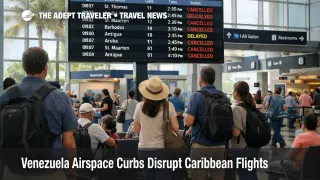
U.S. airlines began resuming service to parts of the Caribbean after emergency FAA airspace curbs tied to reported U.S. military activity in Venezuela triggered a broad wave of cancellations across multiple island gateways. Travelers booked on Eastern Caribbean routes, especially those using connections through major hubs, absorbed the immediate shock of canceled departures, missed onward flights, and last minute hotel and transfer changes. For most travelers, the next step is to treat January 4, 2026 as a recovery day, confirm that a specific flight is operating before leaving for the airport, then use airline waivers to shift to the next workable bank or a different routing.
The Venezuela airspace curbs Caribbean flights disruption ended when the restrictions expired at 12:00 a.m. ET on January 4, 2026, but the operational hangover did not end at the same moment. The hardest part is not flipping flights back on, it is rebuilding a network where aircraft, crews, and available seats no longer match the published schedule after a full day of cancellations. American said it was resuming scheduled Eastern Caribbean flying on January 4, 2026, and also added extra capacity, including nearly 5,000 additional seats, plus larger aircraft where possible. Delta also said it was resuming Caribbean flying, while warning that additional schedule adjustments were possible as resources were repositioned, and it urged customers not to show up to impacted airports without a confirmed or rebooked ticket. Reuters reported that JetBlue alone canceled 215 flights during the disruption, which is the kind of single carrier volume that can take several days to fully unwind across island stations with limited spare lift.
Who Is Affected
Travelers headed to, from, or through the Eastern Caribbean are the core affected group, particularly on routes involving Luis Muñoz Marín International Airport (SJU), Cyril E. King Airport (STT), and Henry E. Rohlsen Airport (STX), plus leisure heavy gateways such as Queen Beatrix International Airport (AUA), Grantley Adams International Airport (BGI), Curaçao International Airport (CUR), V. C. Bird International Airport (ANU), Princess Juliana International Airport (SXM), and Hewanorra International Airport (UVF). American's travel alert list also included smaller markets and onward points, which matters because thin schedules mean one cancellation can erase same day alternatives.
Connecting passengers are disproportionately exposed because a single broken link forces a full itinerary rebuild. If a traveler was relying on a same day connection through San Juan, Miami International Airport (MIA), or another hub to reach an island with limited frequency, even a short recovery delay can cascade into an overnight. That cascade spreads beyond the airport. When arrivals bunch into fewer flights during recovery, hotels near hubs and in destination markets can see sudden compression, rental car inventory can tighten, and prepaid experiences can become sunk costs unless they are moved.
Cruise travelers face a specific timing problem. A cancelled or late inbound flight can turn a planned pre night into an unplanned additional night, or it can eliminate the buffer entirely if the only remaining routing lands close to embarkation cutoffs. AP reported that the aviation disruption also reached cruise operations, which is consistent with what happens when air arrivals into cruise homeports or nearby feeder airports get interrupted in peak season.
What Travelers Should Do
First, verify that your specific flight is operating before heading to the airport, and do not assume a general resumption means your route is clean. Recovery days can still include rolling cancellations, aircraft swaps, and long gaps between rebooking options, especially at smaller islands with limited gate space and overnight parking. If you are traveling on a carrier that published a waiver for the Eastern Caribbean airspace closure, use it early, because the best alternates disappear fast once rebooking queues surge.
Second, use clear decision thresholds for rerouting versus waiting. If you have a cruise embarkation, a wedding, a non refundable tour start, or a last flight of the day connection, treat any itinerary that arrives after mid afternoon as fragile on January 4 and January 5, 2026, and move to an earlier bank or a different gateway while seats still exist. AP reported that destinations farther west, including parts of the Dominican Republic and Jamaica, were less affected, so if your airline can legally and practically reroute you through a less exposed corridor, that can be a better option than waiting on a single constrained island flight. If your trip is discretionary and you are on one ticket with multiple later protected options, waiting can make sense, but only if you can absorb an overnight without paying peak pricing near the airport.
Third, monitor the signals that usually predict whether recovery is stabilizing over the next 24 to 72 hours. Watch for airlines adding extra sections, upsizing aircraft, and publishing updated waiver eligibility windows, because those moves often indicate they are actively rebuilding capacity rather than just restarting the baseline schedule. Also watch whether the main Caribbean hubs, especially San Juan, show steady on time departures through the midday and afternoon banks, because once those banks run clean, misconnect rates tend to fall quickly. If cancellation strings continue into January 6, 2026, plan for a longer tail, and consider moving travel to later in the week to let aircraft and crews fully reset.
For broader pattern awareness on how disruptions cascade into missed connections and overnight costs, travelers can also compare this event to standard network stress mechanics in Flight Delays and Airport Impacts: January 2, 2026 and the system level context in U.S. Air Traffic Control Privatization: Reality Check.
How It Works
An FAA airspace restriction is an operational safety action that can prohibit or limit U.S. civil aviation operations in defined airspace when the risk picture changes, for example during active military activity. When the restriction is broad enough, airlines often have no choice but to cancel flights into airports that would require operating through the restricted region, even if the destination airport itself is open and the local weather is fine.
The first order effects show up immediately as cancellations, diversions, and holding patterns that strand passengers at origin airports, at Caribbean hubs, and at intermediate connection points. The second order ripples arrive during the restart. Aircraft that were supposed to overnight on an island are now elsewhere, crews hit duty limits, and the next morning's schedule launches short of both planes and staff in the right places. That is why a restriction that ends at 12:00 a.m. ET can still produce uneven schedules on the following day, and why full normalization often takes several days, not several hours. A third layer hits the ground system, where terminal space, hotel inventory, airport curb access, and cruise transfer plans all get stressed when large numbers of travelers try to rebook onto fewer available seats at the same time.
Sources
- American resumes Eastern Caribbean flying: Adds nearly 5,000 additional seats and the airline's largest aircraft to the region
- Travel alerts, FAA airspace closure, Eastern Caribbean
- Caribbean Airspace Closure, Delta advisory
- Delta issues customer advisory, resumes Caribbean service
- Travel Advisories and Alerts, Caribbean Airspace Closure
- United travel waiver, Caribbean Airspace Closure
- US lifts Caribbean airspace curbs after attack on Venezuela
- US military operation in Venezuela disrupts Caribbean holiday travel, hundreds of flights canceled