

Measles Exposure Sydney Airport T3 Arrivals Dec 29
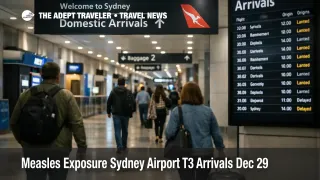
NSW Health issued a measles exposure alert linked to Sydney Kingsford Smith Airport (SYD), after a confirmed case moved through the domestic arrivals environment used by Qantas in Terminal 3 late on December 29, 2025. The notice matters most for travelers who were in the Terminal 3 Domestic Arrivals Hall between 1030 p.m. and 1100 p.m. local time, and for anyone who was on Qantas flight QF748 from Adelaide Airport (ADL) to Sydney that evening. If you may have been in either exposure setting, the practical next step is to confirm your measles vaccination status, monitor for symptoms through mid January, and be ready to adjust near term travel if you become unwell.
The Sydney Airport Terminal 3 measles exposure changes plans because the risk management burden shifts to travelers after the fact. NSW Health states the listed locations do not pose an ongoing risk, which means the terminal is not being treated as a continuing hazard for today's passengers. The operational consequence is not airport capacity, it is personal itinerary stability, especially for families, for travelers about to join cruises or tours with health screening, and for anyone returning home to vulnerable relatives.
Who Is Affected
The most directly affected group is narrow and time bound, passengers on Qantas flight QF748 arriving in Sydney at about 1030 p.m., and people who were in the Sydney Airport Domestic Arrivals Hall at Terminal 3 from 1030 p.m. to 11:00 p.m. on December 29, 2025. NSW Health advises anyone who may have been exposed to watch for measles symptoms until January 16, 2026, reflecting the incubation window it cites of up to 18 days after exposure.
Risk is not evenly distributed. If you are unvaccinated, are unsure of your vaccination history, are traveling with an infant who is not fully vaccinated, or you have close contact with someone who is immunocompromised, the threshold for seeking medical advice should be lower, because the downstream impact of a preventable infection is higher for those groups. NSW Health explicitly frames this as a vaccination status check, and notes that anyone born after 1965 should ensure they have had two doses of measles vaccine, and that additional doses are safe if you are unsure.
The second order travel ripple is usually felt away from the airport. Exposed travelers who develop symptoms mid trip may need same day clinical assessment, may be advised to isolate, and may have to abandon onward connections or pre booked activities, which then drives hotel extensions, rebooking costs, and disrupted cruise or tour join ups. At the system level, public health alerts also push short term demand toward pharmacies, GP appointments, and telehealth lines as travelers seek post exposure guidance, which can slow access if you wait until the last minute to act.
What Travelers Should Do
If you were on QF748 or you were in the Terminal 3 domestic arrivals hall during the exposure window, check your vaccination status now, and set a personal monitoring window through January 16, 2026. If symptoms develop, NSW Health's most important operational advice is to call ahead before you go to a GP, urgent care, or an emergency department, so you do not spend time in waiting rooms and risk exposing others.
For near term travel plans, a simple decision threshold helps. If you develop fever, worsening respiratory symptoms, or any rash pattern that looks consistent with measles, treat that as a stop signal, pause onward travel, and seek medical guidance before you board flights, long distance rail, or join group tours or cruises. If you remain well, keep plans but build buffer time and flexibility into the next one to two weeks, because a same day clinic visit can break tight connections and prepaid transfers.
Over the next 24 to 72 hours, monitor official updates for any expansion of exposure locations, and keep your travel contacts informed if you are in a shared itinerary group. If you are unsure whether you received two measles vaccine doses, NSW Health notes MMR vaccine availability through GPs, and through pharmacies for people over 5 years of age, which can be useful for future travel protection even if it does not change this specific past exposure.
How It Works
Measles is an airborne, highly contagious viral illness, and public health agencies treat airports as high leverage exposure sites because one infectious traveler can share enclosed airspace with many unrelated households in a short time. NSW Health lists typical early symptoms as fever, sore eyes, runny nose, and cough, followed several days later by a red blotchy rash, and it warns symptoms can take up to 18 days after exposure to appear. Australia's national disease guidance similarly describes symptom onset commonly within about one to three weeks after infection, and emphasizes that measles can persist in the airspace of enclosed areas for a period even after an infectious person has left.
Post exposure prevention is time sensitive. For people without confirmed immunity, measles vaccine can sometimes provide protection or reduce severity if given within 72 hours of exposure, and immunoglobulin can be considered within six days for certain higher risk contacts, which is why health agencies push exposed travelers to seek advice promptly rather than waiting for symptoms. Because this Sydney Airport Terminal 3 measles exposure window occurred on December 29, 2025, most readers will be beyond those post exposure windows by the time they see the alert, but the monitoring and call ahead guidance still matters through mid January.
In travel terms, the disruption propagates through traveler behavior and screening rather than through flight schedules. First order effects are individual, deciding whether to proceed with onward travel, whether to visit vulnerable relatives, and whether to attend events or embarkations that may include health checks. Second order effects show up as rebooking and lodging friction if illness develops away from home, plus increased demand on local medical access points in Sydney and in any onward destination where exposed travelers seek care or advice.