

US ATC Radar Upgrade Contracts Awarded to RTX, Indra
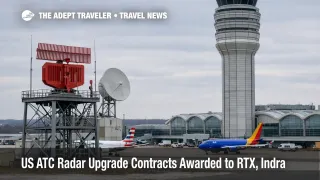
The U.S. Department of Transportation and the Federal Aviation Administration said they awarded new radar contracts to RTX and Indra Sistemas to replace aging surveillance radars that underpin air traffic control (ATC) across the United States. Any traveler flying within U.S. airspace can be affected because radar reliability and coverage shape how efficiently aircraft can be spaced, sequenced, and rerouted when weather or congestion hits. Travelers should treat this as a phased, multi year infrastructure rollout, not an overnight fix, and keep normal delay buffers in place while watching for localized cutovers through 2028.
The FAA says the contracts support replacing up to 612 radars by June 2028, starting with deployments that prioritize high traffic areas. The same package also calls for installing surface radars at 44 airports, purchasing 27,625 radios, and adding 110 weather stations in Alaska, a region where weather and distance can turn minor disruptions into major schedule breaks.
Officials did not disclose contract values in the initial announcements. Reuters reported the awards sit inside a $12.5 billion overhaul plan that Congress approved last year, and that FAA leadership has said more funding is needed to complete the broader modernization of telecom, surveillance, and supporting infrastructure.
Who Is Affected
Any itinerary that depends on tight scheduling at peak periods is the most exposed, especially travel through large hub banks where small spacing changes amplify into missed connections. When radar, communications links, or controller tools are constrained, the system often responds by reducing arrival rates, increasing in trail spacing, or issuing flow programs that delay departures before they even push back, and that pattern tends to ripple from one metro area into connecting banks nationwide.
Travelers flying through Newark Liberty International Airport (EWR) and other capacity sensitive airports have already seen how equipment or ATC constraints can translate into widespread delays and cancellations, and officials have explicitly pointed to modernizing legacy systems to reduce those failure modes over time. Even if you never fly to Alaska, modernization steps there matter because aircraft, crews, cargo, and maintenance rotations connect Alaska schedules to West Coast hubs, and disruptions can cascade into missed aircraft turns and downstream delays.
Airlines, cargo operators, and general aviation will also be affected operationally. For travelers, the practical effect is that schedule reliability gains will arrive gradually, while short, localized risk windows can appear when a facility transitions equipment, tests integrations, or temporarily runs parallel systems during commissioning.
What Travelers Should Do
For trips booked in 2026, plan as if today's delay patterns still apply, especially in winter and during thunderstorm seasons. Favor earlier departures, avoid last flight of the day when you cannot absorb a cancellation, and keep connection buffers that survive a one to two hour ATC delay without breaking the trip.
Rebook rather than wait when your itinerary cannot tolerate a missed connection, for example, separate tickets, cruise embarkation days, or same day international departures after a domestic feeder. If your airline issues an ATC related waiver for your departure or connection airport, or if your flight is repeatedly retimed by more than about 90 minutes, shifting to a different hub, a different day, or a nonstop often beats gambling on a tight recovery.
Over the next 24 to 72 hours before departure, monitor your airline's alerts, the airport's operations page, and FAA related program notices that show demand management in effect. If you are connecting, watch inbound aircraft routing and arrival delays into your hub, because the earliest warning sign is often your aircraft arriving late from a constrained airspace region.
Background
Surveillance radar is one of the core inputs that lets controllers see aircraft position and maintain separation safely. When that surveillance picture is degraded, intermittent, or harder to maintain because parts are obsolete, the operational response is usually conservative, controllers slow the flow, increase spacing, and accept fewer arrivals per hour. That first order slowdown then creates second order ripples, missed connections, crew duty time limits, aircraft out of position for later flights, and a spike in forced hotel nights and rebooking competition when banks collapse at a hub.
The radar awards also sit inside a wider modernization push that includes communications networks and controller automation tools. Reuters has reported FAA leadership plans to commit $6 billion by the end of 2025 for telecom infrastructure and radar surveillance systems, while also acknowledging that completing the full upgrade will require substantially more funding beyond what has already been appropriated.
The FAA has also named Peraton as prime integrator for the broader "brand new" air traffic control system effort, a governance and execution move meant to coordinate large scale deployment across the National Airspace System. For readers who want the larger architecture context, see US Air Traffic Control Overhaul Common Platform, plus the policy debate framing in U.S. Rules Out Air Traffic Control Privatization and U.S. Air Traffic Control Privatization: Reality Check.
Sources
- US awards radar contracts to RTX, Indra in air traffic overhaul
- Trump's Transportation Secretary Duffy & FAA Administrator Bedford Announce Radar Contracts as Part of Brand-New Air Traffic Control System
- Trump's Transportation Secretary Duffy & FAA Administrator Bedford Announce Radar Contracts as Part of Brand-New Air Traffic Control System
- US FAA to spend $6 billion on air traffic telecom, radar
- US FAA picks Peraton to oversee air traffic control reform