

Belgium Nationwide Rail Strike Hits Trains Jan 26 to 30
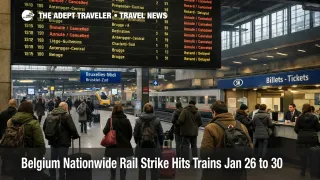
Belgium rail strike January 26 is set to disrupt SNCB NMBS trains nationwide through January 30, 2026, after rail unions announced a five day walkout. Travelers are most exposed if they rely on commuter rail, intercity trains, or airport and international connections that funnel through Brussels, Belgium. The safest move is to shift travel dates where you can, and where you cannot, build larger buffers and line up a backup ground transfer plan before capacity tightens.
The Belgium rail strike January 26 plan matters for travelers because SNCB says it will run a minimum service timetable, but the train by train plan is typically only published close to departure, and the planner can change as staffing declarations come in.
Who Is Affected
The highest risk group is anyone traveling on January 26, 2026, through January 30, 2026, on domestic Belgian trains for hotel check ins, tours, meetings, and same day airport departures. Even if some trains operate, the pattern can be uneven across lines, and gaps tend to create crowding at the departures boards, ticket offices, and platforms when passengers are forced onto fewer departures.
Airport bound travelers should treat rail to Brussels Airport (BRU) as fragile during the strike window, because the airport station is directly under the terminal, and a reduced timetable can translate into missed flight check in windows, especially early in the morning. Travelers using Brussels South Charleroi Airport (CRL) are also exposed when their itinerary depends on rail positioning through Charleroi or Brussels, even if their last mile is a coach transfer.
Cross border travelers are exposed in a different way. If you are arriving on Eurostar, ICE, or other international services and then connecting onto SNCB to reach Bruges, Antwerp, Ghent, or smaller cities, the first train might run while the onward leg collapses, which is where separate tickets become expensive. SNCB pushes international rail disruption details to its international channel, and Eurostar compensation generally applies only to the Eurostar leg rather than missed downstream trains, so this is a case where planning the connection matters as much as the headline strike.
Second order effects can show up even for travelers who never planned to ride a Belgian train. When rail capacity drops, some travelers switch to short haul flights, coaches, taxis, or one way car hires, which can tighten inventory and push up prices, especially around Brussels and the main stations that act as recovery magnets.
What Travelers Should Do
If you have flexibility, the best risk reduction is to move travel out of the January 26 to January 30, 2026 window now, while hotel and transport options are still broadly available. If you cannot shift, lock a refundable backup for your last mile, for example a pre booked taxi or car service for Brussels Airport, and avoid booking the tightest connection that still looks possible on paper.
Use clear decision thresholds for rerouting versus waiting. If your itinerary includes a flight, a cruise embarkation, or a timed event you cannot miss, treat any rail plan that arrives with less than 90 minutes of buffer as a reroute candidate, and strongly consider an overnight near the departure point rather than betting on same day positioning. If your only consequence is a late hotel arrival, waiting can make sense, but only once the minimum service plan is visible for your specific train in the official planner.
Over the next 24 to 72 hours before travel, monitor the minimum service plan publication timing, and do not assume that the schedule you see several days out will hold. SNCB notes that essential staff declarations come in at least 72 hours before the strike, and that the alternate timetable is typically loaded late, so the most actionable checks happen the evening before you travel and again the morning of departure. If you are also relying on international rail in the same week, keep an eye on broader network disruptions so you do not stack two fragile segments on the same day, as recent Eurostar schedule instability has shown.
How It Works
Belgian rail strikes usually do not map cleanly to a simple on or off switch. Belgium has a continuity of service framework that requires essential staff to declare whether they will work, and SNCB then builds an alternative transport plan from the staff who report in, which is why the train list is often finalized close to departure.
The first order disruption is fewer trains, longer headways, and unpredictable capacity on the remaining departures. The second order ripple is that Brussels becomes both a bottleneck and a staging area. When inbound trains thin out, platform crowding and ticketing friction rise, and missed connections cascade into later departures because travelers are shifted forward into the same limited set of trains. That spillover reaches the airport layer quickly because Brussels Airport rail is integrated into the terminal footprint, and it reaches the international layer because Brussels Midi is a major handoff point for Eurostar and other cross border services.
For lodging, the strike window can compress hotel inventory in Brussels and other hubs when travelers pre position early, or when they are forced into unplanned overnights after late cancellations. If you are making contingency bookings, an apartment style stay can add resilience for groups, but only if you are confident in operator stability and late arrival handling, which is part of why travelers have been re evaluating alternative lodging risk over the last year. What Sonder's Collapse Means for Apartment Hotels
Related coverage that can help if you are stacking multiple rail sensitive segments in Europe this month includes Eurostar Netherlands Trains Suspended, Paris Limits Jan 5 and Italy Transport Strike Hits Flights, Trains January 9-10
Sources
- Strikes and union actions | SNCB-NMBS
- Railway union announces week-long strike in January
- Belgian rail unions announce week-long strike over reforms and funding cuts
- By train to Brussels Airport - Zaventem | NMBS
- Refunds & compensation for delays & cancellations
- Traffic disruptions and works | SNCB International