

Hilton Drops Lakeville Hampton Inn Near Minneapolis
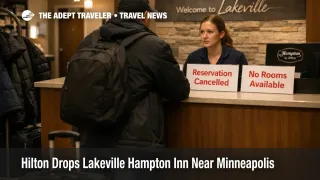
Hilton says it is removing the Hampton Inn by Hilton Lakeville Minneapolis in Lakeville, Minnesota, from its system after a new video showed hotel staff again refusing to rent rooms to federal immigration and homeland security personnel. That decision can ripple to any traveler with an upcoming reservation at the property, especially guests who booked through Hilton channels expecting brand standards and loyalty benefits. If you are staying in the south Minneapolis suburbs, confirm your reservation status now, then line up backup lodging near Minneapolis Saint Paul International Airport (MSP) or downtown in case your booking is canceled or reissued.
Hilton drops Lakeville Hampton Inn from its distribution and franchise relationship, which can change how reservations are honored, how payments are processed, and whether loyalty benefits apply for future stays.
The latest escalation followed a timeline that matters for travelers because it signals a real, operational break, not just a social media dispute. The Department of Homeland Security shared screenshots on January 5, 2026, that it said were emails from the property telling government travelers it was not allowing ICE or immigration agents to stay there. On January 6, 2026, Hilton said a new video raised concerns the hotel was not meeting Hilton standards and values, and that Hilton would take immediate action to remove the hotel from its systems.
Who Is Affected
Anyone holding a future reservation at the Lakeville property is potentially affected, even if they have nothing to do with government travel. The highest risk sits with guests who booked through Hilton channels, including Hilton.com, the Hilton app, corporate portals that route to Hilton inventory, and negotiated rate programs, because those channels depend on the property remaining active in Hilton's system.
Guests who booked through online travel agencies can also be affected, but the mechanics can differ. Your reservation may still exist in the agency's confirmation record while the hotel's ability to recognize, modify, or honor that reservation shifts during a system change. That is when travelers see the classic failure modes, room type mismatches, payment authorization glitches, and last minute walk situations.
Travelers arriving late in the evening are exposed most, because a confused front desk, or an unclear policy environment, is when a solvable issue turns into a midnight rebooking scramble. If you are connecting through Minneapolis Saint Paul and you chose Lakeville to keep drive times down for early departures, treat this as a time sensitive lodging reliability problem.
What Travelers Should Do
If you have a stay booked at the Hampton Inn by Hilton Lakeville Minneapolis, start by validating your reservation in two places, your original booking channel and the hotel directly. Save screenshots of your confirmation, rate, cancellation terms, and any messages, and confirm whether your credit card authorization is still valid. If you booked with a flexible rate, lock in a refundable backup at a nearby hotel now, then you can release it later if your original booking holds.
Use timing thresholds to decide whether to rebook immediately or monitor. If your arrival is within the next 72 hours, do not gamble on a smooth check in, rebook now, because a brand removal event can break the last mile even when a reservation technically exists. If your stay is more than 72 hours out, you can monitor for formal cancellation notices, but you should still price out alternatives today so you know what your real downside is if inventory tightens.
Over the next 24 to 72 hours, watch for three signals, a cancellation or modification email from Hilton or your agency, a sudden change in the property's availability pattern, and any new charge, reversal, or authorization hold on the card tied to the booking. If you are traveling for work, document any rate difference between your original booking and your replacement hotel, because reimbursement systems often require proof when disruption is not flight related.
Background
This story is not just about one desk interaction, it is about how modern lodging distribution works, and how quickly it can fail when brand standards enforcement becomes public. Hampton Inn properties operate under a franchise model, meaning the building is typically independently owned or managed, while the brand supplies reservation systems, loyalty programs, quality standards, and distribution reach. When the brand decides a property is not meeting standards, the fastest lever is to remove the hotel from brand systems, because that cuts off new bookings, loyalty accrual, and many rate programs in one move.
That first order effect hits the source, the property's ability to sell rooms through the channels many travelers actually use. The second order ripples into the broader travel stack. Travelers who planned Lakeville to simplify driving, reduce pre flight stress, or align with meetings in the south metro may now shift to hotels closer to Minneapolis Saint Paul or along major corridors, tightening availability and pushing rates up for everyone else who is simply trying to sleep near a reliable highway exit. Corporate travel managers may also redirect volume to alternate branded hotels, which can compress inventory on peak nights around events, weather disruptions, or airline irregular operations at Minneapolis Saint Paul.
There is also a systems lesson here that travelers can apply beyond Minnesota. When a large brand pulls inventory from its own channels, the experience can resemble other rapid distribution removals, even when the underlying reason is different. A useful parallel for how suddenly bookings can be stranded, and how to protect yourself with documentation and backup inventory, is outlined in What Sonder's Collapse Means for Apartment Hotels.
Sources
- Hilton drops Minneapolis hotel over cancelled ICE bookings, Reuters
- Hilton moves to cut ties with Lakeville hotel that canceled DHS reservation, KSTP 5 Eyewitness News
- Dept. of Homeland Security accuses hotel of canceling reservations for immigration agents, ABC News
- Hilton removing MN hotel that denied ICE bookings from its system, FOX 9
- Hampton Inn Lakeville Minneapolis listing, Travel Weekly