

Lisbon Airport Border Checks Reinforced With GNR Guards
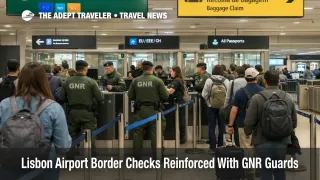
Lisbon Humberto Delgado Airport (LIS) has added National Republican Guard personnel to reinforce border control operations in the arrivals area as Portugal tries to reduce long entry queues. The added presence matters most for non EU arrivals, and for any traveler connecting onward from Lisbon on the same day. Plan for longer variability at passport control, and protect onward legs with larger buffers or an overnight when your schedule is tight.
The Portuguese government said it suspended the European Union Entry Exit System (EES) at Humberto Delgado Airport effective December 30, 2025, for three months, alongside a boost in external border equipment capability and additional staffing using the GNR's certified border control capabilities. In practical terms, the near term goal is to keep processing moving with simpler, more resilient lane operations while staffing and equipment are reinforced.
Local reporting tied the most visible staffing step to the start of January, with 24 GNR members assigned to documentation checks in arrivals in flexible teams, and earlier reinforcement by Public Security Police (PSP) during the Christmas and New Year peak after long waits were reported. Travelers should treat this as a capacity stabilization move, not a guarantee of consistently short lines, because queue length still depends on flight bunching, staffing at each desk, and the mix of first time EES enrollments versus repeat travelers.
Who Is Affected
Non EU citizens arriving at Lisbon are the most exposed because they face the full set of border formalities, and EES enrollment can add time for first time users when it is active. Even with the EES suspension at Lisbon, passport control can still become the bottleneck when several long haul flights arrive close together, which is common on Brazil and North America patterns.
EU and Schengen area travelers can still feel indirect impacts. When non EU lanes back up, the arrivals hall and baggage claim area can become congested, which slows everyone's movement into landside pickup zones, taxi ranks, rideshare collection points, and public transport connections.
Connecting passengers are a distinct risk group. Lisbon is a hub for onward connections across Portugal, Europe, and some transatlantic itineraries, and border delays can propagate into missed domestic flights, missed rail departures from central Lisbon, and missed cruise embarkations when a same day transfer depends on clearing arrivals on schedule. The second order ripple is often cost, last minute hotel nights, higher walk up fares, and limited rebooking inventory when a flight bank disruption cascades through crew and aircraft rotations later in the day.
What Travelers Should Do
If you arrive at Lisbon in the next few weeks, build a larger arrival to landside buffer than you would normally use, and share your flight number and a flexible pickup window with your driver, hotel, or tour operator. Keep documentation easy to present, including hotel address, onward ticket details, and travel insurance information, because smooth desk processing is one of the easiest ways to reduce your personal clearance time.
Use hard thresholds to decide whether to rebook versus wait. If you have less than 3 hours from scheduled landing to a fixed onward departure, treat your plan as fragile, especially on separate tickets or a self transfer. If your onward segment is refundable or changeable, shifting to a later departure or adding an overnight in Lisbon can be cheaper than missing the connection and paying walk up pricing.
Over the next 24 to 72 hours before travel, monitor three signals, your airline's arrival punctuality on your route, airport or government updates on staffing measures, and any changes in EES operating posture across your itinerary, because other Schengen entry points may still be phasing in EES even while Lisbon is paused. If you see repeated arrival delays on your flight number, assume queues will be worse, because late arrivals tend to bunch into the next bank and overload desks and baggage belts.
How It Works
The EU Entry Exit System is designed to replace manual passport stamping with electronic records for short stay non EU travelers, and it uses biometric identifiers such as facial images and fingerprints to link entries and exits across the Schengen area. The European Commission says the system became operational on October 12, 2025, and countries are introducing it gradually, with full replacement of manual stamping expected by April 10, 2026.
The rollout is operationally sensitive because it changes the time it takes to process each traveler at the desk, especially during initial enrollment. When a hub airport's arrival banks are dense, even small per passenger increases can compound into long queues, crowding in arrivals corridors, slower baggage hall turnover, and missed transfer windows. Those first order effects then ripple outward into late day flight connections, tour pickups that cannot wait at the curb, and hotel check in surges when stranded travelers need last minute rooms.
In Lisbon's case, the Portuguese government framed the EES suspension and staffing reinforcement as contingency measures to reduce waits and restore stable processing. Separately, reporting said an unannounced European Commission assessment of Lisbon's border controls between December 15 and 17, 2025, flagged serious deficiencies, including process quality issues and long waiting times, which put additional pressure on authorities to change operations quickly.
Sources
- Contingency measures strengthened at Humberto Delgado airport
- Why are soldiers reinforcing border control at Lisbon Airport?
- Entry/Exit System (EES), Travel to Europe
- How the new digital borders system works
- Entry/Exit System (EES), Migration and Home Affairs
- EU begins gradual rollout of digital border system
- Lisbon airport suspends new EU border controls for three months